Enterprise AI Readiness: Strategic Checklist for 2026
3 September 2026 · 17 min read


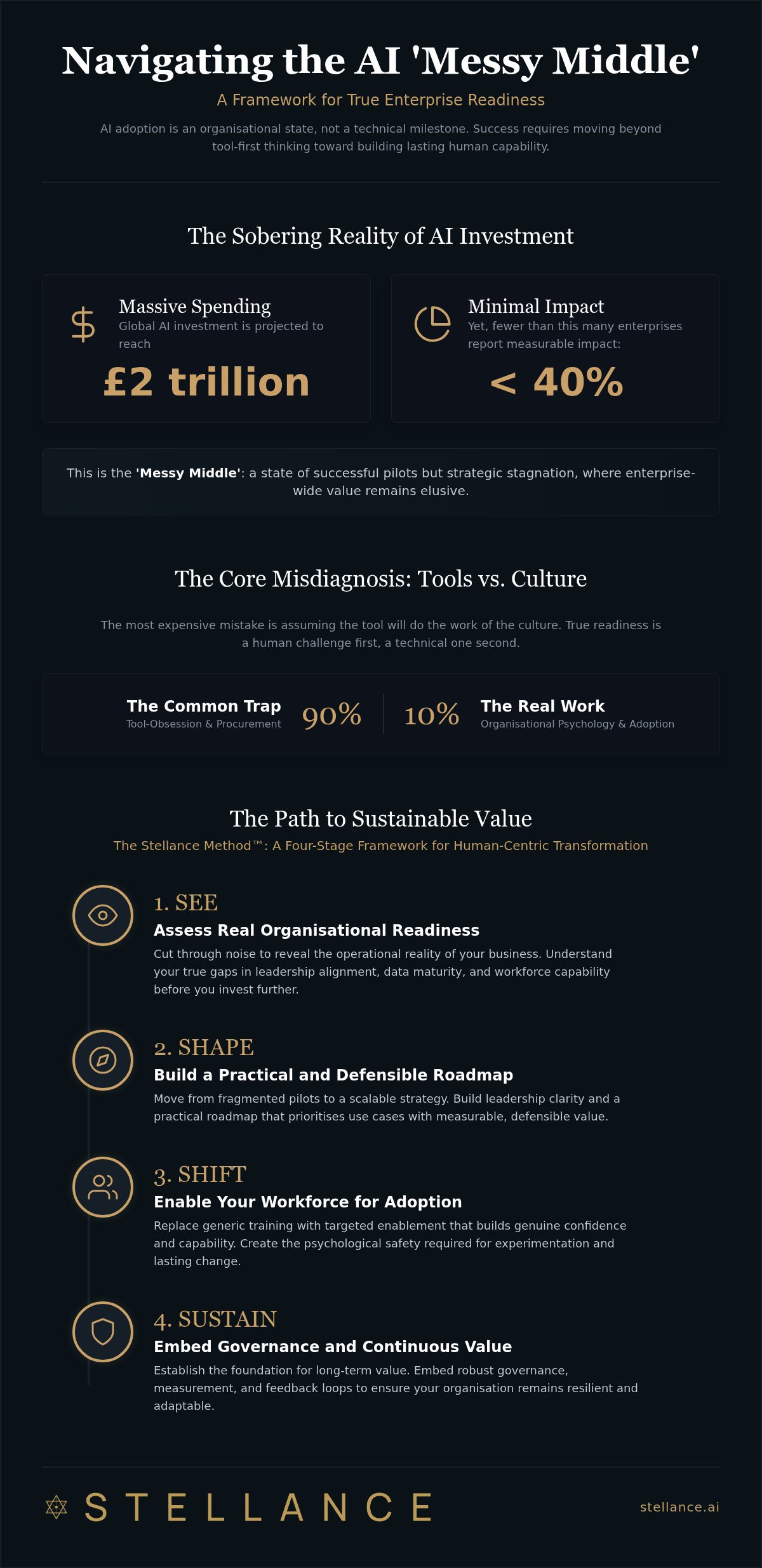
The most expensive mistake a leader can make in 2026 isn't choosing the wrong AI tool; it's assuming the tool will do the work of the culture. Whilst global AI spending is projected to reach £2 trillion this year, fewer than 40% of enterprises report any measurable impact on their bottom line. It's a sobering reality. You're likely feeling the pressure to scale, yet your organisation is caught in the messy middle, where pilots are successful but enterprise-wide value remains elusive. This friction isn't a technical failure. It's a signal that your human systems aren't yet aligned with your digital ambitions.
You need a defensible logic for your investment, not more hype. This guide provides a strategic framework to conduct a meaningful AI readiness assessment for enterprise, moving away from tool-first thinking toward workforce enablement. We'll explore how to apply The Stellance Method™ to your strategy, specifically how to SEE your true organisational gaps and SHAPE a roadmap that prioritises capability over mere acquisition. It's time to stop reacting to the storm and start building the architecture for a sustainable, human-centric transformation.
Key Takeaways
- Understand why true readiness is a human capability challenge rather than a technical one, moving beyond the trap of tool-first implementation.
- Learn how to conduct a rigorous AI readiness assessment for enterprise using the SEE stage of The Stellance Method™ to align leadership and identify operational gaps.
- Discover how to transition from the "messy middle" of fragmented pilots to a scalable strategy by prioritising use cases with a defensible, practical roadmap.
- Recognise why the SHIFT stage is vital for workforce enablement, replacing generic training with a programme that builds genuine confidence and capability.
- Establish a foundation for long-term value by embedding governance and measurement, ensuring your organisation remains resilient amidst the regulatory landscape of 2026.
Beyond the Hype: Defining True Enterprise AI Readiness in 2026
AI readiness is not a technical milestone. It is an organisational state. In 2026, the distinction between possessing tools and possessing capability has never been sharper. True readiness occurs at the intersection of leadership clarity, workforce capability, and technical architecture. An effective AI readiness assessment for enterprise must look beyond the server room and into the boardroom and the breakroom. It requires a sober look at whether your organisation can actually absorb the technology you intend to deploy.
The current environment demands a shift from "compliance-first" to "capability-first" thinking. With the general application of the EU AI Act as of August 2026, legal obligations for high-risk systems are now enforceable. However, meeting these regulations is the baseline, not the goal. A ready organisation doesn't just tick boxes to avoid fines; it builds the internal structures to turn those obligations into a competitive advantage. It prioritises long-term growth and stability over the frantic pursuit of the latest model.
The "Messy Middle" of AI Adoption
Most organisations aren't starting from zero. Research indicates that whilst 88% of large enterprises use AI in some capacity, fewer than 10% have scaled it across a single business function. This is the "messy middle." It is a state where pilots are technically successful but strategically stagnant. You might recognise the symptoms: fragmented data, "Shadow AI" appearing in departments without oversight, and a workforce that feels more threatened than enabled.
Moving through this phase requires the SEE stage of The Stellance Method™. It involves cutting through the noise to assess whether your foundations can actually support the weight of enterprise-wide integration. This isn't about running more experiments. It's about identifying why your current experiments aren't delivering measurable EBIT impact, which currently only 39% of enterprises report achieving. You can explore how we help leaders navigate this transition through our bespoke advisory services.
Why Tool-Obsession Leads to Strategic Failure
You cannot buy your way to readiness. Buying licenses for a new platform is a procurement task; building the capacity to use them is a leadership task. Tool-obsession ignores "absorptive capacity," the limit of how much change your team can meaningfully process at once. When the technology outpaces the people, the result is usually costly implementation failure and workforce resistance.
A calm, perceptive assessment prioritises human capability over tool acquisition. It recognises that the most significant barrier is rarely the software, but the lack of "data activation" and leadership alignment. Success in 2026 belongs to the "battle-tested" leaders who understand that AI adoption is 10% about the algorithm and 90% about the organisational psychology required to make it work. It's about translation; bridging the gap between complex systems and human output.
The SEE Stage: Assessing Strategic and Human Alignment
Assessment is not an audit of what you have. It is a discovery of what you lack. The SEE stage of The Stellance Method™ is designed to strip away the noise of market hype to reveal the operational reality of your business. It is the foundation of a robust AI readiness assessment for enterprise. Without this initial clarity, any subsequent investment is merely a gamble on the latest trend. We focus on identifying the "real world" gaps between your strategic intent and your current organisational capability.
Leadership alignment is the first hurdle. In 2026, 40% of company directors named AI the single most challenging issue to oversee. If your board is not speaking the same language, your transformation will stall. This isn't about technical jargon; it's about a shared understanding of how AI serves the business's long-term stability. It requires moving from fear-based resistance to purpose-driven adoption, where every stakeholder understands their role in the architecture of change. This shift depends entirely on psychological safety, the belief that experimentation is encouraged and that failure is a necessary data point rather than a professional risk.
Leadership Clarity and the "Sage" Perspective
Effective leadership in this era requires a shift in focus. It is not about being tool-obsessed; it's about being strategy-focused. Many executives feel pressured to "buy AI" without a clear "why," leading to the cost overruns reported by 79% of enterprises in the past year. We provide the necessary translation through high-level executive briefings that bridge the gap between technical complexity and commercial delivery. For those seeking a more tailored approach to alignment, The AI Leadership Accelerator offers a bespoke path to build this strategic confidence at the highest level.
Workforce Sentiment and the Human Challenge
Technology does not fail in a vacuum. It fails when the people expected to use it are left behind. Measuring "AI anxiety" is a critical part of the SEE stage. You must identify whether your teams see AI as a threat to their roles or as an enablement of their potential. A perceptive leader identifies internal champions who can drive adoption and addresses blockers without creating organisational conflict. We look for the difference between basic tool training and true workforce enablement. One is a checkbox exercise; the other is a commitment to building long-term capability. If you are unsure where your team stands, you might consider an initial advisory consultation to map your human landscape.
The Enterprise AI Readiness Checklist: Four Critical Pillars
A checklist shouldn't be a burden. It should be a map. Many leaders are currently drowning in spreadsheets containing hundreds of technical data points; a process that often leads to analysis paralysis rather than progress. A meaningful AI readiness assessment for enterprise filters out the noise and focuses on four specific pillars of stability. These pillars ensure your organisation isn't just "doing AI," but is architected to sustain it.
Clarity is the antidote to the "messy middle." By categorising your readiness into these distinct areas, you can identify exactly where the friction lies. It allows you to move from a state of reactive experimentation to one of deliberate, sequenced growth. Each pillar represents a foundational requirement for moving beyond pilots and into scalable, enterprise-wide value.
Pillar 1 & 2: Strategy and Architecture
Strategic intent is the "Why" and the "Where." It's the difference between a tool-first experiment and a value-driven transformation. You must assess whether your leadership has moved beyond general curiosity to a specific, defensible logic for investment. This involves more than just a roadmap. It requires a commitment to solving defined business problems that move the needle on your bottom line.
- Leadership Alignment: Does the board have a unified definition of success for AI initiatives?
- Roadmap Clarity: Are use cases prioritised by commercial impact and feasibility rather than technical novelty?
- Data Activation: Is your data fragmented across silos, or is it accessible, trusted, and ready for model consumption?
- Scalable Infrastructure: Can your current architecture support enterprise-wide deployment without experiencing the cost overruns reported by 79% of enterprises last year?
Pillar 3 & 4: Capability and Governance
The remaining pillars focus on the "Who" and the "When." Human capability is the engine of adoption. Without workforce enablement, even the most sophisticated systems will sit idle or be used incorrectly. Governance is the framework that ensures this value is sustained over time. It is about moving from a restrictive "policing" mindset to one of active enablement. It ensures your organisation remains resilient amidst the enforceable obligations of the EU AI Act that became active in August 2026.
- Workforce Enablement: Have you moved beyond basic tool training to building genuine capability and confidence across all tiers?
- Change Management: Is there a structured programme to address AI anxiety and identify internal champions?
- Governance Framework: Do you have auditable controls and an AI Management System (AIMS) aligned with ISO/IEC 42001:2023?
- Continuous Value Realisation: Do you have the metrics in place to measure the EBIT impact of AI over the next 24 months?
Transitioning from assessment to action requires a sequenced approach that prioritises these human and structural factors. You can explore our AI Adoption Roadmap services to understand how we translate these four pillars into a practical, multi-stage strategy for your organisation. This is the SHAPE stage of our method: converting discovery into a defensible plan for delivery.
The SHAPE Stage: Converting Assessment into a Practical Roadmap
Discovery without distillation is merely noise. The SHAPE stage of The Stellance Method™ serves as the bridge between identifying gaps and delivering results. It is the process of converting the raw findings of an AI readiness assessment for enterprise into a sequenced, defensible strategy. This isn't about creating an exhaustive list of technical possibilities. It's about building leadership clarity on what is actually achievable within your current architecture. An effective AI readiness assessment for enterprise is only as good as the roadmap it produces.
We move from the theoretical world of forecasting to the real world of delivery. A roadmap shouldn't be hype-led; it must be judgement-led. This means prioritising projects based on their ability to solve specific business problems rather than their proximity to the latest trend. It is a methodical approach that ensures no stage of the process is rushed or skipped. We prioritise "not this, but that" thinking: not the most futuristic project, but the most impactful one for your specific stability.
Prioritisation Frameworks for Executives
Not all use cases deserve your budget. We categorise initiatives into "low-hanging fruit" and "strategic bets" to ensure a balance between immediate progress and long-term stability. Quick wins are essential for building workforce confidence, yet they must not distract from the broader organisational transformation. This stage requires candour over comfort. If a current pilot isn't delivering measurable value, we must be bold enough to dismantle it. It is about a steady hand on the shoulder of a decision-maker, offering order in a chaotic environment.
Defining Measurable Value Realisation
Success is rarely found in vague productivity gains. In 2026, where only 6% of enterprises qualify as high performers by attributing more than 5% of EBIT to AI, your metrics must be visceral and grounded. We set realistic KPIs that lead naturally into the SHIFT and SUSTAIN stages. These aren't just technical benchmarks; they are measures of human capability and governance health. The roadmap remains flexible. It's an architecture that allows for the rapid pace of technological change whilst maintaining a steady hand on the organisational wheel.
Building Sustainable Capability: Why the SHIFT Matters
The final transition in an AI readiness assessment for enterprise isn't about the software's launch; it's about the workforce's transformation. Many organisations treat AI adoption as a technical deployment, but the reality of failure is usually the inverse. If your people don't trust the system or understand how to integrate it into their daily workflows, the investment is lost. This is where the SHIFT stage of The Stellance Method™ becomes the critical differentiator. It moves beyond the passive consumption of training videos toward active, purpose-driven enablement. It is the steady hand that guides your team from the "messy middle" to a state of measurable progress.
Execution requires a move away from cold technical implementation. It demands a supportive, people-centric advisory style that prioritises honesty over easy promises. You don't need another tool training session. You need a change management programme that addresses the visceral challenges of organisational change. This is the bridge between a successful pilot and a scalable, enterprise-wide capability.
Enablement vs. Tool Training
Training is a transfer of information. Enablement is a transfer of capability. Most corporate training programmes fail because they focus on "how to use the tool" rather than "how to change the work." A ready organisation builds a culture of continuous adaptation, where employees feel supported in redesigning their roles around new efficiencies. It's about building confidence, not just competence. We treat this as a human and organisational challenge first, ensuring that the shift in behaviour is as structured and methodical as the shift in technology. This is not about superficial experimentation; it's about lasting, defensible growth.
Securing the Future: The SUSTAIN Stage
Sustainability is the quiet work that follows the initial excitement. The SUSTAIN stage embeds AI into the organisational DNA through robust governance and continuous value realisation. In the 2026 regulatory environment, governance must not be a restrictive "policing" function. It should be an architecture that supports innovation whilst maintaining auditable controls. It involves a steady focus on long-term growth, ensuring that the progress made during the SHIFT stage doesn't erode as new technologies emerge. We focus on bridging the gap between high-level strategy and the granular reality of daily tasks.
As your AI Adoption Strategist, Stellance acts as the connective tissue between complex systems and human output. We draw on 23 years of digital transformation experience to guide you through this transition, ensuring your roadmap leads to measurable EBIT impact rather than just technical novelty. We're bold enough to tell difficult truths and committed enough to stand alongside you as you build a future-ready organisation.
Moving Beyond the Messy Middle
Readiness in 2026 isn't defined by the speed of your tools, but by the stability of your architecture and the confidence of your people. A rigorous AI readiness assessment for enterprise provides the defensible logic needed to stop reacting to market noise and start delivering measurable results. It's about moving from a state of frantic experimentation to one of deliberate, sequenced growth. You need a strategy that prioritises organisational health over technical novelty.
We bring 23 years of lived digital transformation experience to help you navigate this transition. Whether through our bespoke 1-2-1 leadership accelerator programmes or the implementation of The Stellance Method™, we focus on building the internal capability required for long-term success. You don't have to face the complexity of scaling alone. With a steady hand and a clear roadmap, you can turn the challenges of the "messy middle" into a sustainable competitive advantage.
The path to true transformation is demanding, but it's entirely achievable with the right framework and a focus on human capability. We're here to help you build it.
Frequently Asked Questions
What is the first step in an AI readiness assessment for a large enterprise?
The first step is the SEE stage of The Stellance Method™. This involves cutting through the noise to identify strategic alignment and real organisational opportunity. It is not about listing tools, but about understanding if the leadership team has a unified vision. Without this clarity, technical audits are premature. It's about finding where the business friction actually lies before committing to a budget or a roadmap.
How long does a typical enterprise AI readiness assessment take?
The duration varies based on organisational complexity, but a thorough assessment typically spans several weeks to a few months. It is a methodical process that cannot be rushed if you want a defensible logic for investment. We focus on a sequenced discovery that builds momentum naturally. This ensures that every stage, from leadership interviews to cultural sentiment mapping, is thorough and results in measurable progress.
Why do most AI readiness assessments fail to deliver actionable results?
Most fail because they are tool-obsessed rather than capability-focused. They often produce technical maturity scores without addressing the human and organisational challenges of change. An AI readiness assessment for enterprise should bridge the gap between complex systems and human output. If the assessment ignores leadership alignment and workforce anxiety, the resulting roadmap will likely lead to the cost overruns seen by 79% of enterprises.
Is our data infrastructure the most important part of AI readiness?
Data is essential, but it is not the most important factor. Readiness is the intersection of leadership clarity, human capability, and technical architecture. You can have a perfect data lake, but without workforce enablement, the technology remains dormant. We treat AI adoption as a human challenge first and a technology challenge second. The goal is data activation; making information accessible and trusted for human decision-making.
How do we assess if our leadership team is aligned on AI strategy?
Alignment is assessed through candour and structured briefings rather than generic surveys. We look for a shared definition of success and a unified logic behind AI investment. If the board is speaking different languages or chasing disparate projects, the strategy lacks stability. Our SEE stage involves deep-dive interviews to reveal these gaps, ensuring the leadership team moves from confusion to a state of calm confidence.
What is the difference between AI training and AI workforce enablement?
Training is a transfer of information about how a tool works. Enablement is a broader change management programme that builds genuine capability and confidence. It addresses the psychological challenges of adoption and ensures employees can redesign their workflows effectively. Enablement is the SHIFT stage of our method; it's about changing how people work, not just what software they use to do it.
Can we conduct an AI readiness assessment whilst already running pilots?
Yes, and it is often necessary for those in the "messy middle". Many organisations have successful pilots that fail to scale because they lack a foundational AI readiness assessment for enterprise. Conducting an assessment during active pilots allows you to evaluate why certain experiments are stagnant. It provides the perspective needed to pivot from isolated experiments to a practical, enterprise-wide strategy that delivers EBIT impact.
How often should an organisation reassess its AI readiness?
Readiness should be viewed as a continuous process of value realisation rather than a one-off event. Given the technological pace of 2026, a formal review every six to twelve months is advisable. This ensures your governance remains resilient and your roadmap stays flexible. The SUSTAIN stage of our framework involves embedding this continuous measurement into your organisational DNA to ensure long-term stability and growth.
Frequently Asked Questions
The first step is the SEE stage of The Stellance Method™. This involves cutting through the noise to identify strategic alignment and real organisational opportunity. It is not about listing tools, but about understanding if the leadership team has a unified vision. Without this clarity, technical audits are premature. It's about finding where the business friction actually lies before committing to a budget or a roadmap.
The duration varies based on organisational complexity, but a thorough assessment typically spans several weeks to a few months. It is a methodical process that cannot be rushed if you want a defensible logic for investment. We focus on a sequenced discovery that builds momentum naturally. This ensures that every stage, from leadership interviews to cultural sentiment mapping, is thorough and results in measurable progress.
Most fail because they are tool-obsessed rather than capability-focused. They often produce technical maturity scores without addressing the human and organisational challenges of change. An AI readiness assessment for enterprise should bridge the gap between complex systems and human output. If the assessment ignores leadership alignment and workforce anxiety, the resulting roadmap will likely lead to the cost overruns seen by 79% of enterprises.
Data is essential, but it is not the most important factor. Readiness is the intersection of leadership clarity, human capability, and technical architecture. You can have a perfect data lake, but without workforce enablement, the technology remains dormant. We treat AI adoption as a human challenge first and a technology challenge second. The goal is data activation; making information accessible and trusted for human decision-making.
Alignment is assessed through candour and structured briefings rather than generic surveys. We look for a shared definition of success and a unified logic behind AI investment. If the board is speaking different languages or chasing disparate projects, the strategy lacks stability. Our SEE stage involves deep-dive interviews to reveal these gaps, ensuring the leadership team moves from confusion to a state of calm confidence.
Training is a transfer of information about how a tool works. Enablement is a broader change management programme that builds genuine capability and confidence. It addresses the psychological challenges of adoption and ensures employees can redesign their workflows effectively. Enablement is the SHIFT stage of our method; it's about changing how people work, not just what software they use to do it.
Yes, and it is often necessary for those in the "messy middle". Many organisations have successful pilots that fail to scale because they lack a foundational AI readiness assessment for enterprise. Conducting an assessment during active pilots allows you to evaluate why certain experiments are stagnant. It provides the perspective needed to pivot from isolated experiments to a practical, enterprise-wide strategy that delivers EBIT impact.
Readiness should be viewed as a continuous process of value realisation rather than a one-off event. Given the technological pace of 2026, a formal review every six to twelve months is advisable. This ensures your governance remains resilient and your roadmap stays flexible. The SUSTAIN stage of our framework involves embedding this continuous measurement into your organisational DNA to ensure long-term stability and growth.
Next step
Let’s talk about where AI creates value in your organisation.
A short, practical conversation with no obligation.