AI for Non-Technical Leaders: A Strategic Guide
31 August 2026 · 16 min read

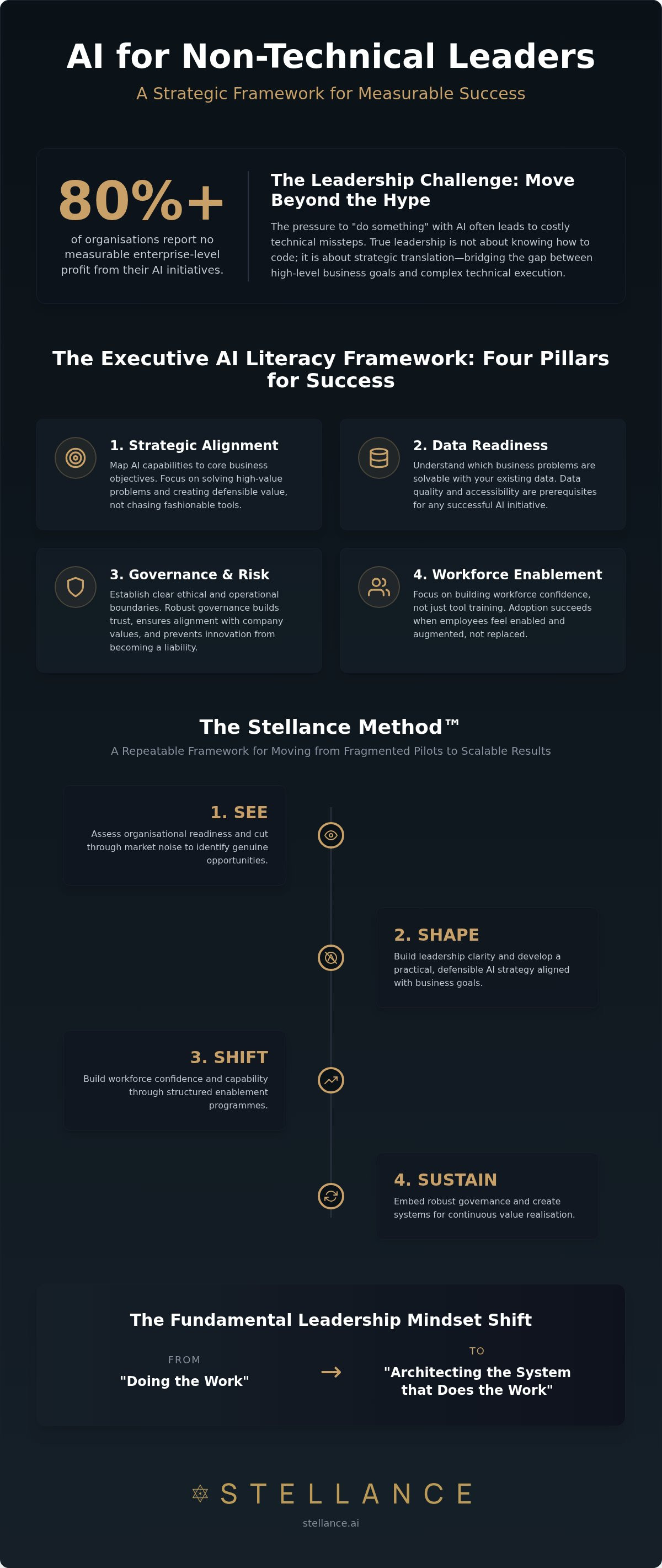
Over 80 per cent of organisations report no measurable enterprise-level profit effect from their AI initiatives. It's a sobering reality that cuts through the frantic noise of the current market. You've likely felt the pressure to "do something" with artificial intelligence, whilst simultaneously fearing a costly technical misstep. Leading AI for non-technical leaders isn't about learning to code or memorising technical libraries. It's about strategic translation. It's about bridging the gap between high-level business goals and complex technical execution.
You don't need a computer science degree to command a room of engineers or to sign off on a multi-million pound investment. This guide provides the strategic clarity you've been seeking. We'll move past the hype to focus on the human and organisational challenges that actually determine success. By following the four stages of The Stellance Method™, See, Shape, Shift, and Sustain, you'll gain a repeatable framework for governance and value realisation. You'll learn how to lead with quiet confidence, ensuring your AI strategy serves your business objectives rather than the other way around.
Key Takeaways
- Shift your focus from technical tools to strategic outcomes by viewing artificial intelligence as an organisational capability rather than a software implementation.
- Learn to lead AI for non-technical leaders by mastering the four pillars of executive literacy: strategic alignment, data readiness, governance, and workforce enablement.
- Transition from fragmented pilots to scalable results using The Stellance Method™ to see through market hype and shape a defensible long-term strategy.
- Bridge the communication gap with technical teams by using structured executive briefings that prioritise business requirements over complex jargon.
- Understand how the AI Leadership Accelerator Programme provides the bespoke, 1-2-1 advisory needed to embed continuous value and robust governance.
Beyond the Code: Why AI Leadership is a Strategic Capability
The noise surrounding artificial intelligence is deafening. Leaders feel an immense pressure to act, yet many are paralysed by the fear of making a costly technical error. This is the "AI storm." To weather it, you must recognise that AI leadership is not a technical function. It is a strategic capability. It requires a sober, grounded approach that prioritises business logic over algorithmic complexity.
Most organisations fall into what we call the "Technical Trap." They focus on platform selection and tool training before they've defined what success looks like. Strategic enablement is the opposite. It prioritises business outcomes over technical specifications. Your business acumen is your most valuable asset. It allows you to see the organisational gaps that technology alone cannot bridge. You don't need to be a developer to understand where a process is broken or where a customer's experience is lacking.
The Myth of the Technical Barrier
You don't need to write Python or build neural networks to lead effectively. Deconstruct the idea that you're "behind" because you don't understand the underlying code. Successful AI for non-technical leaders is built on the ability to identify high-value problems, not high-speed code. The most impactful initiatives are led by those who understand the business problem deeply. You are the "Chief Translator." Your role is to bridge the gap between commercial objectives and technical possibilities. For instance, understanding AI in Marketing isn't about knowing the algorithm; it's about knowing how predictive analytics can reduce customer churn or optimise spend. If you understand the problem, you can lead the solution.
Strategic Management in the Age of Autonomy
AI is shifting the architecture of decision-making. We are moving from a world of "doing the work" to "architecting the system that does the work." This requires a fundamental shift in mindset. In the SHAPE stage of The Stellance Method™, we focus on building leadership clarity. This isn't a technical exercise. It's an exercise in governance and oversight. Robust governance is far more valuable than a clever script. It ensures that as systems become more autonomous, they remain aligned with your core values and risk appetite. Stability comes from structure, not just speed. You're not just managing a tool; you're managing a new organisational capability.
The Executive AI Literacy Framework: Four Pillars for Success
True literacy is often mistaken for technical proficiency. In the context of AI for non-technical leaders, literacy is the ability to map technical capability to strategic opportunity. It isn't about knowing the difference between machine learning and deep learning; it's about knowing which business problems are solvable with the data you already have. This framework is designed to help you ask the right questions rather than provide the technical answers. It serves as the foundation for a robust AI Adoption Roadmap that moves your organisation from fragmented pilots to scaled, measurable impact.
Strategic Alignment and Value Identification
The market is flooded with "shiny objects" that promise revolutionary change but deliver little more than distraction. Defensible business value comes from alignment with existing KPIs and long-term corporate strategy. You must distinguish between isolated experiments and scalable capabilities. Whilst academic resources such as Harvard Business School's AI for Leaders provide a strong theoretical base, your role is to translate that theory into operational reality. Success is found when AI initiatives are built into the architecture of your business goals, not bolted on as an afterthought.
Governance, Risk, and the Human Element
Governance is the steady hand that prevents innovation from becoming a liability. As a leader, you're responsible for setting the ethical and operational boundaries that protect your organisation. This is particularly critical given the emerging "patchwork" of regulations, such as the Illinois Artificial Intelligence Safety Measures Act of 2026. Governance isn't just about compliance; it's about building an architecture of trust amongst your workforce. Adoption fails when employees feel replaced; it succeeds when they feel enabled. In the SHIFT stage of The Stellance Method™, we focus on building this workforce confidence through clear enablement programmes rather than just tool training.
This four-pillar approach ensures that you aren't just reacting to trends, but building a sustainable organisational capability. If you're struggling to move beyond the pilot phase, a bespoke AI Leadership Accelerator Programme can provide the 1-2-1 clarity needed to bridge these gaps. It’s about transforming your leadership posture from one of uncertainty to one of quiet, defensible confidence.
Navigating the Hype: Identifying Defensible AI Opportunities
The current market environment isn't just noisy; it's predatory. It feeds on the executive fear of being left behind. To lead effectively, you must adopt a posture of calm amidst the storm. This means distinguishing between ephemeral trends and defensible business value. Identifying the right AI for non-technical leaders starts with a simple choice: not isolated pilots, but scalable capabilities. We prioritise projects based on their impact on organisational architecture and long-term stability. If a project doesn't strengthen the core, it's a distraction.
The "AI for AI's sake" trap is a common pitfall. It exhausts budgets and drains team morale without delivering measurable ROI. We use the SEE stage of The Stellance Method™ to cut through this noise. This stage isn't about technical feasibility alone. It's about assessing readiness and identifying where artificial intelligence can act as a force multiplier for your existing strategy. You aren't looking for a miracle; you're looking for a measurable improvement in operational efficiency.
Evaluating the Real-World Utility of Generative AI
Move beyond the simple chatbot. Integrated workflow transformation is the true prize. Lived experience is your best guide here. You know where the friction exists in your operations better than any software vendor. Focus on removing that friction. Be wary of technical debt. Every "quick win" carries a long-term maintenance burden. You must evaluate the total cost of ownership, including the human oversight required to keep these systems accurate and safe.
Building for Scalability and Long-Term Stability
An experiment is a toy; a capability is a tool. Despite the hype, fewer than 10 per cent of companies have fully scaled an AI solution within a single business function. This gap exists because leaders focus on the pilot rather than the architecture. You must demand interoperability and modularity from every vendor. Don't allow your organisation to be locked into proprietary silos. Providing a defensible logic for investment is your primary duty to the board. Frameworks such as the AI Guide for Government offer a structured way to evaluate these strategic implications. They help you focus on the architecture of the system rather than the mechanics of the code. Stability comes from order, not just experimentation.
Bridging the Translation Gap: Managing Technical Teams
Leading technical teams is often where the most well-intentioned strategies falter. For many, the interaction feels like an exercise in frustration. You speak in terms of ROI and market share; they speak in terms of hyperparameters and model latency. Bridging this gap is the core challenge of AI for non-technical leaders. Your role is not to become a junior data scientist. It is to remain a senior strategist who can translate business intent into technical requirements.
Accountability in AI is not about tracking lines of code or the number of experiments run. It is about tracking the movement of business KPIs. In the SHIFT stage of The Stellance Method™, we help leaders move away from technical vanity metrics and focus on outcomes that actually matter to the board:
- Reduction in operational friction or processing time.
- Improvement in customer retention or lead quality.
- Measurable cost savings through automated decision-making.
- Alignment with long-term governance and risk frameworks.
Communicating Business Intent
Defining "Done" in an AI project is notoriously difficult. Unlike traditional software, AI is probabilistic, not deterministic. This means 100 per cent accuracy is almost always a myth. You must decide what level of accuracy is "good enough" to deliver value whilst managing risk. An effective executive briefing acts as a bridge between the strategic "why" and the technical "how," ensuring that the engineering team understands the commercial stakes of their architectural choices. When conflicts arise between technical constraints and business needs, your role as the translator is to prioritise the outcome that serves the long-term architecture of the organisation.
Fostering a Culture of Experimentation
AI initiatives require a high degree of psychological safety. Because these projects are iterative, teams must be allowed to fail in early pilots without fear of retribution. However, this experimentation must be paired with transparency. You should never accept the "black box" excuse. If a team cannot explain the logic behind an AI's output, it is a governance failure, not a technical necessity. Leading by example means showing a commitment to continuous learning and a willingness to iterate based on evidence rather than ego. Stability in an organisation comes from this blend of innovation and disciplined oversight.
To truly master this translation role and ensure your technical teams are delivering real-world value, consider our AI Leadership Accelerator Programme for bespoke 1-2-1 support.
Accelerating Your Impact: The Stellance Approach
Generic training is often a sedative for executive anxiety, not a solution for organisational friction. It creates a temporary sense of progress whilst leaving the underlying architecture untouched. For AI for non-technical leaders, the challenge isn't a lack of information. It's a lack of synthesis. You don't need a curriculum that treats your business like a generic case study. You need a partner who has navigated the complexities of digital transformation for over 23 years. This is the difference between academic theory and lived experience.
Our AI Leadership Accelerator Programme is designed as a bespoke 1-2-1 solution. It acts as a steady hand on the shoulder of a decision-maker, providing the order and defensible logic required in a chaotic market. We help you move from the "messy middle" of stalled pilots to a state of measurable progress. This is achieved through a tailored AI Adoption Roadmap and bespoke executive briefings that align technical capability with your specific business goals. We don't just build models; we build organisational capability.
Bespoke Advisory vs Generic Training
High-level executives require more than just tool training. They require personalised mentorship that understands organisational psychology and the human challenges of change. Our focus is on human-centric advisory. We move you from a reactive posture, where you're constantly defending against the latest hype, to a proactive strategy. This transition is essential for those who wish to lead with quiet confidence. By focusing on strategic enablement rather than technical implementation, we ensure your AI initiatives are built for long-term stability and growth.
Next Steps for the Strategic Leader
Alignment begins within your senior leadership team. You must move past the "Technical Trap" and start defining success through business outcomes rather than technical metrics. This process starts with the SHAPE stage of The Stellance Method™, where we build leadership clarity and a practical strategy. The final goal is the SUSTAIN stage, where governance and continuous value realisation are embedded into your corporate DNA. It's about architecting a system that delivers results without requiring you to write a single line of code.
If you're ready to master the art of leading AI initiatives with strategic clarity and quiet confidence, we invite you to Enquire about our bespoke AI Leadership Accelerator Programme. Let's move your organisation from confusion to a state of measurable progress.
Mastering the Strategic Shift
The path to artificial intelligence maturity is not paved with code. It is paved with strategic clarity and the courage to prioritise long-term stability over short-term hype. We have explored how AI for non-technical leaders is fundamentally a translation challenge. Success requires a focus on the four pillars of literacy and a commitment to The Stellance Method™. By moving through See, Shape, Shift, and Sustain, you can transform artificial intelligence from a source of anxiety into a defensible organisational capability.
You don't have to navigate this transition alone. Led by Mike Borrelli, an expert with over 20 years of digital transformation experience, Stellance provides the steady hand you need. Our bespoke 1-2-1 programmes are tailored to your specific organisational architecture, focusing on measurable progress rather than empty promises. It's time to move past the messy middle and lead with quiet, earned confidence. Enquire about the AI Leadership Accelerator Programme to begin architecting your future today. The storm of hype will eventually pass; ensure your organisation is built to remain standing when it does.
Frequently Asked Questions
Do I need to learn coding to lead an AI project?
You don't need to write a single line of code to lead effectively. Leadership is a strategic function rather than a technical one. Your value lies in your ability to translate business goals into technical requirements and to hold teams accountable for commercial outcomes. Whilst developers focus on the "how" of the algorithm, your role is to define the "why" of the solution and ensure it aligns with organisational architecture.
What is the difference between AI literacy and technical expertise?
Technical expertise is the ability to build and maintain models, but AI literacy is the ability to map those technical capabilities to strategic opportunities. For AI for non-technical leaders, literacy means asking the right questions about data readiness, governance, and value realisation. It's about understanding the logic of the system rather than the mechanics of the code. This distinction allows you to lead with quiet confidence without needing a computer science degree.
How do I identify the best AI opportunities for my business?
Identifying defensible opportunities requires a "calm amidst the storm" posture. We use the SEE stage of The Stellance Method™ to cut through the hype and assess real organisational readiness. The best opportunities aren't found in "shiny objects" but in areas where AI can remove operational friction or act as a force multiplier for existing strategy. Focus on projects that offer scalable capabilities rather than isolated pilots that exhaust budgets without delivering measurable ROI.
What are the biggest risks for a non-technical leader in AI adoption?
The primary risks are strategic and organisational rather than technical. One of the most significant risks for AI for non-technical leaders is the "Technical Trap," prioritising tool selection over governance and workforce enablement. This leads to unmanageable technical debt and "black box" systems that lack transparency. Without a structured framework, you risk building solutions that don't scale or that create an architecture of distrust amongst your employees, ultimately stalling your transformation efforts.
How can I ensure my workforce is ready for AI integration?
Workforce readiness is a human challenge first and a technology challenge second. In the SHIFT stage of our framework, we focus on building workforce confidence through enablement rather than just tool training. Employees need to understand how AI augments their roles rather than replacing them. This requires a cultural shift that prioritises psychological safety and continuous learning, ensuring your team feels equipped to adopt new capabilities with purpose and judgement.
What should be included in an AI executive briefing?
An effective executive briefing should act as a connective tissue between complex systems and human output. It must include a clear definition of business intent, the expected commercial outcomes, and any ethical or operational boundaries. Avoid technical jargon; instead, focus on data requirements, potential risks, and the level of accuracy required for the project to be considered "done." This ensures technical teams remain aligned with the broader organisational strategy and governance.
How do I measure the ROI of AI transformation programmes?
Measuring ROI requires moving past technical vanity metrics toward measurable organisational transformation. In the SUSTAIN stage of The Stellance Method™, we focus on continuous value realisation through commercial KPIs such as reduced processing time, improved customer retention, or direct cost savings. Success is measured by how effectively the AI strategy serves your business goals. If a programme doesn't strengthen the organisational architecture or deliver defensible logic for investment, it isn't delivering true value.
Why do most AI initiatives fail at the leadership level?
Most initiatives fail because leaders lack a repeatable framework for adoption. They often move straight from pilots to scale without the SHAPE stage, which builds leadership clarity and a practical roadmap. This results in the "messy middle," where projects are technically sound but strategically adrift. Failure at the top is rarely about a lack of technical knowledge; it's about a lack of focus on governance, workforce enablement, and long-term capability building.
Frequently Asked Questions
You don't need to write a single line of code to lead effectively. Leadership is a strategic function rather than a technical one. Your value lies in your ability to translate business goals into technical requirements and to hold teams accountable for commercial outcomes. Whilst developers focus on the "how" of the algorithm, your role is to define the "why" of the solution and ensure it aligns with organisational architecture.
Technical expertise is the ability to build and maintain models, but AI literacy is the ability to map those technical capabilities to strategic opportunities. For AI for non-technical leaders, literacy means asking the right questions about data readiness, governance, and value realisation. It's about understanding the logic of the system rather than the mechanics of the code. This distinction allows you to lead with quiet confidence without needing a computer science degree.
Identifying defensible opportunities requires a "calm amidst the storm" posture. We use the SEE stage of The Stellance Method™ to cut through the hype and assess real organisational readiness. The best opportunities aren't found in "shiny objects" but in areas where AI can remove operational friction or act as a force multiplier for existing strategy. Focus on projects that offer scalable capabilities rather than isolated pilots that exhaust budgets without delivering measurable ROI.
The primary risks are strategic and organisational rather than technical. One of the most significant risks for AI for non-technical leaders is the "Technical Trap," prioritising tool selection over governance and workforce enablement. This leads to unmanageable technical debt and "black box" systems that lack transparency. Without a structured framework, you risk building solutions that don't scale or that create an architecture of distrust amongst your employees, ultimately stalling your transformation efforts.
Workforce readiness is a human challenge first and a technology challenge second. In the SHIFT stage of our framework, we focus on building workforce confidence through enablement rather than just tool training. Employees need to understand how AI augments their roles rather than replacing them. This requires a cultural shift that prioritises psychological safety and continuous learning, ensuring your team feels equipped to adopt new capabilities with purpose and judgement.
An effective executive briefing should act as a connective tissue between complex systems and human output. It must include a clear definition of business intent, the expected commercial outcomes, and any ethical or operational boundaries. Avoid technical jargon; instead, focus on data requirements, potential risks, and the level of accuracy required for the project to be considered "done." This ensures technical teams remain aligned with the broader organisational strategy and governance.
Measuring ROI requires moving past technical vanity metrics toward measurable organisational transformation. In the SUSTAIN stage of The Stellance Method™, we focus on continuous value realisation through commercial KPIs such as reduced processing time, improved customer retention, or direct cost savings. Success is measured by how effectively the AI strategy serves your business goals. If a programme doesn't strengthen the organisational architecture or deliver defensible logic for investment, it isn't delivering true value.
Most initiatives fail because leaders lack a repeatable framework for adoption. They often move straight from pilots to scale without the SHAPE stage, which builds leadership clarity and a practical roadmap. This results in the "messy middle," where projects are technically sound but strategically adrift. Failure at the top is rarely about a lack of technical knowledge; it's about a lack of focus on governance, workforce enablement, and long-term capability building.
Next step
Let’s talk about where AI creates value in your organisation.
A short, practical conversation with no obligation.