AI Business Case Template UK: A Strategic Framework for 2026
2 September 2026 · 16 min read


Only 31% of UK organisations report achieving a positive return on their AI investment, despite nearly nine in ten increasing their spend. It's a sobering statistic that exposes the "messy middle" of digital transformation. You're likely underwhelmed by the results of isolated pilots and overwhelmed by the pressure to scale. To move forward, you need more than a spreadsheet of projected efficiencies. You need a defensible AI business case template UK leaders can rely on to shift the focus from technical hype to genuine organisational capability.
We agree that the current landscape feels chaotic. The challenge isn't the availability of tools, but the scarcity of a clear, strategic architecture for adoption. This article promises to help you master the art of building a value-driven framework that aligns leadership with the workforce. We'll explore the SHAPE stage of the Stellance Method™, moving beyond simple ROI to focus on long-term enablement and governance. It's time to stop buying software and start building a resilient, human-centric roadmap for 2026.
Key Takeaways
- Stop the cycle of underwhelming pilots by shifting your focus from tool acquisition to building deep organisational capability.
- Utilise the SHAPE stage of the Stellance Method™ to create a strategic architecture that survives the scrutiny of the boardroom.
- Master the essential components of an AI business case template UK leaders can rely on to bridge the gap between technical systems and human output.
- Replace vague ROI forecasts with a measurement framework that captures tangible shifts in productivity and operational readiness.
- Transition from a static strategy to a live capability through structured change programmes and the AI Leadership Accelerator.
Why Most AI Business Cases Fail: Moving Beyond Technical Hype
Most AI initiatives in the UK stall before they even begin. It isn't for a lack of ambition. It's because the foundation is built on sand. Many leaders approach a business case as a procurement exercise rather than a strategy for organisational change. They buy the tool, then wonder why the capability doesn't follow. This is the "tool-first" trap. It leads directly into the "messy middle," where investment is high but impact is invisible. According to research from Helium42 in April 2026, while over 85% of UK organisations are increasing investment, only 31% report a positive return. To move beyond the hype, a structured AI business case template UK must focus on capability architecture rather than just procurement.
Vendor promises often distort executive decision-making. They sell automation as a magic bullet for cost reduction. In reality, the high cost of hype is measured in lost time and eroded trust. A robust AI business case template UK must account for organisational readiness. If your architecture isn't ready to absorb new technology, the tech will simply sit on the shelf. It's a silent killer of ROI. A business case must be a translation of complex technology into tangible human output. It isn't about what the software does. It's about what the person can now achieve.
The Problem with Tool-Obsessed Strategies
There is a sharp distinction between tool training and genuine workforce enablement. Teaching someone to use a prompt isn't the same as enabling them to solve business problems with AI. Without a strategic roadmap, isolated pilots remain expensive experiments. They often result in:
- Fragmented workflows that increase complexity rather than reducing it.
- Eroding morale amongst UK teams who feel "AI Fatigue" from constant, shallow changes.
- Wasted budget on software licences that remain underutilised.
We see this often. A tool is deployed, but the underlying workflow remains unchanged. The result is a superficial layer of technology that fails to scale because it doesn't address the core operational reality.
Recognising the Human and Organisational Challenge
AI adoption is a change management programme. It isn't a software rollout. Leaders must address the fear-based narrative with a calm, experienced voice that prioritises people over pixels. Leadership clarity is the prerequisite for any investment. You cannot automate a process you don't understand, nor can you scale a capability your team doesn't embrace. This is where the AI Leadership Accelerator provides value. It's about bridging the gap between technical potential and daily delivery through a structured change programme. Success requires a steady hand and a focus on long-term enablement. This is the only way to move from confusion to a state of measurable progress.
The Stellance Method™: Structuring Your Case for Clarity
A strategic framework is the difference between a reactive purchase and a proactive investment. Most leaders are exhausted by the noise of the market. They don't need more options; they need a path through the chaos. The Stellance Method™ provides this by moving through four distinct phases: SEE, SHAPE, SHIFT, and SUSTAIN. It's a structured approach that ensures an AI business case template UK executives can defend isn't just about software costs. It's about the architecture of your future organisation.
Stage 1: SEE — Cutting Through the Noise
Clarity begins with an honest assessment of where you stand. In the SEE stage, we identify high-impact opportunities whilst ignoring the technical hype that often clouds judgement. This isn't about what AI can do in theory. It's about what it must do for you in practice. Based on 23 years of lived digital transformation experience, we define organisational readiness as the measurable alignment between technical infrastructure, cultural permission, and executive intent. Our AI Executive Briefings serve as the baseline for this stage. They help leadership teams move from a state of curiosity to a state of informed decision-making before a single pound is committed to a vendor.
Stage 2: SHAPE — Defining the Roadmap
Once you see the opportunity, you must define the architecture. The SHAPE phase is where your strategy takes form. This is more than an ad-hoc plan. It's a repeatable signature framework that aligns with the National AI Strategy and your specific business goals. A practical AI business case template UK organisations use must bridge the gap between high-level ambition and granular delivery. For those seeking a bespoke path, our AI Leadership Accelerator provides the 1-2-1 advisory required to turn a roadmap into a reality. It's about building a defensible logic that your board will trust.
The SHIFT stage focuses on the human element. Workforce confidence is the primary driver of ROI in any business case. If your team doesn't trust the system, they won't use it. We move away from cold technical implementation toward a supportive, people-centric advisory style. This ensures that the transition is smooth and that the organisation gains genuine capability rather than just new software. It's a steady hand on the shoulder of your team during a period of significant change.
Finally, we SUSTAIN the progress. Governance isn't a one-time checkbox; it's a continuous process of value realisation. We ensure that the frameworks established in the SHAPE phase remain resilient as technology evolves. Long-term success requires a commitment to enablement over mere compliance. If you're ready to move beyond isolated pilots and build a roadmap that delivers, you can reach out to discuss your strategy.
Essential Components of a UK AI Business Case Template
A business case is a commitment to a specific future state. It's not a marketing brochure. An effective AI business case template UK organisations deploy begins with a sober, unglamorous Executive Summary. It strips away the adjectives. It focuses on the specific friction points within your existing organisational architecture that AI is uniquely positioned to resolve. This isn't about chasing every emerging trend. It's about strategic alignment. You're building a bridge between your current operational reality and a state of enhanced capability.
Budgeting often fails because it treats software as the final destination. Genuine transformation requires budgeting for enablement, not just tool training. In the UK regulatory landscape, governance should be viewed as a capability rather than a mere compliance hurdle. With the government's principles-based approach, your business case must demonstrate how you will manage risk through robust architecture and human oversight. This ensures your integration is defensible, even as sector-specific guidance evolves. It's about creating a stable foundation in a shifting environment.
Defining Strategic Value Over Simple ROI
We must move from "cost-out" to "value-in" metrics. Simply calculating seat licences is a trap that ignores the "human debt" of poor adoption. Strategic value is found in data-driven decision-making and the reduction of cognitive load on your workforce. You must also articulate the Cost of Inaction (COI). In a market where 49% of large UK businesses have already adopted AI as of June 2026, the risk is no longer just about falling behind. It's about losing the ability to compete for talent and operational efficiency. Inaction is a decision with its own heavy price tag.
Workforce Enablement and Adoption Planning
Resources must be specifically allocated for the SHIFT stage of the Stellance Method™. Adoption doesn't happen by accident. It requires a structured change programme that addresses the psychological barriers to new technology. Training shouldn't just be about where to click. It should be about building the confidence to integrate AI into daily workflows safely and effectively. By investing in our AI workforce enablement services, you ensure that your business case delivers on its human promise. You're not just rolling out software; you're evolving your culture. This is how you move from a tool-obsessed strategy to a genuine organisational capability.
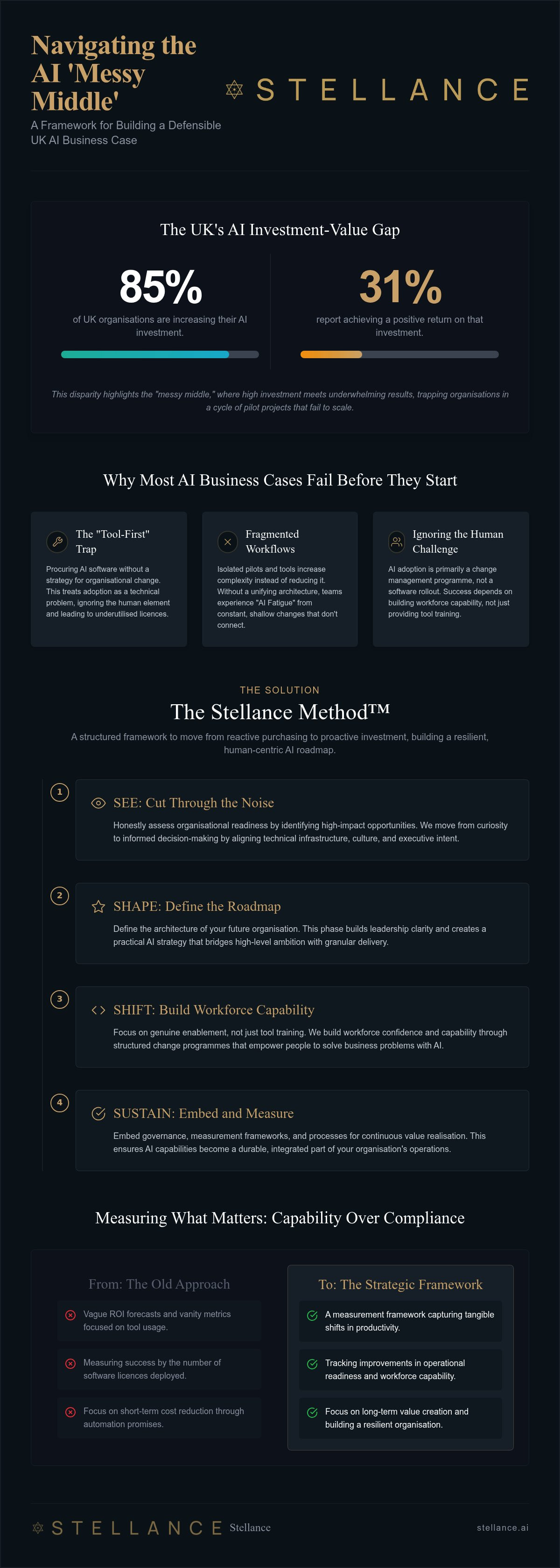
Measuring Success: Capability Over Compliance
Measuring AI success by compliance alone is a dangerous fallacy. It creates a false sense of security whilst the business remains stagnant. A defensible AI business case template UK leaders can stand behind must move beyond audit trails to measure genuine shifts in human productivity. Governance isn't a barrier to progress. It's an enabler of speed. When you have clear boundaries, your team can move faster, not slower. This is the essence of the SUSTAIN phase of the Stellance Method™. It ensures continuous value realisation by treating the integration as an evolving capability rather than a static project. It's about building a system that learns from its own implementation and matures over time.
The Metrics that Matter to UK Boards
Boards don't want to hear about token usage or model accuracy. They want to understand the "time to capability" across different departments. This metric tracks how quickly a team moves from initial training to achieving measurable business outcomes that impact the bottom line. We also focus on the quality of leadership decision-making. Is the executive team better equipped to handle operational complexity because of the insights AI provides? "Progress over perfection" is the necessary mantra for sustainable adoption. A strategy that values steady, incremental gains will always outperform one that waits for a flawless, finished system that never arrives.
Embedding Governance into Daily Operations
A pragmatic AI risk management framework is integrated into the daily workflow, not bolted on as an afterthought. This is where the distinction between a "tool trainer" and a "battle-tested strategist" becomes critical. A trainer teaches you which buttons to press. A strategist helps you architect a resilient system that manages risk whilst driving growth. Your AI business case template UK should remain a living document that adapts as your team's skills mature. It must evolve alongside the technology and the shifting regulatory environment in the UK. This ensures your roadmap remains relevant and your investment stays protected against the rapid pace of technical obsolescence.
Executing Your Roadmap with Stellance
A business case on paper is a promise. Execution is a reality. Many organisations get stuck in the "messy middle" because they lack the bridge between strategy and delivery. Our AI Leadership Accelerator is designed to be that bridge. It transforms your AI business case template UK from a static document into a living, breathing organisational capability. It isn't about software rollout. It's about leadership readiness. We help you move beyond the technical hype to deliver a roadmap that actually functions in the real world of budgets and delivery.
The work of transformation is difficult. It requires more than just a spreadsheet of projected efficiencies. You need a calm, credible partner who understands the human friction of change. We don't offer easy promises or unglamorous shortcuts. Instead, we provide a steady hand and a methodical approach to ensure your investment results in measurable progress. It's about building a defensible logic that survives the scrutiny of the boardroom and the reality of the shop floor.
The Bespoke Advantage for Leaders
Generic corporate training often fails senior leadership teams. It treats everyone as a technical operator and ignores the strategic weight of executive decisions. The Stellance approach is different. It's perceptive, practical, and human-centric. We provide 1-2-1 bespoke coaching that respects your lived experience whilst providing the modern architecture you need to lead. This is how you transition from the SHAPE stage to the SHIFT stage with confidence. Not through superficial experimentation, but through earned momentum and intellectual clarity.
We act as the connective tissue between complex systems and human output. This isn't theoretical forecasting; it's operational readiness. By focusing on the "translation" of technology into business value, we ensure your team isn't just using new tools, but is genuinely enabled to solve problems. It's a shift from tool-obsession to genuine organisational capability. You're not just buying software; you're evolving your culture.
Your Next Steps for AI Adoption
Ready to replace confusion with clarity? The pressure to scale is real, but the path doesn't have to be chaotic. You can move from a state of pressured reaction to one of calm, defensible logic. We invite you to a strategic briefing to assess your organisational readiness and define a roadmap that delivers. It's time to stop navigating the storm and start leading through it.
Moving from Strategy to Sustainable Capability
Building an AI business case template UK leaders can trust is a commitment to organisational maturity. It isn't a technical exercise; it's a strategic architecture for the human workforce. We've explored how shifting from tool-obsession to capability building prevents the "messy middle" of failed pilots. Genuine success is measured by the quality of leadership decision-making and the speed of workforce enablement, not just compliance checkboxes.
With 23 years of lived digital transformation experience, we've refined the Stellance Method™ to guide you through the SEE, SHAPE, SHIFT, and SUSTAIN phases. This framework ensures your investment results in a defensible roadmap rather than a superficial experiment. You don't have to navigate this transition alone. Through bespoke 1-2-1 executive coaching, we replace frantic hype with a state of measurable progress and order.
It's time to stop reacting to external trends and start building a roadmap that lasts. We're here to help you lead with confidence and intellectual clarity.
Frequently Asked Questions
What should be included in a UK AI business case for 2026?
A robust AI business case template UK leaders can approve must include a sober executive summary, a clear architecture for capability building, and a roadmap for workforce enablement. It shouldn't focus purely on software licences. Instead, it needs to address the SHAPE stage of the Stellance Method™, outlining how AI integrates with existing organisational goals. You must also include a pragmatic risk management framework that prioritises operational readiness over theoretical forecasting.
How do I calculate the ROI of AI adoption beyond simple cost savings?
You calculate ROI by measuring "value-in" metrics rather than just "cost-out" efficiencies. This includes tracking the "time to capability" across departments and measuring the quality of leadership decision-making post-integration. It's about the reduction of cognitive load and the increase in strategic output. Whilst seat licences are easy to count, the true return is found in the long-term enablement of your people to solve complex business problems with higher precision.
What is the difference between AI tool training and workforce enablement?
Tool training is a narrow technical exercise that teaches staff where to click within a specific platform. Workforce enablement is a broader change programme that builds the confidence and judgement required to solve business problems using AI. It's the difference between knowing how to use a hammer and knowing how to architect a house. Enablement focuses on the SHIFT stage of our method, ensuring technology change is led by people, not fear.
Why do most AI business cases fail at the board level?
Most cases fail because they are built on exaggerated vendor claims rather than defensible logic. They often fall into the "tool-first" trap, presenting software as a magic bullet without addressing the human and organisational friction required to make it work. Boards require a sober, unglamorous view of the opportunity. They need a clear AI business case template UK executives can trust to translate technical potential into tangible organisational capability.
How does the Stellance Method™ improve the success rate of AI integration?
The Stellance Method™ improves success rates by providing a methodical, four-stage sequence: SEE, SHAPE, SHIFT, and SUSTAIN. It ensures no stage of the process is rushed or skipped. By assessing real readiness before building a roadmap, we help organisations navigate the messy middle of integration. This signature framework is built on 23 years of lived digital transformation experience, prioritising human capability over superficial technical implementation and hype-driven promises.
Is a bespoke AI leadership programme necessary for a small executive team?
Yes, because generic corporate training often fails senior leadership teams by ignoring the strategic weight of their decisions. A small executive team requires the intellectual clarity that only a bespoke programme can provide. Our AI Leadership Accelerator offers 1-2-1 advisory that respects your lived experience whilst providing a practical architecture for adoption. It ensures your leadership remains a calm, stabilising force during periods of significant and potentially disruptive technological change.
How do we address workforce anxiety within our AI business case?
You address anxiety by prioritising candour over comfort. Your business case should treat AI adoption as a change management programme that values human output over technical automation. By focusing on the SHIFT stage of our method, you build workforce confidence through transparent communication and supportive enablement. It's about moving away from cold technical rollouts toward a people-centric style where technology change is led by human judgement, not by external pressure.
What are the specific UK governance requirements for AI in 2026?
The UK does not have a single, comprehensive AI Act. Governance is managed through existing, sector-specific regulators like the ICO and FCA. Your business case must align with the government's principles-based framework, which requires a focus on capability over mere compliance. You must monitor updates from your specific governing bodies and ensure your AI architecture is resilient enough to adapt as domestic regulations and national hardware plans continue to evolve.
Frequently Asked Questions
A robust AI business case template UK for 2026 must prioritise organisational capability over technical specifications. It should include a sober assessment of readiness (SEE), a practical strategic roadmap (SHAPE), and a clear plan for workforce enablement (SHIFT). You must also define a governance framework (SUSTAIN) that aligns with sector-specific UK regulations. This ensures the case moves beyond hype to address the real-world challenges of operational architecture and human output.
Calculating ROI requires shifting from "cost-out" metrics to "value-in" outcomes. You should measure the quality of leadership decision-making and the "time to capability" across departments rather than just seat licenses. By tracking how AI augments professional judgement rather than just replacing tasks, you capture the true strategic value of the transformation. This approach provides the board with a sense of order and measurable progress whilst avoiding exaggerated vendor promises.
Tool training focuses on the technical "how-to" of a specific platform, whereas workforce enablement builds the confidence and judgement required for long-term adoption. Training is often a one-off event that leads to AI fatigue; enablement is a continuous change management process. It bridges the gap between complex systems and daily tasks, ensuring your people don't just use the software but actually improve their operational output through the SHIFT stage of our framework.
Most cases fail because they are built on technical hype rather than defensible logic. Boards are often underwhelmed by results because the initial proposal ignored the human and organisational challenges of scaling. If a business case prioritises software acquisition over workforce readiness, it lacks a credible path to ROI. Leaders require a calm, experienced voice that translates technological potential into measurable organisational capability and stable, long-term growth across the entire enterprise.
The Stellance Method™ improves success rates by treating AI adoption as a human challenge first. It follows a methodical four-stage sequence: SEE (readiness assessment), SHAPE (strategic roadmap), SHIFT (workforce enablement), and SUSTAIN (governance and value). Drawing on 23 years of lived digital transformation experience, this framework replaces recycled theory with practical results. It ensures no stage of the process is rushed, creating earned momentum and a clear path to sustainable value for the organisation.
Yes, because generic corporate training often fails to address the unique strategic architecture of a specific business. Even small executive teams benefit from the AI Leadership Accelerator, which offers 1-2-1 bespoke coaching. This programme builds the leadership clarity required to move from the "messy middle" to scalable success. It provides a private, supportive environment to dismantle misconceptions and replace them with a practical, human-centric strategy tailored to your team's specific organisational goals.
Addressing anxiety requires a people-centric advisory style that prioritises honesty over easy promises. Your business case should explicitly resource the SHIFT stage, which focuses on building workforce confidence through enablement. By positioning AI as a tool for augmentation rather than replacement, you foster a culture of optimistic participation. It's about moving away from fear-based narratives and showing how technology change is led by people, not just forced upon them by external trends.
The UK follows a sector-based approach rather than a single AI Act. A critical development is the Information Commissioner's Office (ICO) Code of Practice on AI, which came into force on 12 May 2026 and carries significant legal weight. A comprehensive AI business case template UK framework must account for these evolving standards by embedding governance into daily operations (SUSTAIN). This ensures your organisation remains stable and compliant whilst navigating the national regulatory landscape with confidence.
Next step
Let’s talk about where AI creates value in your organisation.
A short, practical conversation with no obligation.