Generative AI for Executives: Navigating the Shift from Hype to Strategic Capability
1 September 2026 · 16 min read


Most executive teams aren't failing at generative AI because they lack the technology; they're failing because they've mistaken a handful of pilot projects for a genuine strategy. It's a common trap. You've likely felt the mounting pressure to show immediate results, yet the reality of fragmented pilots often leaves you underwhelmed and your workforce confused. It's one thing to experiment with a tool, but it's quite another to architect a resilient organisation. This article offers a grounded, experience-led analysis of generative AI for executives, stripping away the frantic hype to focus on building genuine strategic capability. We'll move beyond the "messy middle" of adoption by using a structured framework to see the landscape, shape your approach, shift your culture, and sustain your progress. By the end, you'll have the confidence to make defensible investment decisions that prioritise long-term growth over superficial trends. We'll replace the noise of 2026 with a clear roadmap for a workforce that's truly AI-enabled.
Key Takeaways
- Move beyond the "messy middle" by reframing AI as a fundamental shift in knowledge work architecture rather than a simple IT upgrade.
- Address workforce resistance by prioritising human-led adoption and psychological safety over cold technical deployment.
- Master a structured framework for generative AI for executives using the SEE, SHAPE, SHIFT, SUSTAIN method to build long-term organisational capability.
- Distinguish between strategy-led integration and tool obsession to ensure your investments provide defensible logic in a chaotic market.
- Learn why bespoke mentorship and a "progress over perfection" mindset are the essential keys to avoiding executive analysis paralysis.
Generative AI for Executives: Moving Beyond the Noise of the Hype Cycle
The era of the "magic" chatbot is over. By 2026, the initial novelty of Generative artificial intelligence has given way to a more demanding reality. It's not a peripheral tool for drafting emails or generating images; it's a fundamental shift in the architecture of knowledge work itself. Leaders who treat this as a simple software update are finding themselves left behind by those who view it as a structural evolution of their entire business model.
For the forward-thinking leader, generative AI for executives represents a catalyst for organisational redesign rather than a mere productivity tool. Whilst futurists focus on theoretical utopias, pragmatic leaders focus on delivery. They understand that success isn't found in the technology alone, but in the translation of that technology into defensible business value. It's about moving from being a spectator of tech trends to becoming an architect of organisational capability.
The Reality of the "Messy Middle" in 2026
In 2026, 76% of large organisations are actively using AI, yet many are hitting a wall. This isn't a technical failure; it's a leadership gap. Post-pilot fatigue occurs when the excitement of a proof-of-concept meets the friction of legacy processes. Without a structured approach, these initiatives remain "random acts of AI" that fail to move the needle on the balance sheet. True readiness requires more than a subscription to a model; it requires a redesign of how work actually gets done. To navigate these complexities, bespoke leadership advisory and AI strategy is often the most direct path to clarity. Identifying real organisational readiness versus superficial tool interest requires looking for:
- Clear governance frameworks that move beyond simple risk avoidance.
- Operational infrastructure capable of supporting integrated workflows.
- A workforce that possesses genuine AI literacy, not just passing familiarity.
Capability Over Compliance: A New Executive Priority
Regulation is necessary, but it shouldn't be your North Star. With major enforcement phases of the EU AI Act now active, many senior teams have retreated into a compliance-only mindset. This is a mistake. Focusing solely on regulation can stifle the very innovation it seeks to protect. The goal is to build "judgement over jargon." You don't need to be a data scientist, but you must be a translator. You need the ability to bridge the gap between technical potential and strategic delivery.
Judgement over jargon means understanding the "why" behind an investment. It's about knowing that a save of 2.2% in total work hours, as seen in recent productivity data, only matters if those hours are reinvested into high-value activity. If you don't have the architecture to capture that value, the productivity gain is just a theoretical statistic. You must lead the shift from isolated tools to an integrated, AI-enabled workforce.
Why Generative AI Adoption is a Human Challenge, Not a Technical One
Technology is rarely the reason digital transformations fail. Having spent 23 years navigating complex shifts in organisational architecture, I've seen that the breakdown almost always occurs at the human level. Generative AI for executives is no different. It isn't a technical hurdle to be cleared by the IT department; it's a profound psychological transition for every member of your staff. If your team feels threatened by automation, they won't use it effectively. They'll resist it, bypass it, or at best, use it to perform low-value tasks that don't move the needle.
Moving from "tool training" to genuine workforce enablement is the core of the SHIFT stage in The Stellance Method™. It's the point where theoretical potential becomes operational reality. This requires more than a few hours of prompt engineering videos. It demands a supportive environment where leaders act as mentors rather than enforcers. For those navigating this delicate balance, Executive AI Coaching in the UK provides the necessary framework to lead with confidence and empathy.
Leading Through the Cultural Shift
Success requires fostering a culture of optimistic scepticism amongst your senior staff. You want your team to be open to the possibilities of AI whilst remaining critical of its outputs. This isn't a contradiction; it's a safeguard. Psychological safety is paramount. When employees understand that AI is there to augment their capability rather than replace their value, resistance turns into engagement. It's a fundamental truth of change management: successful adoption is 80% behaviour and only 20% technology. It's about how people think, not just the buttons they press.
The Fallacy of the "Quick Fix" AI Tool
Buying a thousand licences for a new model is not a strategy. It's an expense. Many organisations are currently suffering from unmanaged AI adoption, leading to fragmented data silos and the rise of "shadow AI" where staff use unvetted tools in secret. This creates significant risk. A steady hand is required to bring order to this chaos. Leaders must prioritise long-term capability building over the allure of the quick fix. If you're ready to move beyond isolated pilots, consider discussing your organisational readiness with a partner who understands the human stakes of this transition.
Strategic AI Integration: Capability vs Tool Obsession
Buying tools is easy. Building capability is hard. The current market is flooded with "tool-obsessed" leaders who believe a fleet of licences will solve their operational inefficiencies. This is a mirage. True strategic generative AI for executives requires a pivot from software acquisition to organisational architecture. It's the difference between buying a fast car and building a road network. Without the road, the car is just an expensive ornament in your digital garage.
For those seeking a structured path, The Artificial Intelligence Leadership Accelerator provides a bespoke framework to move beyond these superficial experiments. It focuses on translation: turning technical potential into defensible logic that aligns with your specific commercial goals. We replace the frantic search for "the next big model" with a methodical focus on how intelligence actually flows through your business.
Building a Defensive AI Architecture
Executives don't need to understand the transformer math behind a model, but they must understand the architecture of adoption. This is the connective tissue between your proprietary data and the generative output. With 80% of organisations currently worried about data leakage, your architecture must be defensive by design. It must protect your core IP whilst allowing you to leverage the power of public models. Good governance isn't a bottleneck; it's a set of guardrails that allows your team to move faster with confidence. It replaces unmanaged shadow AI with a transparent, governed environment.
The SEE and SHAPE Stages of Strategy
The Stellance Method™ begins with two critical phases that many consultants skip in their rush to deploy. The SEE stage is a sober assessment of your true organisational readiness. It's about looking past the isolated success of a pilot to see if your data structures and leadership culture are actually ready for scale. We dismantle misconceptions and replace them with a realistic view of your current state. Once we see the reality, we move to SHAPE.
In the SHAPE phase, we build a practical roadmap. This isn't a generic template. It's a bespoke plan that aligns AI capability with your existing business objectives. We move from ad-hoc experimentation to a repeatable signature framework. This ensures that every investment is sequenced and methodical, building earned momentum rather than creating isolated pockets of innovation that eventually stall. Stability is the goal. Progress is the result.
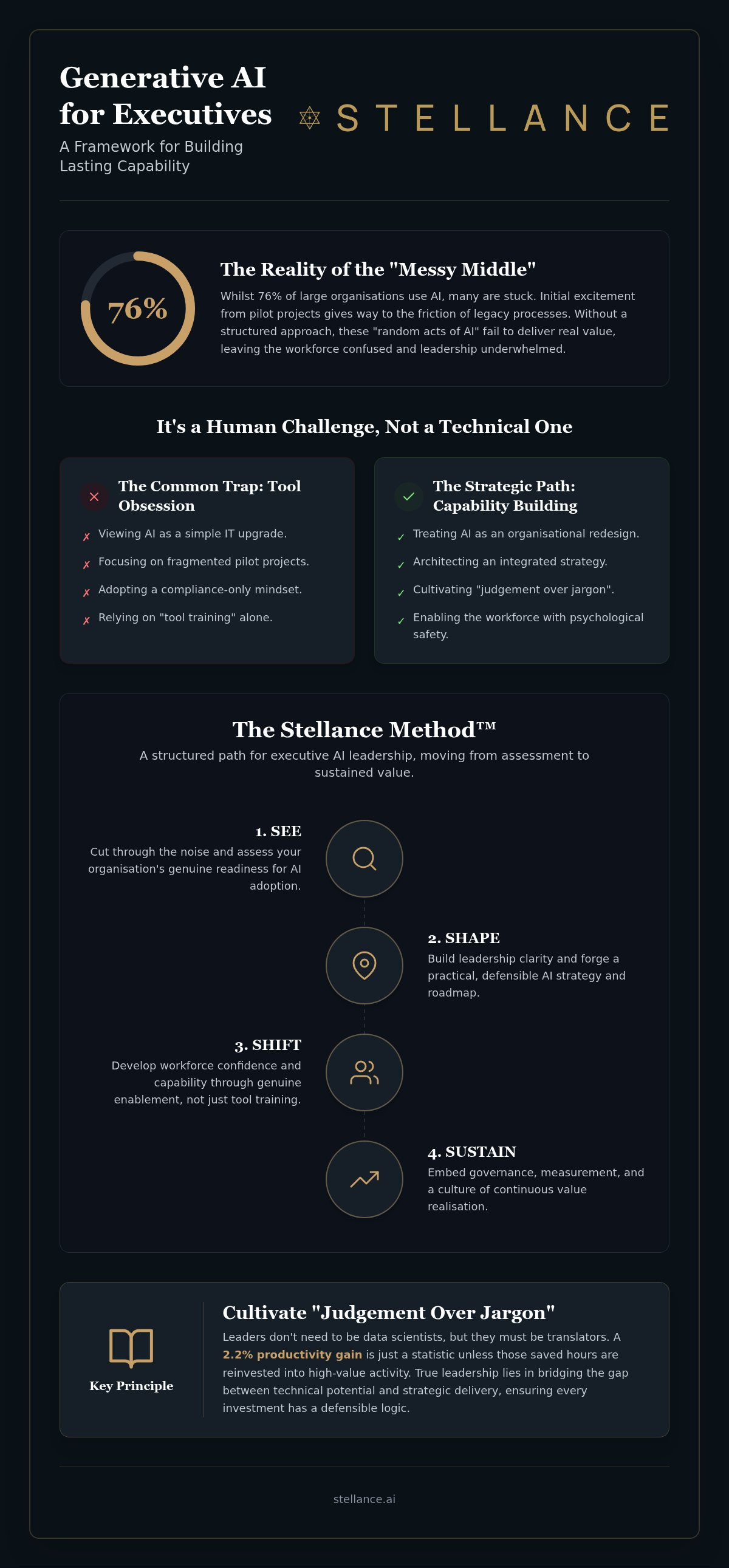
The Stellance Method™: A Structured Path for Executive AI Leadership
Most organisations are currently reacting to AI rather than leading it. They're caught in a cycle of reactive experimentation that yields high noise but low value. The Stellance Method™ is the antidote to this haphazard approach. It's a signature framework designed to move you from confusion to a state of measurable progress. We prioritise clarity over noise, ensuring that every move you make is defensible, logical, and aligned with your long-term commercial goals. This is the definitive path for generative AI for executives who refuse to be swayed by passing trends.
Phase 1 & 2: SEE and SHAPE
We begin with SEE. This is a perceptively honest assessment of your current AI maturity. We don't look at what your vendors claim; we look at the reality of your data architecture, your leadership culture, and your operational readiness. It's about finding the gaps before they become bottlenecks. Once we have a clear view, we move to SHAPE. Here, we develop a roadmap that prioritises high-value, low-friction initiatives. We align the senior leadership team on a single version of the truth. No more siloed projects. No more "random acts of AI." Just a sequenced plan for delivery that respects your existing business objectives.
Phase 3 & 4: SHIFT and SUSTAIN
The SHIFT phase is where we build genuine workforce capability. We move beyond generic classroom training to structured enablement programmes that respect the human element of change. We bridge the gap between technical potential and daily output, ensuring your staff feel supported rather than threatened. Finally, we reach SUSTAIN. This is the most critical and often ignored stage. It's about embedding governance and measurement into your organisational fabric. As generative AI models evolve and the regulatory landscape shifts, your architecture must remain resilient. This phase ensures continuous value realisation, turning a one-off project into a permanent strategic capability.
Organising for the Future: Next Steps for Senior Leaders
Generic classroom training is a commodity. Bespoke mentorship is a strategic asset. For the C-suite, the path to mastery doesn't lie in learning how to write a better prompt; it lies in understanding how to lead a shifting organisation. Generative AI for executives is a leadership discipline that requires a steady hand and a clear eye. You don't need to be the most technical person in the room, but you must be the most strategically grounded. It's time to move beyond the comfort of isolated pilots and embrace the difficult work of building permanent capability.
Avoid the trap of analysis paralysis. In a landscape where the global generative AI market has reached approximately £84 billion in 2026, waiting for the "perfect" moment to scale is a recipe for irrelevance. Perfection is a myth in a field that evolves every few months. Adopt a "progress over perfection" mindset. Focus on building momentum through sequenced, defensible moves. This requires candour over comfort. You must be willing to look honestly at your results, even when they challenge your initial assumptions about what AI could achieve.
Evaluating Your Current AI Engagement
Most transformation teams are currently focused on the technology, not the transition. To regain control, you must ask the difficult questions. Does this initiative solve a boardroom problem or an IT curiosity? Who owns the human adoption metric? Is our data architecture defensive by design? There is a profound difference between a technology vendor and an adoption strategist. A vendor sells you a licence; a strategist builds your resilience. For examples of how this looks in practice, review our Stellance Engagements to see how we've helped other leaders bridge the gap between technical potential and commercial delivery.
Leading the SHIFT in 2026
The next 12 months are critical. With 76% of large organisations now actively using AI, the competitive advantage is no longer found in having the tool, but in how effectively your people use it. This is the year you build your defensive architecture and your cultural readiness. Our AI Leadership Accelerator Programme is designed specifically for this moment. It provides the 1-2-1 bespoke mentorship required to navigate the "messy middle" with confidence. Remember: technology is led by people, not fear. Your role is to provide the order and logic that allows your workforce to thrive in an AI-enabled future.
If you're ready to move from frantic experimentation to a state of measurable strategic progress, it's time to change your approach. Speak with a Stellance strategist today to begin architecting your organisational capability.
Architecting Your Organisational Resilience
The window for reactive experimentation is closing. By 2026, the distinction between market leaders and those left behind will be defined by organisational architecture rather than model access. Success in generative AI for executives isn't found in the frantic pursuit of the latest tool; it's found in the methodical cultivation of internal capability. It requires a sharp pivot from technology-first projects to human-led transformation. We've spent 23 years guiding leaders through these complex digital shifts, replacing the noise of the hype cycle with the defensible logic of The Stellance Method™.
By focusing on the four stages of SEE, SHAPE, SHIFT, and SUSTAIN, we ensure your investments deliver measurable business value whilst building a resilient, AI-enabled workforce. This isn't about chasing a fleeting trend. It's about building a stable foundation that can withstand the inevitable shifts in the technological landscape. A steady hand is available to help you move from the "messy middle" of adoption to a state of earned momentum and intellectual clarity.
The future belongs to those who lead with order, logic, and a deep commitment to their people. It's time to build a strategy that lasts.
Frequently Asked Questions
What is the difference between AI tool training and AI adoption strategy?
Tool training focuses on the technical "how-to" of specific platforms, such as mastering prompt engineering. In contrast, an AI adoption strategy addresses the organisational "why" and "where" of integration. It's the difference between learning to drive and designing a transport network. Strategy ensures that generative AI for executives aligns with commercial goals and human behaviour, creating a stable architecture for long-term capability rather than just temporary productivity spikes.
How can executives cut through the generative AI hype to find real value?
Cutting through the noise requires prioritising "judgement over jargon" and focusing on the SEE stage of the adoption process. This involves a perceptively honest assessment of your current operational readiness rather than listening to vendor promises. Real value is found by identifying where intelligence can bridge specific gaps in your business architecture. It's about looking for defensible logic and measurable progress, not just chasing the latest open-weight model release.
Why do most generative AI pilots fail to scale in large organisations?
Most pilots stall in the "messy middle" because they are treated as isolated technical experiments rather than structural changes. Scaling fails when there is no cohesive leadership strategy to bridge the gap between a successful proof-of-concept and daily operational reality. Organisations often underestimate the human element; without psychological safety and a clear roadmap for workforce enablement, staff resistance or "shadow AI" usage eventually suffocates the initiative.
What are the risks of ignoring generative AI at the executive level in 2026?
With 76% of large organisations already actively using AI, the primary risk is strategic irrelevance. Ignoring generative AI for executives in 2026 means missing out on measurable productivity impacts, such as the 2.2% saving in total work hours reported in recent data. Beyond efficiency, the risk includes a fragmented regulatory posture and a workforce that lacks the necessary literacy to compete in an increasingly automated knowledge work landscape.
How does The Stellance Method™ differ from traditional management consulting?
Traditional consulting often relies on recycled academic theory and ad-hoc advice. The Stellance Method™ is a named, repeatable signature framework built on 23 years of lived digital transformation experience. It prioritises "capability over compliance" and "candour over comfort." Whilst others focus on the technology, we focus on the intersection of leadership decision-making and workforce enablement, ensuring that the shift is led by people rather than fear.
What should be included in a practical AI adoption roadmap for a business?
A practical roadmap, developed during the SHAPE stage, must prioritise high-value, low-friction initiatives that align with existing commercial goals. It should include a clear governance framework, a plan for defensive data architecture, and a structured enablement programme for the workforce. Crucially, it must define how value will be measured and sustained. It isn't a static document; it's a sequenced path that builds earned momentum through small, defensible wins.
How can leaders build AI capability without a technical background?
Building capability doesn't require learning to code; it requires becoming an effective "translator" between technology potential and business value. Leaders should focus on developing strategic judgement rather than technical jargon. Bespoke 1-2-1 mentorship, such as our AI Leadership Accelerator, helps senior leaders gain the confidence to make defensible investment decisions. The goal is to lead the organisation's architecture and culture, which is a management discipline, not a technical one.
What is the "messy middle" of AI adoption, and how can we navigate it?
The "messy middle" is the difficult transition period after successful pilots but before full-scale organisational adoption. It's characterised by post-pilot fatigue and fragmented "random acts of AI." Navigating it requires a return to first principles: using the SEE and SHAPE stages to re-align strategy. You move through it by replacing haphazard experiments with a structured path that focuses on workforce confidence and embedding governance into the organisational fabric.
Frequently Asked Questions
AI tool training focuses on the technical "how-to" of specific platforms, whilst AI adoption strategy addresses the human and organisational architecture required for long-term value. Training is often a one-off event. Strategy is an ongoing process that aligns generative AI for executives with business goals. It moves beyond teaching staff to use a chatbot, focusing instead on building the judgement and confidence needed to integrate these systems into daily delivery.
Leaders must prioritise judgement over jargon and candour over comfort. Cutting through the noise requires a perceptively honest assessment of your current organisational readiness. Instead of chasing the latest model release, focus on the unglamorous reality of your data foundation and workforce literacy. By using a structured framework like the SEE stage of The Stellance Method™, you can identify high-value, low-friction initiatives that deliver a measurable P&L impact.
Scaling fails when adoption is treated as a technology challenge rather than a human one. Pilots often take place in isolation, lacking a cohesive leadership strategy or a plan for workforce enablement. Research from MIT suggests 95% of enterprise pilots fail to deliver measurable impact. This is typically due to poor integration into existing workflows, hidden data silos, and a lack of psychological safety amongst staff who fear their roles are under threat.
Ignoring this shift creates significant operational and strategic risks, particularly with the EU AI Act transparency obligations now in effect. Beyond compliance, the primary danger is a loss of competitive capability. Organisations that fail to build a defensive AI architecture will struggle with cost overruns and inefficient knowledge work. You risk ceding market share to rivals who have successfully navigated the "messy middle" to build a resilient, AI-enabled workforce.
Traditional consulting often relies on recycled theory and ad-hoc advice. The Stellance Method™ is a named, repeatable signature framework built on 23 years of lived digital transformation experience. It follows a methodical, four-stage progression: SEE, SHAPE, SHIFT, and SUSTAIN. We act as a pragmatic mentor rather than a distant consultant, standing alongside leaders to translate complex technology into practical organisational capability. Our focus remains on human-led adoption rather than selling specific platforms.
A practical roadmap must align with existing business goals and prioritise operational readiness. It should include a clear audit of data architecture, a strategy for workforce enablement, and a structured governance framework. Rather than a list of tools, it should define the sequence of the SHAPE and SHIFT stages. This ensures that leadership clarity is established before any large-scale rollout, preventing "random acts of AI" that drain resources without delivering value.
Executive leadership is about decision-making and translation, not coding. Building generative AI for executives requires you to be an architect of change who understands the "architecture of adoption." You need to bridge the gap between technical potential and business value. By focusing on capability over compliance and asking the right questions of your transformation teams, you can lead with quiet confidence. Bespoke mentorship provides the necessary clarity without requiring technical expertise.
The "messy middle" describes the period post-pilot but pre-scale, where organisations often stall due to fatigue and contradictory hype. Navigating this requires a steady hand and a structured path. You must move from superficial experimentation to the SUSTAIN stage of our method, embedding measurement and governance into the organisational fabric. This transition involves shifting focus from tool novelty to the long-term enablement of your people, ensuring technology change is led by judgement rather than fear.
Next step
Let’s talk about where AI creates value in your organisation.
A short, practical conversation with no obligation.