AI Strategy for CEOs: 2026 Guide to Practical Adoption
4 September 2026 · 15 min read


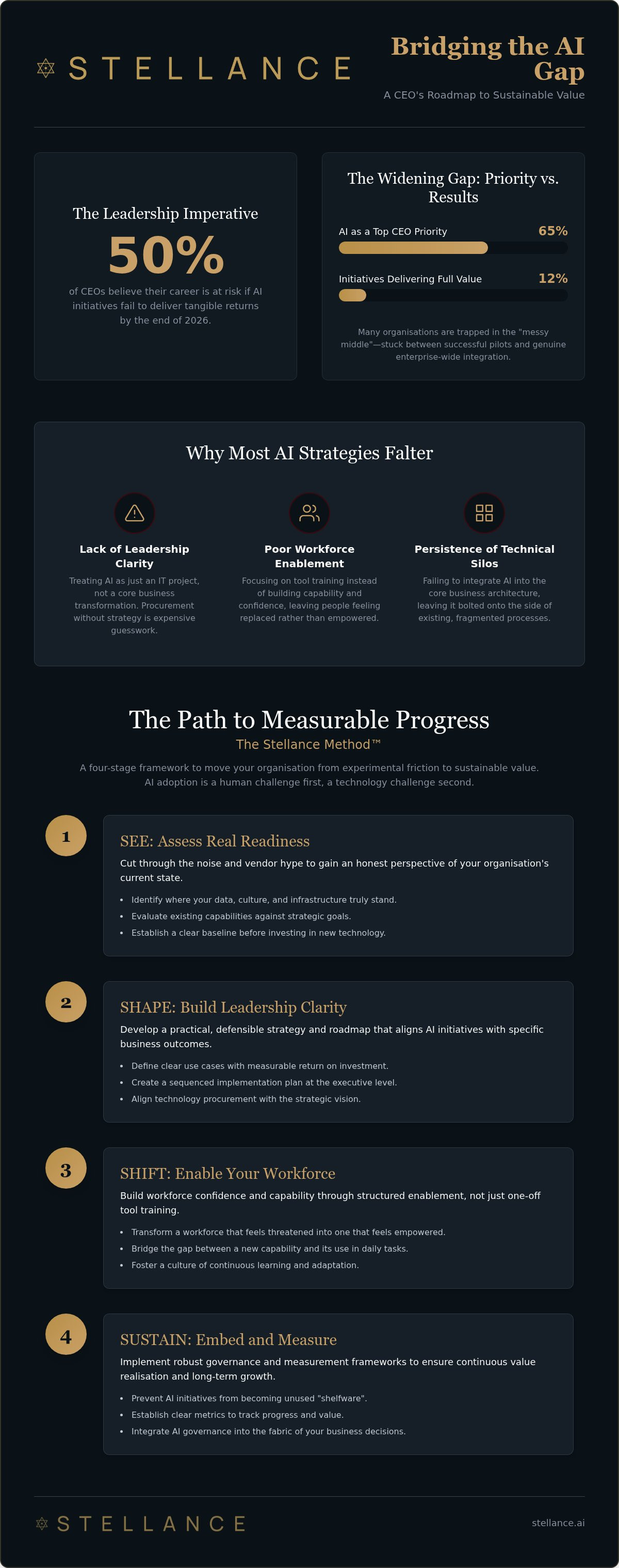
Half of all CEOs currently believe their career is at risk if their AI initiatives fail to deliver tangible returns by the end of 2026. It's a sobering reality that cuts through the frantic noise of vendor demos and glossy slide decks. You've likely felt the relentless pressure to move fast, yet you're probably seeing more pilot stagnation than actual profit. Developing a resilient AI implementation strategy for CEOs in 2026 isn't about chasing the latest model. It's about bridging the gap between technical potential and organisational capability.
You don't need more hype. You need a defensible roadmap that treats technology as a secondary concern to human enablement. Stellance AI - AI Strategy for Leaders provides a human-centric framework to move your organisation from experimental friction to measurable, sustainable value. This guide provides a clear path to apply The Stellance Method™: a four-stage process to SEE past the jargon, SHAPE a clear strategy, SHIFT your workforce's mindset, and SUSTAIN long-term growth through robust governance and measurement.
Key Takeaways
- Learn why organisations often stall after initial pilots and how to move beyond technical experimentation into enterprise-wide integration.
- Discover how to build a defensible AI implementation strategy for CEOs using The Stellance Method™, a battle-tested framework for measurable value.
- Understand the critical distinction between tool training and workforce enablement to ensure your people feel supported rather than replaced.
- Identify practical, low-risk opportunities for AI adoption by following the SEE and SHAPE stages of strategic readiness.
- Explore the necessity of bespoke leadership advisory to maintain governance and navigate the complex regulatory landscape of 2026.
Beyond the Hype: The Reality of AI Implementation for CEOs in 2026
Most organisations are currently trapped in the "messy middle" of AI adoption. They've run successful pilots and experimented with various models, yet they've failed to achieve meaningful scale or measurable ROI. This stagnation often stems from a fundamental misunderstanding of the work required. A successful AI implementation strategy for CEOs isn't a software roll-out; it's a profound organisational shift. It requires moving beyond tool-obsessed checklists toward a value-driven roadmap that prioritises human capability over technical novelty.
The gap between experimentation and integration is widening. Whilst 65% of CEOs name AI as a top priority for 2026, only 12% report that their initiatives have delivered both cost and revenue benefits. To bridge this gap, leadership must stop acting as mere permission-givers for IT projects. You must become a capability-builder. This means creating an environment where AI is integrated into the core business architecture rather than bolted onto the side of existing processes.
The 2026 Landscape: Clarity over Noise
For UK businesses, the "wait and see" approach has become a strategic liability. With corporate spending on AI expected to double this year, staying on the sidelines means falling behind in operational readiness. Strategies fail for three specific reasons: a lack of leadership clarity, poor workforce enablement, and the persistence of technical silos. You don't need more vendor hype or complex jargon. You need a calm, experienced voice to translate these complexities into a defensible path forward that protects your margins and your people.
Capability over Compliance
Compliance is a baseline, not a strategy. Whilst the phased enforcement of the EU AI Act and new UK-specific guidelines require rigorous attention, focusing purely on regulatory boxes stifles true innovation. A robust Technology Strategy must integrate AI into the fabric of your business decisions. We must shift the conversation from "what can the tool do" to "what can our people achieve." This transition requires professional judgement and lived experience rather than recycled theory. By focusing on enablement, you transform a workforce that feels threatened into one that feels empowered to deliver sustainable value.
The Stellance Method™: A Strategic Framework for AI Adoption
Ad-hoc experimentation is a recipe for wasted capital and organisational fatigue. A robust AI implementation strategy for CEOs requires a repeatable method that bridges the gap between high-level leadership decisions and technology strategy. This isn't theoretical advice. It's built on 23 years of lived digital transformation experience. We use The Stellance Method™ at Stellance AI - AI Strategy for Leaders, a four-stage framework designed to move your organisation from confusion to measurable progress. For those seeking a deeper dive into this methodology, our Artificial Intelligence Leadership Accelerator provides the direct, bespoke context required for executive success.
SEE and SHAPE: Building the Foundation
The first two stages focus on clarity and design. SEE involves cutting through the vendor hype to assess your real organisational readiness. It's about identifying where your data, culture, and infrastructure actually stand. You cannot build a stable architecture on a foundation of fragmented data or resistant culture. Once you see the reality, you can SHAPE the path forward. This stage involves creating a practical strategy and roadmap that aligns with your specific business goals. This Practical CEO Roadmap for AI illustrates the importance of sequencing these decisions correctly. Crucially, this shaping must happen at the executive level before a single tool is procured. Procurement without a strategy is merely expensive guesswork. It leads to technical debt that hampers future growth.
SHIFT and SUSTAIN: Executing for Longevity
Execution is where most initiatives falter. SHIFT is about workforce enablement, not just technical training. It's the process of building workforce confidence so your people feel enabled rather than replaced. We focus on bridging the gap between a new capability and a daily task. Finally, SUSTAIN embeds the governance and measurement frameworks necessary for continuous value realisation within your AI implementation strategy for CEOs. Without this final stage, AI initiatives quickly become "shelfware", expensive tools that nobody uses and nothing improves. Governance isn't about restriction; it's about providing the guardrails that allow your teams to innovate safely. If you're ready to move beyond pilots, you might consider how a structured advisory partnership could stabilise your roadmap.
Organisational Change: Treating AI as a Human Challenge
AI adoption is frequently misidentified as a purely technical project. In reality, successful integration is 80% cultural and 20% technical. If your AI implementation strategy for CEOs prioritises the purchase of software licenses over the preparation of people, the resulting friction will inevitably erode any potential ROI. At Stellance AI - AI Strategy for Leaders, we advocate for a "people-led, technology-supported" philosophy. This means viewing AI not as a replacement for human output, but as a catalyst for human judgement and purpose. It requires a steady hand to guide a workforce that is often more concerned with job security than software features.
Enablement vs Training
There's a sharp distinction between tactical tool training and strategic capability building. Training is often a passive exercise in learning software features. It's unglamorous and frequently ignored because it doesn't solve a specific problem. Enablement, however, is the process of building confidence and agency within your teams. It's about ensuring your workforce understands how to use these systems to solve real business challenges. Within the SHIFT stage of our signature framework, we move beyond the classroom to align organisational culture with technical capability. Generic training fails because it doesn't bridge the gap between a new tool and a daily task. True enablement changes behaviour. It transforms anxiety into active participation.
Leading Through the Cultural Shift
Effective leadership during this transition requires candour over comfort. Employees are perceptive; they can sense when a CEO is masking the reality of workforce disruption with corporate platitudes. To maintain trust, you must be honest about the changing nature of roles whilst highlighting the new opportunities for higher-value work. This approach aligns with the core AI imperatives for CEOs and Boards, which stress the importance of organisational agility and human-centric design. Practical communication should focus on how AI will support staff in their specific functions, rather than abstract promises of "efficiency." When people feel enabled rather than replaced, the "messy middle" of implementation becomes a period of growth rather than a source of resistance. If you're ready to stabilise your culture and build these foundations, you can explore our workforce enablement engagements to see how we translate strategy into human action.
Practical Steps for the CEO: From Strategy to Execution
Execution is where the abstract becomes concrete. For many leaders, the transition from high-level vision to daily operations is where the friction begins. A successful AI implementation strategy for CEOs requires a deliberate, four-step progression that prioritises organisational stability over frantic speed. It's about building a foundation that can support long-term growth rather than just securing a short-term win. This approach is particularly vital for those navigating the "messy middle," where initial excitement has faded and the reality of scaling initiatives begins to set in.
The Executive AI Briefing
Your first step is alignment. An executive briefing isn't a technical deep-dive; it's a strategic calibration for the board and senior leadership. It should move the conversation away from hype-driven questions about specific tools toward value-driven strategy. You must set the tone for a calm, credible adoption. This is where you define the "why" before the "how," ensuring the leadership team is unified in its approach to governance and risk. Without this alignment, technical silos will inevitably form and stifle progress.
Building the Roadmap
Once aligned, you must move into the SEE phase of The Stellance Method™. This involves identifying high-value, low-risk opportunities where AI can deliver measurable results. You aren't just looking for efficiency; you're assessing data quality, process readiness, and technical debt. It's about finding the "low-hanging fruit" that builds workforce confidence without overstretching your existing resources. From here, you enter the SHAPE phase to develop a bespoke AI adoption roadmap. This is distinct from a traditional technology roadmap because it accounts for cultural readiness and human architecture. The SHAPE phase is the architecture of future business growth. It provides the defensible logic required to prioritise initiatives based on their strategic impact rather than their technical novelty.
The final step is launching a pilot that focuses on measurable capability. Don't just test "cool tech." Test how the technology enhances human judgement and operational throughput. This pilot serves as a proof of concept for the SUSTAIN stage, proving that your AI implementation strategy for CEOs can deliver sustainable value in a real-world environment. It's the difference between a one-off experiment and a scalable capability that transforms the organisation.
Sustaining Value: The Role of AI Leadership Development
Academic theory provides a sense of intellectual safety, but it rarely survives the friction of a board meeting or a complex budget review. To secure a successful AI implementation strategy for CEOs, you need a battle-tested strategist rather than a generic consultant or a distant academic. Ad-hoc advice often leads to fragmented results; a structured, repeatable method ensures that your investment translates into long-term capability. This is about embedding governance that supports progress over perfection. It requires a steady hand to ensure that your organisation remains agile whilst maintaining the operational stability required for continuous value realisation.
The AI Leadership Accelerator
Bespoke mentorship is the most effective way for non-technical leaders to navigate the complexities of 2026. Our 1-2-1 AI Leadership Accelerator Programme provides the specific clarity and confidence required to bridge the gap between leadership decision-making and technology strategy. Unlike academic certificates that prioritise theory, this programme focuses on your lived experience and your organisation's unique architecture. It acts as the connective tissue between complex systems and human output, allowing you to lead with a posture of quiet confidence. By focusing on your specific challenges, we move past the superficial and into the granular reality of delivery.
Next Steps for the Perceptive CEO
The journey from the noise of vendor hype to measurable progress is a sequenced path. By following the SEE, SHAPE, SHIFT, and SUSTAIN stages of The Stellance Method™, you move beyond the "messy middle" and into a state of sustainable value. Lead with judgement and purpose. Your role is not to master the code, but to master the organisational capability that the code enables. This is the difference between a tool-obsessed experiment and a defensible roadmap for the future. It's time to move beyond the theoretical and into the real world of delivery.
Leading with Clarity in a Post-Hype Era
The era of speculative experimentation has ended. For the perceptive leader, the challenge is no longer about discovering what AI can do, but about architecting what your organisation can achieve. A robust AI implementation strategy for CEOs requires a shift from tool-centric thinking toward human-centric enablement. By applying the SEE, SHAPE, SHIFT, and SUSTAIN stages of The Stellance Method™, you move from reactive pressure to proactive capability. You transform a workforce that feels threatened into one that feels empowered to deliver.
Success isn't found in academic theory or generic consulting. It's earned through lived experience and the steady application of defensible logic. With 23 years of digital transformation experience, we provide the steady hand needed to bridge the gap between technical complexity and operational delivery. Our bespoke 1-2-1 Leadership Accelerator Programme is designed to give you the specific confidence to lead this shift with purpose and order. You have the opportunity to move beyond the noise and build a legacy of measurable, sustainable value.
Frequently Asked Questions
How do CEOs start a practical AI implementation strategy?
Practical adoption begins with the SEE phase of our signature framework. You must first cut through the market noise to assess your real organisational readiness and identify high-value opportunities. This initial assessment prevents the common mistake of procuring tools before a strategy exists. By focusing on your specific architecture and culture, you establish a defensible logic that guides every subsequent investment. This ensures your AI implementation strategy for CEOs is grounded in reality rather than vendor hype.
What is the difference between AI tool training and AI workforce enablement?
Tool training is a tactical exercise focused on software features, whilst workforce enablement is a strategic process of building human capability. Training often results in "shelfware" that staff ignore or fear. Enablement, delivered through the SHIFT stage of The Stellance Method™, focuses on building confidence and agency. It ensures your people understand how to apply AI with judgement and purpose. This human-centric approach transforms a workforce from passive observers into active participants in change.
How can I measure the ROI of my AI implementation programme?
Measuring ROI requires moving beyond simple cost-cutting metrics to focus on continuous value realisation. Within the SUSTAIN stage of our methodology, we embed governance and measurement frameworks that track both operational throughput and strategic impact. You should monitor how AI enhances human judgement and accelerates delivery. By establishing clear baselines during the SEE phase, you can demonstrate measurable progress that justifies your AI implementation strategy for CEOs and secures long-term board support.
What are the four stages of the Stellance Method™?
The Stellance Method™ consists of four distinct stages: SEE, SHAPE, SHIFT, and SUSTAIN. SEE involves cutting through noise to assess organisational readiness. SHAPE focuses on building leadership clarity and a practical strategy. SHIFT builds workforce confidence and capability through enablement. Finally, SUSTAIN embeds the governance and measurement necessary for long-term growth. This repeatable framework replaces ad-hoc consulting with a structured path to success, drawing on 23 years of lived digital transformation experience.
How do I manage employee fear during AI transformation?
Managing fear requires a posture of candour over comfort. You must communicate a "people-led, technology-supported" philosophy that treats AI as a catalyst for human output rather than a replacement. Through the SHIFT stage, you provide the enablement required for staff to feel secure in their evolving roles. Honest communication about the future of work, combined with practical upskilling, builds the trust necessary to navigate the cultural shifts of enterprise-wide AI adoption.
Why do most AI pilots fail to scale in large organisations?
Most pilots fail to scale because they are treated as isolated technical experiments rather than core organisational shifts. Organisations often get stuck in the "messy middle" because they skip the foundational SEE and SHAPE stages. Without a bespoke roadmap and leadership alignment, initiatives lack the architecture needed to move beyond a small-scale test. Scaling requires embedding governance and capability into the fabric of the business, ensuring the technology supports existing strategic goals.
What should be included in an AI executive briefing?
A high-impact executive briefing should focus on strategic alignment rather than technical specifications. It must include an assessment of organisational readiness, a value-driven roadmap, and a clear governance framework. The goal is to move the leadership team from hype-driven questions to a state of calm, credible decision-making. By defining the "why" before the "how," the CEO ensures that the board remains focused on long-term capability building and measurable value rather than superficial experimentation.
Is bespoke 1-2-1 AI coaching more effective than group training for leaders?
Bespoke 1-2-1 mentorship is significantly more effective for senior leaders who require personal context and strategic clarity. Group training often stays at a theoretical level, but our AI Leadership Accelerator Programme provides the direct, practical guidance needed to make high-stakes decisions. This 1-2-1 format allows you to explore the intersection of technology strategy and leadership without the distractions of a generic classroom setting. It builds the individual confidence necessary to lead organisational transformation.
Frequently Asked Questions
Practical adoption begins with the SEE phase of our signature framework. You must first cut through the market noise to assess your real organisational readiness and identify high-value opportunities. This initial assessment prevents the common mistake of procuring tools before a strategy exists. By focusing on your specific architecture and culture, you establish a defensible logic that guides every subsequent investment. This ensures your AI implementation strategy for CEOs is grounded in reality rather than vendor hype.
Tool training is a tactical exercise focused on software features, whilst workforce enablement is a strategic process of building human capability. Training often results in "shelfware" that staff ignore or fear. Enablement, delivered through the SHIFT stage of The Stellance Method™, focuses on building confidence and agency. It ensures your people understand how to apply AI with judgement and purpose. This human-centric approach transforms a workforce from passive observers into active participants in change.
Measuring ROI requires moving beyond simple cost-cutting metrics to focus on continuous value realisation. Within the SUSTAIN stage of our methodology, we embed governance and measurement frameworks that track both operational throughput and strategic impact. You should monitor how AI enhances human judgement and accelerates delivery. By establishing clear baselines during the SEE phase, you can demonstrate measurable progress that justifies your AI implementation strategy for CEOs and secures long-term board support.
The Stellance Method™ consists of four distinct stages: SEE, SHAPE, SHIFT, and SUSTAIN. SEE involves cutting through noise to assess organisational readiness. SHAPE focuses on building leadership clarity and a practical strategy. SHIFT builds workforce confidence and capability through enablement. Finally, SUSTAIN embeds the governance and measurement necessary for long-term growth. This repeatable framework replaces ad-hoc consulting with a structured path to success, drawing on 23 years of lived digital transformation experience.
Managing fear requires a posture of candour over comfort. You must communicate a "people-led, technology-supported" philosophy that treats AI as a catalyst for human output rather than a replacement. Through the SHIFT stage, you provide the enablement required for staff to feel secure in their evolving roles. Honest communication about the future of work, combined with practical upskilling, builds the trust necessary to navigate the cultural shifts of enterprise-wide AI adoption.
Most pilots fail to scale because they are treated as isolated technical experiments rather than core organisational shifts. Organisations often get stuck in the "messy middle" because they skip the foundational SEE and SHAPE stages. Without a bespoke roadmap and leadership alignment, initiatives lack the architecture needed to move beyond a small-scale test. Scaling requires embedding governance and capability into the fabric of the business, ensuring the technology supports existing strategic goals.
A high-impact executive briefing should focus on strategic alignment rather than technical specifications. It must include an assessment of organisational readiness, a value-driven roadmap, and a clear governance framework. The goal is to move the leadership team from hype-driven questions to a state of calm, credible decision-making. By defining the "why" before the "how," the CEO ensures that the board remains focused on long-term capability building and measurable value rather than superficial experimentation.
Bespoke 1-2-1 mentorship is significantly more effective for senior leaders who require personal context and strategic clarity. Group training often stays at a theoretical level, but our AI Leadership Accelerator Programme provides the direct, practical guidance needed to make high-stakes decisions. This 1-2-1 format allows you to explore the intersection of technology strategy and leadership without the distractions of a generic classroom setting. It builds the individual confidence necessary to lead organisational transformation.
Next step
Let’s talk about where AI creates value in your organisation.
A short, practical conversation with no obligation.