AI Capability Building: A Guide to Human-Led Adoption
11 September 2026 · 17 min read


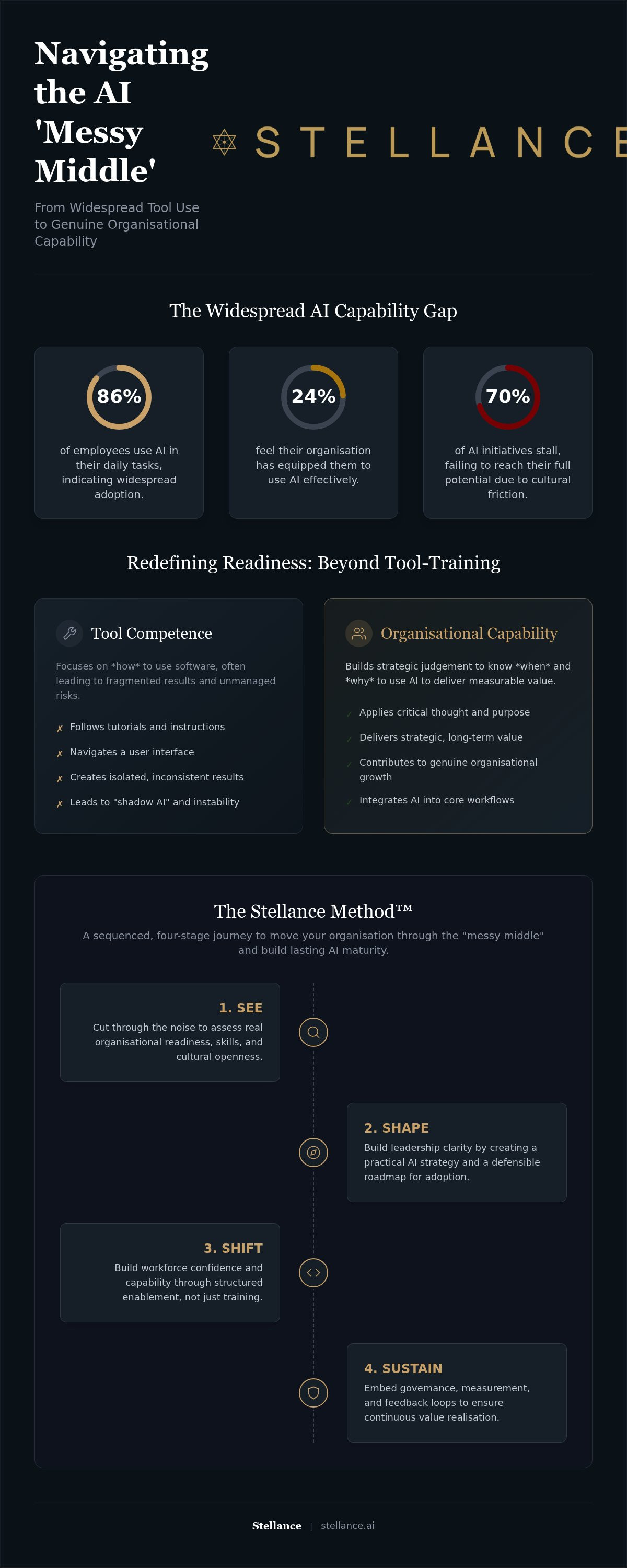
Whilst 86% of employees are now using AI in their daily tasks, a mere 24% feel their organisation has actually equipped them to use it effectively. Most business leaders find themselves navigating a "messy middle" where the initial gloss of technology has worn thin, leaving behind a workforce that is often overwhelmed but under-utilised. You don't need more software. You need a structured approach to AI capability building for teams that prioritises human judgement over technical novelty.
At Stellance AI - AI Strategy for Leaders, we recognise the pressure to deliver results amidst the relentless industry noise. We'll move past the hype to focus on a grounded, human-centric framework for adoption. By following the SHIFT stage of The Stellance Method™, you'll learn how to transition your workforce from simple tool-competence to high-impact capability. This guide provides the strategic roadmap required to build a team that uses AI with purpose, ensuring your investment delivers measurable, long-term value and genuine organisational readiness.
Key Takeaways
- Distinguish between tool-training and genuine capability. One is about software proficiency; the other is about the human ability to deliver organisational value.
- Discover how The Stellance Method™ provides a sequenced, four-stage journey to move your organisation through the "messy middle" of adoption.
- Prioritise human judgement over technical jargon. Effective AI capability building for teams ensures technology is used with purpose and critical thought.
- Learn to execute the SHIFT stage of enablement. This involves translating high-level strategy into tangible daily behaviours and grassroots ownership.
- Embed continuous value by building feedback loops and governance. This ensures your team's capability evolves in lockstep with technological advancement.
Beyond the Tool-Training Trap: Redefining AI Capability
Most organisations are currently stalled. They have moved past the initial excitement of generative AI, completed a handful of successful pilots, and now find themselves stuck in the "messy middle." Industry data suggests that roughly 70% of AI initiatives fail to reach their full potential. This failure rarely stems from technical limitations or software bugs. Instead, projects stall because of cultural friction and a fundamental misunderstanding of what it means to be "AI ready."
Genuine AI capability building for teams requires a fundamental shift in focus. It is not a technology challenge; it is a human and organisational one. At Stellance AI - AI Strategy for Leaders, we observe that leaders who treat AI adoption as a simple software rollout often find their teams under-whelmed and resistant. To move from a pilot to a scaled, value-generating reality, you need a steady hand and a clear distinction between teaching a tool and building a capability.
The Difference Between Competence and Capability
Competence is knowing how to use a tool. It is the ability to follow a tutorial, navigate an interface, or write a basic prompt. Whilst necessary, competence alone is insufficient for organisational growth. Capability is the strategic judgement required to know when a tool is the right solution and why a specific output matters. It is the difference between a team that follows instructions and a team that delivers value.
When training focuses solely on tool-competence, it often leads to "shadow AI." Employees use various platforms in isolation, creating inconsistent results and unmanaged risks. This fragmented approach lacks the architecture needed for long-term stability. AI capability is the intersection of human judgement and technological potential. It requires a sequenced journey, moving from basic proficiency to a state where AI is used with purpose and critical thought.
Why Hype-Driven Learning Fails Your Teams
The current market is loud. It is filled with frantic promises of immediate transformation that often leave leaders feeling pressured and teams feeling exhausted. This "AI fatigue" is a real psychological cost. When organisations deploy generic, hype-driven training, they often provide motivation without substance. These one-off workshops fail to address the specific nuances of different departments or the practical realities of daily delivery.
To build lasting adoption, we must look at how humans actually accept change. The Technology Acceptance Model (TAM) highlights that adoption is driven by perceived usefulness and ease of use. If a team doesn't see how AI solves a specific, real-world problem in their workflow, they will eventually revert to old habits. True enablement is about bridging this gap. It is about moving away from tool-obsession and toward a supportive, people-centric strategy that prioritises lived experience over academic theory.
The Stellance Method™: A Strategic Framework for Team Enablement
Adoption is not an event; it is a process. Many organisations treat AI integration as a plug-and-play exercise, assuming that providing access to a tool is synonymous with building a capability. It isn't. Effective AI capability building for teams requires a sequenced architecture that respects the human element of change. The framework developed by Stellance AI - AI Strategy for Leaders provides this structure, moving through four distinct stages: SEE, SHAPE, SHIFT, and SUSTAIN. This is not a series of one-off workshops, but a methodical journey toward organisational maturity.
By treating AI adoption first as a human challenge and second as a technology challenge, we replace frantic experimentation with defensible logic. Each stage of the framework builds the necessary foundation for the next, ensuring that growth is stable rather than superficial. It is a posture of calm amidst the storm, prioritising long-term enablement over short-term hype.
SEE and SHAPE: The Foundations of Readiness
Before a team can be enabled, the environment must be prepared. The SEE stage is about cutting through the noise to assess real organisational readiness. This involves an honest evaluation of current skills, data infrastructure, and cultural openness. This aligns with foundational principles found in the AI Readiness Framework, which emphasises the importance of defining literacy and readiness rubrics before deployment.
Once readiness is understood, the SHAPE stage builds leadership clarity. This is where we create a practical AI strategy and roadmap. Team capability cannot exist in a vacuum; it requires a clear signal from the top. Leaders must define the "why" and the "where" before the workforce can tackle the "how." Without this alignment, team-level initiatives lack direction and eventually fragment into inconsistent, unmanaged efforts.
SHIFT and SUSTAIN: From Enablement to Value
The SHIFT stage is the engine of workforce confidence. Here, the focus moves from instruction to enablement. We are not just teaching people how to use a tool; we are teaching them how to integrate that tool into their specific daily behaviours and tasks. For a deeper analysis of this transition, our guide on AI workforce enablement explores how to bridge the gap between technical potential and human output.
Finally, the SUSTAIN stage ensures that progress is not lost. It involves embedding governance, measurement, and continuous feedback loops into the organisational DNA. This stage prevents the common regression to old, inefficient habits once the initial novelty of the technology fades. It transforms AI from a temporary project into a permanent, evolving capability. If you are currently navigating the complexities of this transition, you may find value in reviewing our bespoke engagement models to see how this framework applies to your specific context. To discuss your team's unique requirements, feel free to reach out to Stellance AI - AI Strategy for Leaders for a pragmatic conversation.
Cultivating Judgement: The Human Core of AI Capability
Success in 2026 doesn't depend on who has the most advanced software. It depends on who has the most perceptive people. As we move deeper into enterprise-wide adoption, the essential skill for the modern workforce is "judgement over jargon." Whilst technical proficiency is a baseline, the ability to apply human context to AI outputs is what separates high-performing organisations from those simply following a trend. This is why AI capability building for teams must prioritise people-centric advisory over cold technical implementation.
At Stellance, we believe that effective adoption is built on lived experience rather than theoretical forecasting. We don't just teach your teams to prompt; we teach them to think. This involves "perceptive learning", the specific ability to identify AI hallucinations, recognise biases, and understand the inherent limitations of large language models. By treating AI as a connective tissue rather than a replacement, we bridge the gap between complex systems and human output.
Building Psychological Safety for AI Adoption
Fear is the primary barrier to progress. With 90% of global enterprises projected to face critical AI skills shortages by late 2026, the real risk isn't job displacement; it's the risk of being left behind due to a lack of enablement. Leaders must address these concerns through candid, human-centred communication. It's not about making easy promises, but about offering a steady hand on the shoulder of a workforce that feels pressured by external trends.
We encourage a culture of "progress over perfection." By adopting a "calm amidst the storm" posture, leadership can foster the trust necessary for genuine experimentation. When teams feel safe to fail, they are more likely to find the innovative, department-specific use cases that drive real value. This shift in mindset is a core component of the SHIFT stage within The Stellance Method™.
The Role of Critical Thinking in the AI Workflow
AI outputs should always be treated as a first draft, never a final decision. Capability building requires training teams to challenge AI suggestions constructively. We move organisations from being "AI-enabled", where the tool dictates the workflow, to being "AI-enhanced", where human judgement remains the final arbiter. For example, a marketing team might use AI to generate 50 campaign ideas, but it's the human strategist who selects the one that aligns with the brand's long-term architecture.
This level of critical engagement ensures that technology serves the business, rather than the business serving the technology. It requires a methodical, sequenced approach to learning that embeds governance and purpose into every interaction. By focusing on these human-led behaviours, organisations can move from the "messy middle" to a state of measurable, sustainable progress.
Executing the SHIFT: Practical Steps for Team Readiness
The SHIFT stage of The Stellance Method™ is where theory meets reality. It is the moment when high-level roadmaps are translated into the granular reality of daily tasks. Without this translation, strategy remains an academic exercise. To achieve genuine AI capability building for teams, leaders must move beyond the boardroom and into the operational trenches. This requires identifying department-level "AI Champions", individuals who possess both domain expertise and the willingness to experiment, to drive grassroots adoption.
These champions act as the connective tissue between leadership vision and team output. They help demystify the technology, making it feel less like a threat and more like a supportive partner. For organisations requiring a more bespoke architectural approach to bridge these gaps, our Professional AI Strategy Services offer a clear path through the complexities of the messy middle, ensuring that every step is sequenced and logical.
Identifying Team-Specific AI Use Cases
Adoption often fails because it starts with the platform rather than the problem. We advise a "task audit" approach. Instead of asking what a specific tool can do, ask what specific bottlenecks are currently slowing down your delivery. This identifies the "low-hanging fruit", tasks that are high-volume, repetitive, and rules-based, where AI can offer immediate relief.
Prioritise your efforts based on a simple binary: ROI versus ease of implementation. Focus first on the areas where AI can provide measurable value to an overwhelmed workforce. This builds early momentum and defensible logic for wider scaling. It ensures that AI capability building for teams is grounded in the real world of budgets and delivery, not the theoretical world of forecasting.
Designing Experiential Learning Pathways
Passive webinars are the graveyard of organisational change. Genuine capability is built through lived experience and active, project-based learning. Teams need to get their hands dirty. We advocate for structured peer-to-peer sessions where staff share their "wins" and, perhaps more importantly, their "fails." This creates a sense of order and shared progress in a chaotic environment.
This experiential approach builds confidence amongst non-technical staff. It moves the conversation from abstract fear to practical application. By sharing failure, you normalise the learning curve and reduce the psychological pressure of getting it right the first time. It is a methodical way to ensure that enablement sticks and becomes a permanent part of the organisational DNA, rather than a passing trend.
Sustaining Momentum: Embedding AI into Organisational DNA
The transition from a successful pilot to a permanent organisational asset is the most precarious part of the journey. Many leaders mistakenly believe that once the SHIFT stage is complete, the work is done. It isn't. To prevent a regression into old habits, you must focus on the SUSTAIN stage of The Stellance Method™. This is where we embed AI into the very fabric of your company's DNA. Success here requires a shift in focus from 'compliance as a hurdle' to 'capability as an engine.'
Genuine AI capability building for teams is not a one-time achievement. It is a state of constant, managed evolution. We must move away from measuring usage metrics, such as the number of seats assigned or prompts written, and toward measuring value realisation. If a tool doesn't improve the quality of delivery or the speed of insight, its presence is merely noise. By establishing clear feedback loops, you ensure that your team's skills grow as the technology advances.
Governance as an Enabler of Innovation
Governance is often viewed as the department of 'no.' This is a fundamental misunderstanding of its role in a mature organisation. Clear AI policies actually increase team confidence and speed of adoption. When staff understand the safe boundaries of experimentation, they stop second-guessing their actions and start delivering results.
Our approach integrates governance directly into the SUSTAIN phase. We help you build a structure that protects the business whilst encouraging the workforce to push the boundaries of what's possible. It is about creating a defensible logic for every interaction. This architecture ensures that your AI integration remains stable, ethical, and aligned with your long-term strategic goals.
The Continuous Value Loop
The pace of technological change in 2026 is relentless. To stay ahead, you must establish regular 'AI Review' cycles. These are not formal audits, but collaborative sessions designed to assess team progress and identify new bottlenecks. It is an opportunity to reward and recognise AI-driven improvements, reinforcing the behaviours that lead to high-impact output.
Maintaining a calm, credible voice is your greatest asset as a leader during these shifts. You don't need to react to every new headline; you need to ensure your teams remain focused on purpose and judgement. For executives who require a more tailored, high-level approach to this transition, the AI Leadership Accelerator offers the bespoke guidance necessary to lead with confidence in a chaotic market.
Moving Beyond the Messy Middle
The path from technical experimentation to organisational maturity is rarely linear. It requires a transition from tool-competence to a state of strategic judgement where human expertise remains the final arbiter. By utilising the four stages of The Stellance Method™, you replace the frantic pressure of external trends with a sequenced, defensible logic. Genuine AI capability building for teams is achieved when technology ceases to be a separate project and becomes a permanent, evolving part of your delivery architecture.
Our approach is grounded in 23 years of lived digital transformation experience, offering a steady hand for leaders navigating the complexities of workforce enablement. Whether through our bespoke 1-2-1 leadership development or our repeatable, value-driven framework, we help you bridge the gap between complex systems and human output. You don't have to navigate this transition alone or rely on unproven theory.
Realising measurable value from AI is entirely within reach. With the right structure and a focus on human-led adoption, your organisation can move from confusion to a state of lasting, purposeful progress.
Frequently Asked Questions
How do we start building AI capability if our teams are non-technical?
You begin by focusing on domain expertise rather than technical proficiency. AI capability building for teams starts with identifying existing bottlenecks where human judgement is currently stretched too thin. By auditing tasks and focusing on problem-solving, non-technical staff can learn to use AI as a connective tissue for their work. We prioritise perceptive learning, which allows employees to apply their lived experience to AI outputs without needing a background in data science or software engineering.
What is the difference between tool training and workforce enablement?
Tool training focuses on the mechanics of software, whilst workforce enablement focuses on the delivery of strategic value. Training teaches a team how to write a prompt or navigate an interface. Enablement equips them with the judgement to know when a tool is the right solution and how to integrate it into their daily behaviours. It's the difference between simple competence and a permanent organisational capability that drives measurable results across the business.
How long does it take to see results from an AI capability programme?
Initial results often appear within the first few weeks as teams identify and automate "low-hanging fruit" tasks. However, building a deep, sustainable organisational capability is a sequenced journey that typically unfolds over several months. By following the stages of The Stellance Method™, you move from initial readiness to continuous value realisation. This structured approach ensures that early momentum isn't lost and that AI integration becomes embedded into your company's long-term architecture.
How can we overcome employee fear or resistance to AI?
Resistance is best addressed through candid, human-centred communication and the establishment of psychological safety. Leaders must adopt a "calm amidst the storm" posture to reassure staff that AI is a supportive partner rather than a replacement. By encouraging a culture of "progress over perfection", you allow teams to experiment without the fear of failure. This shift in mindset moves the workforce from defensive, fear-based thinking toward constructive, optimistic engagement.
What are the core stages of The Stellance Method™ for teams?
The Stellance Method™ consists of four specific, sequenced stages designed to replace confusion with clarity. First, SEE cut through the noise to assess real organisational readiness. Second, SHAPE builds leadership clarity and a practical AI strategy. Third, SHIFT builds workforce confidence and capability through enablement. Finally, SUSTAIN embeds governance and measurement to ensure continuous value realisation. This repeatable framework provides a methodical roadmap for organisations navigating the complexities of modern digital transformation.
Do we need to hire new talent or can we upskill our existing workforce?
Upskilling your existing workforce is often more effective than hiring new talent. Your current teams already possess the domain expertise and organisational context that external hires lack. AI capability building for teams focuses on creating "AI Generalists" who can combine their lived experience with technological potential. By investing in enablement, you bridge the skills gap whilst retaining the institutional knowledge that is critical for making nuanced, high-impact business decisions.
How do we measure the success of AI capability building?
Success should be measured through value realisation rather than simple usage metrics. Instead of tracking how many prompts are written, focus on improvements in delivery speed, output quality, and strategic insight. We look for evidence of teams using AI with purpose and critical thought. Effective measurement also includes the strength of your governance feedback loops, ensuring that AI-driven improvements are consistently captured and refined to drive long-term organisational growth.
What is the "messy middle" of AI adoption and how do we navigate it?
The "messy middle" is the precarious period after successful initial pilots but before enterprise-wide scaling has been achieved. It's characterised by fragmented efforts and a lack of clear direction. You navigate this phase by applying a structured framework like The Stellance Method™ to align leadership and enable the workforce. This moves the organisation from isolated experimentation to a state of defensible logic, where AI adoption is treated as a human-led strategic transition.
Frequently Asked Questions
You begin by focusing on domain expertise rather than technical proficiency. AI capability building for teams starts with identifying existing bottlenecks where human judgement is currently stretched too thin. By auditing tasks and focusing on problem-solving, non-technical staff can learn to use AI as a connective tissue for their work. We prioritise perceptive learning, which allows employees to apply their lived experience to AI outputs without needing a background in data science or software engineering.
Tool training focuses on the mechanics of software, whilst workforce enablement focuses on the delivery of strategic value. Training teaches a team how to write a prompt or navigate an interface. Enablement equips them with the judgement to know when a tool is the right solution and how to integrate it into their daily behaviours. It's the difference between simple competence and a permanent organisational capability that drives measurable results across the business.
Initial results often appear within the first few weeks as teams identify and automate "low-hanging fruit" tasks. However, building a deep, sustainable organisational capability is a sequenced journey that typically unfolds over several months. By following the stages of The Stellance Method™, you move from initial readiness to continuous value realisation. This structured approach ensures that early momentum isn't lost and that AI integration becomes embedded into your company's long-term architecture.
Resistance is best addressed through candid, human-centred communication and the establishment of psychological safety. Leaders must adopt a "calm amidst the storm" posture to reassure staff that AI is a supportive partner rather than a replacement. By encouraging a culture of "progress over perfection", you allow teams to experiment without the fear of failure. This shift in mindset moves the workforce from defensive, fear-based thinking toward constructive, optimistic engagement.
The Stellance Method™ consists of four specific, sequenced stages designed to replace confusion with clarity. First, SEE cut through the noise to assess real organisational readiness. Second, SHAPE builds leadership clarity and a practical AI strategy. Third, SHIFT builds workforce confidence and capability through enablement. Finally, SUSTAIN embeds governance and measurement to ensure continuous value realisation. This repeatable framework provides a methodical roadmap for organisations navigating the complexities of modern digital transformation.
Upskilling your existing workforce is often more effective than hiring new talent. Your current teams already possess the domain expertise and organisational context that external hires lack. AI capability building for teams focuses on creating "AI Generalists" who can combine their lived experience with technological potential. By investing in enablement, you bridge the skills gap whilst retaining the institutional knowledge that is critical for making nuanced, high-impact business decisions.
Success should be measured through value realisation rather than simple usage metrics. Instead of tracking how many prompts are written, focus on improvements in delivery speed, output quality, and strategic insight. We look for evidence of teams using AI with purpose and critical thought. Effective measurement also includes the strength of your governance feedback loops, ensuring that AI-driven improvements are consistently captured and refined to drive long-term organisational growth.
The "messy middle" is the precarious period after successful initial pilots but before enterprise-wide scaling has been achieved. It's characterised by fragmented efforts and a lack of clear direction. You navigate this phase by applying a structured framework like The Stellance Method™ to align leadership and enable the workforce. This moves the organisation from isolated experimentation to a state of defensible logic, where AI adoption is treated as a human-led strategic transition.
Next step
Let’s talk about where AI creates value in your organisation.
A short, practical conversation with no obligation.