AI for Strategic Decision Making: Navigating Complexity with Clarity
8 September 2026 · 16 min read


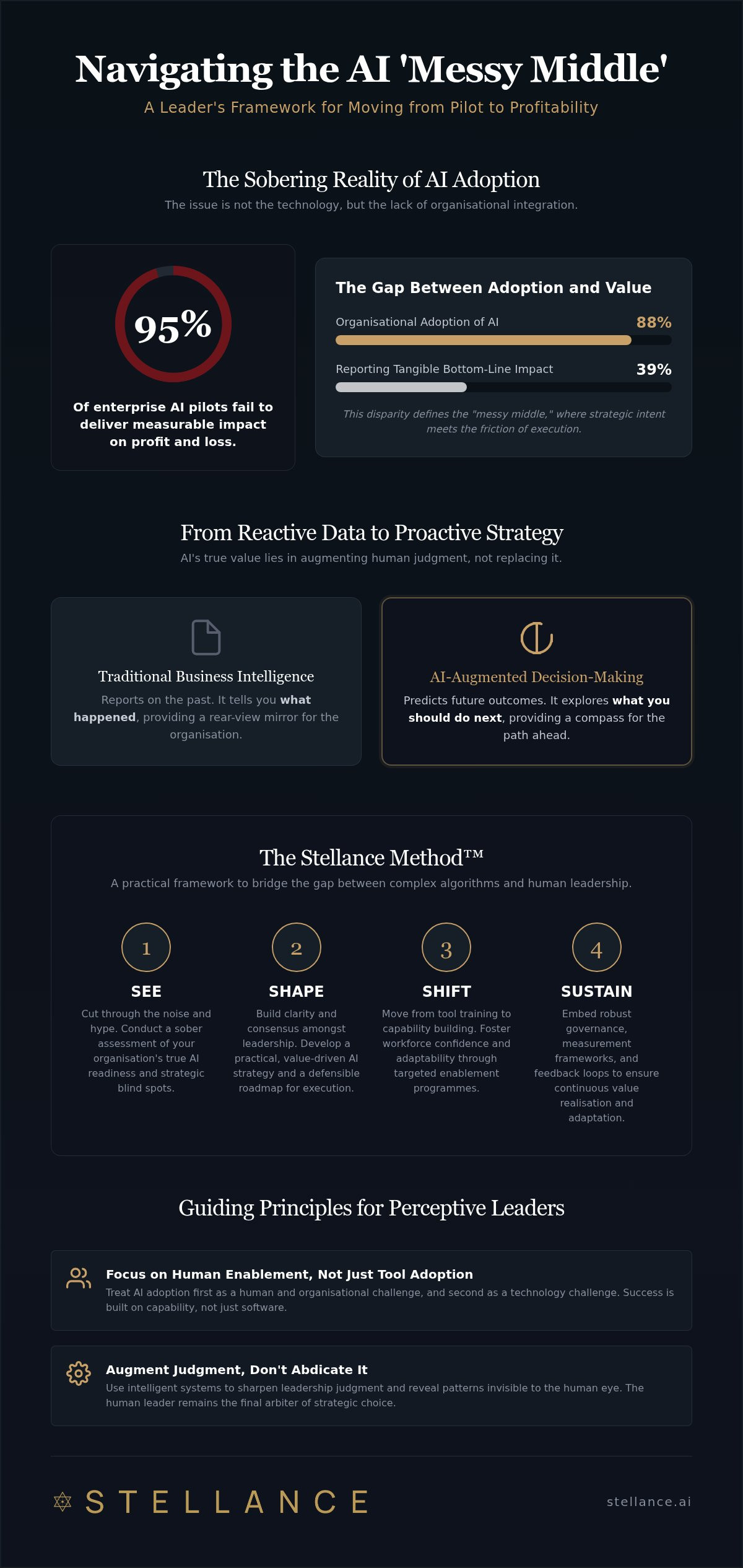
95% of enterprise generative AI pilots fail to deliver a measurable impact on profit and loss. This isn't a failure of the underlying technology, but a failure of organisational integration. For most boards, the initial rush towards AI for strategic decision making has settled into a weary skepticism. You're likely drowning in data yet starved for the clarity needed to make defensible, high-stakes choices. It's not about delegating your judgment to a machine; it's about using intelligent systems to sharpen that judgment. We must move away from the "black box" and towards a model of transparent, augmented intelligence.
We agree that the "messy middle" of adoption is a lonely place for a decision-maker. This article promises to cut through the frantic hype, offering a pragmatic roadmap to integrate AI into your strategic process for genuine value. Drawing on 23 years of lived digital transformation experience, we'll explore how The Stellance Method™, encompassing the SEE, SHAPE, SHIFT, and SUSTAIN stages, bridges the gap between complex algorithms and human leadership. It's time to move beyond the pilot phase and start building the long-term capability your organisation requires to thrive.
Key Takeaways
- Move beyond the "magic wand" myth and understand AI as a sophisticated analytical lever designed to augment, not replace, executive judgment.
- Gain clarity on how intelligent systems synthesise vast datasets to reveal patterns invisible to the human eye, providing the "Sage" perspective required for complex leadership.
- Identify the specific organisational friction points that cause AI initiatives to stagnate in the "messy middle" and learn how to bridge the gap between pilot and scale.
- Discover a structured approach to AI for strategic decision making that prioritises human enablement and operational readiness over mere tool adoption.
- Learn how to apply The Stellance Method™—SEE, SHAPE, SHIFT, and SUSTAIN—to embed governance and drive measurable value across your entire organisation.
Beyond the Hype: The Evolution of AI in Strategic Decision Making
The promise of Artificial intelligence has often been sold as a digital panacea. A magic wand for the modern executive. This is a mirage. In reality, AI for strategic decision making is an analytical lever. It doesn't replace human judgment; it augments it through intelligent data synthesis. Whilst the hype suggests machines will soon run the strategy room, lived experience tells a different story. It’s about clarity, not replacement. It’s about moving from the frantic noise of what's possible to the sober reality of what's useful.
As we move through 2026, the era of aimless experimentation has ended. UK boards are now demanding utility. Recent data suggests that whilst 88% of organisations have adopted AI in some form, only 39% report a tangible impact on their bottom line. With 23 years of lived digital transformation experience, we've seen these cycles before. The technology changes, but the human challenge remains constant. This gap between adoption and value defines the "messy middle." It's the uncomfortable space where strategic intent meets the friction of execution. It's where pilots stall and momentum fades. Navigating this requires more than just better software. It requires a fundamental shift in organisational architecture.
From Data-Driven to AI-Enriched Decisions
Traditional business intelligence tells you where you've been. It reports history. AI-enriched decision-making tells you where you're going. It predicts outcomes. We're moving from "what happened" to "what should we do next." This isn't just about speed. It's about depth. By synthesising vast datasets, AI identifies patterns that remain invisible to the naked eye. It’s not about replacing the board; it’s about refining the board’s reach. The machine provides the insight, but the leader provides the context. The human element remains the final arbiter of strategic choice.
The Role of the Perceptive Leader
Leadership in this era requires a new kind of literacy. It's not about learning to code. It's about learning to distinguish signal from noise. A perceptive leader maintains a posture of calm authority amidst the storm of technological change. They move from fear-based adoption, driven by a "fear of missing out," to purpose-led integration. This involves seeing the organisational landscape clearly before shaping a roadmap. It’s the first step of The Stellance Method™: SEE. Assessing readiness is the only way to ensure AI adds measurable value rather than just more complexity. For those ready to move beyond the theory, our bespoke leadership programmes provide the defensive logic needed in a chaotic market.
The Architecture of Insight: How AI Augments Executive Judgment
Strategic decisions are rarely hindered by a lack of data. They're hindered by a lack of clarity. Whilst traditional analytics report on what is visible, AI for strategic decision making uncovers the structural patterns that lie beneath the surface. It acts as an architect of insight. This isn't about obtaining answers faster. It's about obtaining better answers. We call this the "Sage" perspective: using intelligent systems to gain wisdom from data rather than just accelerating existing processes.
Consider scenario planning. In high-stakes environments, the ability to run complex "what-if" analyses across thousands of variables provides a level of defensible logic that intuition alone cannot match. For instance, we see AI-driven decision making in higher education being used to model resource allocation and policy impacts with surgical precision. This is where professional AI strategy services move beyond the theoretical. They bridge the gap between raw compute power and executive judgement.
SEE: Cutting Through Organisational Noise
The SEE stage of The Stellance Method™ is about cutting through the noise. It’s a sober assessment of where you actually stand. Many organisations rush to buy tools before they understand their own "strategic blind spots." These are the areas where human bias or fragmented data distort the truth. Organisational readiness is a balance of technical infrastructure and cultural openness. Without this foundation, even the most advanced algorithm is just an expensive distraction.
SHAPE: Building Clarity and Strategy
Once you see the landscape, you must SHAPE the response. This stage translates raw insights into a practical roadmap that leadership can actually follow. It’s about creating a single version of the strategic truth. This is not a "tool list" of disconnected software purchases. It is a capability roadmap. It focuses on how your organisation will learn to use these levers over the long term. If you feel your current initiatives are stagnating, it may be time to speak with a strategist who understands the human architecture of technology.
The Messy Middle: Why Data-Driven Strategies Often Stagnate
Success in a controlled pilot environment is deceptively simple. Scaling that success into the operational core of your business is where most initiatives die. This is the "messy middle." It is the phase where the initial excitement of a "magic wand" tool fades, replaced by the friction of real-world implementation. For many boards, the transition to AI for strategic decision making stalls here because they treat it as a technical bolt-on rather than a structural evolution. They focus on compliance; they should focus on capability.
A common objection we hear is that AI is too cold or impersonal for high-stakes strategic work. This is a misunderstanding. It is not about replacing the human "gut feeling" but providing the defensible logic that supports it. Generic corporate approaches to AI fail because they ignore the specific cultural nuances of the organisation. They offer a one-size-fits-all solution to a problem that requires surgical precision. Real value is found when AI for strategic decision making acts as an analytical lever, clarifying the landscape so leaders can exercise better judgement.
The Human Challenge of AI Adoption
Employee fear is a greater blocker than technical debt. If your workforce views AI as a threat to their relevance, they will quietly dismantle your strategy from the inside. This is why human-centric change management is a critical component of AI risk management. It's about moving from "tool training" to "workforce enablement." Within The Stellance Method™, this is the SHIFT stage. We build confidence by showing people how AI augments their specific expertise, turning a perceived threat into a professional capability.
Overcoming the "Black Box" Problem
The danger of over-reliance on algorithms is real. Without human oversight, you risk making high-stakes decisions based on logic you can't explain. This is particularly dangerous in volatile environments, as explored in research regarding AI's impact on strategic decision-making in crisis management. You need governance that ensures decisions remain ethical and defensible. Choosing an AI strategy consultant vs agency is a pivotal choice here. You don't need a vendor to sell you more tools; you need a partner to provide the calm, external perspective required to embed these systems into your governance architecture.
Building Capability: A Practical Framework for AI-Led Decisions
Isolated pilots are laboratories for experimentation. A cohesive framework is an engine for growth. The transition from one to the other is where most organisations falter because they treat AI as a series of disparate tools rather than a unified architecture for AI for strategic decision making. To build true organisational capability, you must move beyond the laboratory and into the operational core. This requires a sequenced approach that prioritises human readiness alongside technical deployment. It’s not about buying more software; it’s about building a better system for judgement.
The Stellance Method™ provides this structure. Having already assessed readiness in the SEE stage and defined the roadmap in the SHAPE stage, we move into the heavy lifting of organisational change. For leaders seeking a structured, one-to-one path through this evolution, the Artificial Intelligence Leadership Accelerator offers a bespoke model for growth. It avoids the pitfalls of generic corporate programmes by focusing on your specific strategic context and leadership challenges.
SHIFT: From Training to Enablement
Tool training is a commodity that fails to build strategic capability. It teaches your staff how to click buttons, but it doesn't teach them how to think with the machine. Enablement is different. It’s about building workforce confidence so that AI is viewed as a supportive Guide rather than a threat to job security. We focus on creating a culture of constructive challenge. Every output must be interrogated, not just accepted. This ensures that AI for strategic decision making remains a tool for human empowerment, where the system provides the synthesis and the leader provides the wisdom.
SUSTAIN: Embedding Long-Term Value
Progress is fragile without governance. To SUSTAIN the momentum gained during the SHIFT phase, you must embed continuous value realisation into your daily operations. This isn't about checking a compliance box. It’s about measuring the real ROI of your decisions over time. Establishing a feedback loop between AI-enriched insights and actual human outcomes ensures your strategy remains grounded in the real world of budgets and delivery. Regular executive briefings are essential here. They maintain leadership alignment and ensure the architecture of your insight remains robust whilst market conditions evolve.
From Theory to Transformation: Adopting AI with The Stellance Method™
Transformation isn't a race to adopt tools; it's a methodical build of organisational strength. Stellance AI - AI Strategy for Leaders acts as the partner for executives who value order over frantic experimentation. We bring 23 years of lived digital transformation experience to a market currently saturated with theoretical promises. Our approach prioritises the internal capability required for AI for strategic decision making to actually deliver. We treat this evolution as a human challenge first and a technology challenge second. It's about moving from a state of overwhelmed confusion to one of quiet, defensible capability.
The path through the "messy middle" is paved by The Stellance Method™. It provides a structured sequence that ensures no stage of the process is rushed or skipped. We begin with SEE, cutting through the noise to assess your real organisational readiness. We then SHAPE your leadership clarity, building a practical AI strategy and roadmap. From there, we SHIFT the culture, building workforce confidence through enablement. Finally, we SUSTAIN the momentum by embedding governance and continuous value realisation. This isn't ad-hoc consulting. It is a battle-tested architecture for long-term growth.
The Stellance Method™ in Action
Leadership clarity is the scarcest resource in the AI era. Our bespoke 1-2-1 programmes are designed to provide exactly that, acting as a steady hand on the shoulder of the decision-maker. Stellance AI - AI Strategy for Leaders doesn't offer generic corporate training. We offer a pragmatic mentorship that helps you translate complex systems into human output. For organisations navigating complex shifts, the value of "Clarity over Noise" cannot be overstated. We help you move beyond the "black box" of algorithms and into a state of order and logical strategy. AI for strategic decision making becomes a reliable lever rather than a source of anxiety.
Your Next Strategic Move
It's time to shift your perspective. You shouldn't lead from a place of fear about being left behind, but from a place of confidence in your ability to steer these new systems. We invite you to explore Stellance engagements to see how we can tailor our advisory to your specific organisational context. AI is a powerful lever, but your human judgement remains the fulcrum. Without your wisdom and context, the technology has no direction. With it, you can navigate the most complex landscapes with absolute clarity. Let's move beyond the theory and start the work of genuine transformation.
Leading with Clarity in a Complex Landscape
Strategic leadership is not about having all the answers. It's about asking the right questions of the right data. We've explored how AI for strategic decision making serves as a sophisticated analytical lever, clarifying the landscape so you can exercise better judgement. It is not a digital panacea that replaces the board; it's an architecture of insight that refines the board's reach. Success requires moving beyond the "messy middle" of isolated pilots and into a state of enterprise-wide capability.
This journey requires a steady hand and a proven roadmap. By applying The Stellance Method™, you bridge the gap between technical potential and human output. We bring 23 years of lived digital transformation experience to this challenge, ensuring your adoption remains grounded in the real world of budgets and delivery. It's a human-centric approach that prioritises logic over hype.
You have the opportunity to move from confusion to capability. Use this moment to build a defensible, long-term strategy that values wisdom as much as speed. The future belongs to those who lead with clarity.
Frequently Asked Questions
How does AI actually improve strategic decision making for executives?
AI improves decision making by synthesising vast datasets to reveal structural patterns that remain invisible to the human eye. It acts as an analytical lever, providing the "Sage" perspective required for complex leadership. By running scenario analyses across thousands of variables, it offers a level of defensible logic that intuition alone cannot match. It’s about using AI for strategic decision making to move from the noise of data to the clarity of insight.
Can AI replace the need for human judgment in high-stakes strategy?
No, AI cannot replace human judgment; it exists to sharpen it. Whilst algorithms can process information at scale, they lack the context, ethics, and lived experience that a seasoned executive provides. We view AI as the lever and human judgment as the fulcrum. Without leadership wisdom, the technology has no direction. The goal is augmented intelligence, where the system provides the synthesis and the leader provides the final, purpose-led decision.
What is the "messy middle" of AI adoption and how do we exit it?
The "messy middle" is the uncomfortable phase post-pilot where initial excitement fades and momentum stalls due to organisational friction. You exit it by moving away from ad-hoc experimentation and adopting a structured architecture like The Stellance Method™. This involves the SEE stage to assess readiness, SHAPE to build a roadmap, SHIFT to enable the workforce, and SUSTAIN to embed governance. It’s a transition from isolated tools to a unified organisational capability.
Why do most AI-led data-driven strategies fail to scale?
Most strategies fail to scale because they treat AI as a technical bolt-on rather than a human and organisational evolution. Research indicates that 95% of generative AI pilots fail to deliver measurable P&L impact. This is often due to employee fear, a lack of leadership clarity, or poor integration into existing business processes. Scaling requires building workforce confidence through enablement rather than just technical deployment. Capability, not just compliance, drives long-term value.
Is AI for strategic decision making only for large corporations?
AI for strategic decision making is relevant to any organisation navigating high-stakes complexity. Whilst large corporations have more data, smaller firms often face greater pressure to make every strategic choice count. The scale of the technology might differ, but the need for clarity remains universal. Any business leader feeling overwhelmed by noise can benefit from the "Sage" perspective. It’s about the quality of the decision-making framework, not the size of the IT budget.
How can we ensure AI-led decisions are ethical and defensible?
Defensibility is achieved through robust governance and human oversight. Decisions must never be made by a "black box" algorithm without a clear feedback loop to human outcomes. Within The Stellance Method™, the SUSTAIN stage focuses on embedding these ethical guardrails. By establishing transparent logic and continuous measurement, you ensure that every AI-led insight is interrogated and aligned with your organisational values. It’s about building a system that is both intelligent and accountable.
What is the difference between AI capability building and tool training?
Tool training is a commodity that teaches staff how to click buttons; capability building is a strategic investment that teaches them how to think with the machine. Enablement focuses on building workforce confidence and judgment, turning a perceived threat into a professional lever. We move beyond "how to use a tool" and focus on the intersection of leadership, workforce readiness, and strategy. This ensures the technology actually serves the human mission of the organisation.
How long does it take to see measurable value from an AI strategy?
Initial clarity can be achieved in weeks through the SEE and SHAPE stages, but measurable organisational value typically follows the SHIFT phase of enablement. Whilst some quick wins are possible, genuine transformation is a methodical build of capability. Our 23 years of lived experience shows that rushing the process leads to pilot stagnation. By following a sequenced roadmap, you move from confusion to capability at a pace that ensures results are both measurable and sustainable.
Frequently Asked Questions
AI improves decision making by synthesising vast datasets to reveal structural patterns that remain invisible to the human eye. It acts as an analytical lever, providing the "Sage" perspective required for complex leadership. By running scenario analyses across thousands of variables, it offers a level of defensible logic that intuition alone cannot match. It’s about using AI for strategic decision making to move from the noise of data to the clarity of insight.
No, AI cannot replace human judgment; it exists to sharpen it. Whilst algorithms can process information at scale, they lack the context, ethics, and lived experience that a seasoned executive provides. We view AI as the lever and human judgment as the fulcrum. Without leadership wisdom, the technology has no direction. The goal is augmented intelligence, where the system provides the synthesis and the leader provides the final, purpose-led decision.
The "messy middle" is the uncomfortable phase post-pilot where initial excitement fades and momentum stalls due to organisational friction. You exit it by moving away from ad-hoc experimentation and adopting a structured architecture like The Stellance Method™. This involves the SEE stage to assess readiness, SHAPE to build a roadmap, SHIFT to enable the workforce, and SUSTAIN to embed governance. It’s a transition from isolated tools to a unified organisational capability.
Most strategies fail to scale because they treat AI as a technical bolt-on rather than a human and organisational evolution. Research indicates that 95% of generative AI pilots fail to deliver measurable P&L impact. This is often due to employee fear, a lack of leadership clarity, or poor integration into existing business processes. Scaling requires building workforce confidence through enablement rather than just technical deployment. Capability, not just compliance, drives long-term value.
AI for strategic decision making is relevant to any organisation navigating high-stakes complexity. Whilst large corporations have more data, smaller firms often face greater pressure to make every strategic choice count. The scale of the technology might differ, but the need for clarity remains universal. Any business leader feeling overwhelmed by noise can benefit from the "Sage" perspective. It’s about the quality of the decision-making framework, not the size of the IT budget.
Defensibility is achieved through robust governance and human oversight. Decisions must never be made by a "black box" algorithm without a clear feedback loop to human outcomes. Within The Stellance Method™, the SUSTAIN stage focuses on embedding these ethical guardrails. By establishing transparent logic and continuous measurement, you ensure that every AI-led insight is interrogated and aligned with your organisational values. It’s about building a system that is both intelligent and accountable.
Tool training is a commodity that teaches staff how to click buttons; capability building is a strategic investment that teaches them how to think with the machine. Enablement focuses on building workforce confidence and judgment, turning a perceived threat into a professional lever. We move beyond "how to use a tool" and focus on the intersection of leadership, workforce readiness, and strategy. This ensures the technology actually serves the human mission of the organisation.
Initial clarity can be achieved in weeks through the SEE and SHAPE stages, but measurable organisational value typically follows the SHIFT phase of enablement. Whilst some quick wins are possible, genuine transformation is a methodical build of capability. Our 23 years of lived experience shows that rushing the process leads to pilot stagnation. By following a sequenced roadmap, you move from confusion to capability at a pace that ensures results are both measurable and sustainable.
Next step
Let’s talk about where AI creates value in your organisation.
A short, practical conversation with no obligation.