AI Workforce Enablement: A Strategic Guide to Organisational Capability
10 September 2026 · 17 min read


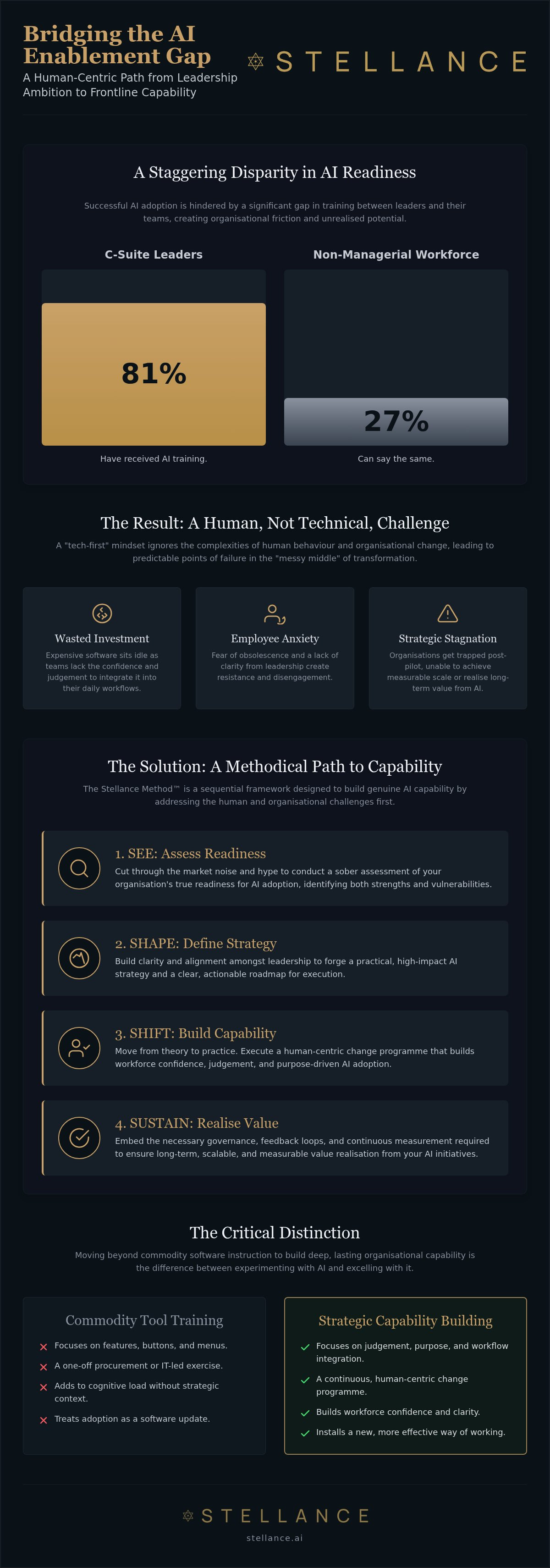
Whilst 81% of C-suite leaders have received AI training, only 27% of their non-managerial workforce can say the same. It's a staggering disparity that transforms a potential strategic advantage into a source of deep organisational friction. You've likely felt this tension already. You see the wasted investment in software that sits idle, and you sense the quiet anxiety amongst employees who equate automation with obsolescence. Effective AI workforce enablement isn't about buying more licenses; it's about bridging the gap between leadership ambition and frontline reality.
This guide offers a sober alternative to the frantic market noise. We'll show you how to move beyond simple tool training to achieve genuine capability by focusing on human-centric strategy. You'll discover how The Stellance Method™ provides a clear roadmap to SEE through the hype, SHAPE a practical strategy, SHIFT your workforce's confidence, and SUSTAIN long-term value. We're moving from a state of confusion to one of measurable progress, building a workforce that uses AI with judgement, purpose, and clarity.
Key Takeaways
- Understand why successful AI adoption is primarily a human and organisational challenge, rather than a technical one.
- Learn how the SHIFT phase of The Stellance Method™ serves as the engine for AI workforce enablement by prioritising employee judgement over simple tool training.
- Discover the critical distinction between commodity software instruction and the strategic building of deep organisational capability.
- Identify how to bridge the "messy middle" of transformation by using the SEE and SHAPE stages to create a practical, leadership-led roadmap.
- Master the SUSTAIN phase to embed the governance and continuous measurement required for long-term, measurable value realisation.
Why AI Workforce Enablement is a Human Challenge, Not a Technical One
Most organisations treat AI as a technical deployment. They buy the software, distribute the logins, and wait for the productivity gains to arrive. They rarely do. True AI workforce enablement is not a software update; it's a fundamental shift in human behaviour. It's the process of equipping teams with the confidence and judgement to adopt AI as a partner, not a replacement. Without this human-centric approach, even the most advanced systems remain underutilised and misunderstood.
We often see businesses trapped in the "messy middle." They've moved past the initial excitement of pilots but haven't achieved measurable scale. The tools are there, but the results are not. This stagnation usually stems from a "tech-first" mindset that ignores the complexities of organizational change management. It's the difference between installing software and installing a new way of working. Leadership must provide clarity through the SEE and SHAPE stages of The Stellance Method™ before a workforce can begin to find its capability. Capability cannot grow in a vacuum of strategic ambiguity; it requires a firm foundation of governance and intent.
The Psychology of AI Adoption in the Workplace
Adoption fails when it's built on fear. Employees worry about job security whilst leaders worry about being left behind. We need to move from these reactive stances toward purpose-driven adoption. This requires "candour over comfort." Leaders must be honest about how roles will shift, dismantling the "hype fatigue" that permeates many UK boardrooms. When people understand the why, the how becomes a shared mission rather than a top-down mandate. It's about moving from a state of being "done to" by technology to being "empowered by" it.
Moving Beyond the Tool-Obsessed Mindset
Buying a thousand Microsoft 365 Copilot licences is a procurement exercise, not a strategy for AI workforce enablement. Tool training is a commodity that focuses on buttons and menus. Capability building, however, focuses on judgement and workflow integration. If you teach someone how to use a tool without teaching them when and why to use it, you've only added to their cognitive load. AI enablement acts as a bridge between complex systems and human output. It's about building a workforce that uses technology with intent rather than just following a script. This transition is what separates companies that experiment from those that excel.
The SHIFT Phase: Building Capability Through The Stellance Method™
Workforce enablement is not a training event; it's a behavioural transition. Most organisations fail here because they treat adoption as a box-ticking exercise rather than a psychological shift. The SHIFT phase is the engine room of AI workforce enablement. It's the critical point where leadership clarity, established in the previous stages, transforms into frontline capability. Whilst the earlier stages focus on readiness and strategy, SHIFT is strictly about the "how." It's a structured, human-centric change programme designed to build confidence through practice rather than theory.
We prioritise "capability over compliance." This means we don't want employees who simply follow a prompt guide because they've been told to do so. We want professionals who apply AI with judgement and purpose. This stage ensures that the technology serves the human, not the other way around. It's about moving from a state of experimentation to a state of operational readiness where AI is used with intent and defensible logic.
Transitioning from Strategy to Execution
Roadmaps are static, but behaviours are dynamic. The SHIFT stage translates the SHAPE stage's high-level strategy into daily team actions. This isn't a one-size-fits-all exercise. We use bespoke programmes to address specific departmental needs, ensuring a marketing team's AI journey looks different from an operations team's. It's about leading with people, not a fear of missing out. We focus on building a bridge between leadership ambition and the granular reality of daily tasks. If your team is struggling to bridge this gap, you might benefit from our AI workforce enablement advisory to help stabilise your path.
The Four Pillars of the Stellance Method™
The Stellance Method™ isn't a collection of ad-hoc workshops. It's a methodical sequence designed to prevent the "consultancy trap" of endless theory without delivery. The stages are precise:
- SEE: We cut through the market noise to assess real organisational readiness and cut out the hype.
- SHAPE: We build leadership clarity and a practical AI strategy that aligns with business goals.
- SHIFT: This is where we build workforce confidence and genuine capability through enablement.
- SUSTAIN: We embed the governance, measurement, and continuous value realisation required for long-term growth.
By following this architecture, organisations avoid the trap of "tool-first" adoption. You cannot shift a workforce that hasn't seen its own readiness or shaped its own path. This steady progression ensures that AI becomes an integrated part of the organisational fabric rather than a superficial, temporary addition.
Distinguishing Enablement from Tool Training: A Strategic Framework
Tool training is a commodity. It's easily bought, quickly outdated, and focuses almost entirely on the mechanical "how" of software use. AI workforce enablement, however, is a competitive advantage. It focuses on the "why" and the "when." Whilst a training module might show an employee how to generate text, enablement teaches them how to interrogate that text for bias, accuracy, and strategic alignment. We don't just want a workforce that can use tools; we want an organisation that can apply judgement to technology.
This requires a shift in mindset from viewing AI as a search engine to viewing it as a collaborator. Many employees still treat generative systems as a way to find answers. This is a mistake. True capability involves using AI to refine ideas, challenge assumptions, and accelerate production through iterative feedback. We measure this capability through tangible output and value realisation, not through vanity metrics like login rates or completed video modules. If the work isn't getting better, the enablement hasn't happened.
The Limitations of Traditional Software Training
Traditional "how-to" guides fail because they ignore the cognitive load of adoption. Knowing where a button is does not mean an employee knows when to trust the output it produces. Our 23 years of lived digital transformation experience proves that human behaviour is the hardest variable to solve for. You cannot patch human reluctance with a PDF manual or a generic webinar. Transformation happens when the workforce understands how the tool fits into their specific daily reality, rather than being told to use it as a top-down mandate.
Building Lived Experience and Judgement
We advocate for a posture of "judgement over jargon." In the SHIFT phase, we use a constructively challenging approach to review existing workflows. We don't just automate bad processes; we redesign them. This involves encouraging "progress over perfection" during the early stages of adoption. High-performance teams don't need a perfect system on day one. They need the permission to experiment and the mentorship to learn from those experiments. Bespoke mentorship, grounded in real-world delivery, accelerates the learning curve far faster than any classroom setting. It moves the conversation from theoretical potential to practical, measurable results.
Designing an AI Adoption Roadmap for High-Performance Teams
A roadmap is not a wish list. It is a sequence of defensible decisions that align your workforce with your strategic intent. Most organisations fail because they build their plans on the shifting sands of tool-specific hype. A robust roadmap for AI workforce enablement begins with architecture, not activity. It requires a methodical progression through the SEE and SHAPE stages to ensure that when you finally reach the SHIFT, your teams aren't just busy; they're effective. Governance and ethics must be baked into this foundation from the outset, serving as the guardrails that allow for safe experimentation.
Assessing Organisational Readiness (SEE)
The first step is a cold, clear-eyed audit of current skill sets. This isn't about creating a culture of surveillance or spying on employee browser history. It's about understanding the "lived experience" of your people. You need to identify your "AI champions" early. These are the individuals already experimenting with tools in their spare time or finding unofficial ways to improve their workflows. By identifying these pockets of organic capability, you can leverage their enthusiasm to anchor your formal strategy. Our approach to engagements focuses on this initial assessment to ensure your starting point is grounded in reality rather than assumption.
Building Leadership Clarity (SHAPE)
Roadmaps fail when the board is not aligned. If leadership cannot define what "success" looks like beyond a vague desire for productivity, the workforce will remain in a state of confusion. High-performance teams require clarity of purpose. Executive briefings are essential here; they set the sober, authoritative tone necessary for a successful SHIFT. Leadership must decide which high-impact opportunities to pursue and which distractions to ignore. This alignment creates the psychological safety employees need to move from fear-based reactions to purpose-driven adoption. For a deeper look at this process, consult our Professional AI Strategy Services guide.
Milestones for Measurable Progress
Capability building requires a deliberate rhythm. We recommend a 90-day framework to move from confusion to measurable progress:
- Day 30: Foundational governance established. AI champions identified and readiness audits completed.
- Day 60: Bespoke departmental programmes launched. The SHIFT phase begins with a focus on high-impact, low-risk pilots.
- Day 90: Initial value realisation. A governance audit ensures adoption remains ethical and aligned with the original roadmap.
This structured approach ensures that momentum is earned, not forced. It moves the organisation away from superficial experimentation and toward a state of operational readiness where AI is an integrated capability rather than a bolt-on tool.
Securing Sustainable Value: Why Leadership Alignment Precedes Enablement
AI workforce enablement is not a standalone project. It is the logical conclusion of a sequenced methodology. If you attempt to enable a workforce before aligning the leadership, you're merely training people for a strategy that doesn't exist. This misalignment is the primary cause of the "messy middle," where pilots are abandoned and expensive tool licences sit idle. Sustainable value is only secured when the organisation moves through the full Stellance Method™, ensuring that every workforce shift is anchored in board-level clarity.
Leaders often feel pressured to "do something" with AI, leading to rushed training programmes that lack context. We challenge this reactive posture. True capability building requires a steady hand and a defensible logic. It's about translation. We bridge the gap between complex technical systems and human output by ensuring that leadership alignment precedes frontline action. When the board is clear on the why, the workforce can finally master the how.
Embedding Continuous Value Realisation (SUSTAIN)
The SUSTAIN phase is where initial excitement transitions into permanent capability. It's not enough to launch a tool; you must embed the governance and continuous measurement required to protect the organisation whilst encouraging innovation. This stage ensures that AI adoption isn't a temporary spike in activity but a long-term architectural shift. Governance should not be a barrier to progress. Instead, it serves as the framework that allows employees to use AI with confidence and safety. Our AI Leadership Accelerator prepares executives for this level of oversight, providing the strategic depth needed to manage a shifting workforce in a volatile market.
The Path Forward with Stellance
In a market saturated with frantic hype, we offer a sober alternative. Our focus is on the human challenge of organisational change, not the technical specifications of the latest platform. We help you move from a state of confusion to a state of confidence. This journey is unique to every organisation, which is why our accelerator programme is a 1-2-1 bespoke experience. We provide the order and logic required to turn AI from a theoretical risk into a measurable strategic asset.
We bring 23 years of lived digital transformation experience to the table. We've seen how technology cycles rise and fall, and we know that the human element is always the deciding factor in success. By focusing on capability over compliance, we ensure your teams are equipped to navigate the future with judgement and purpose. It's time to move beyond the hype and start building genuine organisational capability. We stand alongside you as a pragmatic mentor, ready to help you bridge the gap between where you are and where you need to be.
From AI Confusion to Organisational Capability
True AI workforce enablement is the bridge between technical potential and operational reality. It's not found in a software manual or a generic webinar. It's built through a methodical commitment to human judgement and strategic clarity. We've spent 23 years navigating digital transformations, and the lesson remains the same: technology only works when the people behind it are confident, capable, and aligned with a clear purpose.
By following The Stellance Method™, you move beyond the "messy middle" of stalled pilots. You move from the noise of the market to the order of a structured roadmap. Whether through our bespoke 1-2-1 AI Leadership Accelerator or a broader change programme, the goal is a workforce that uses AI with intent. You don't need more tools; you need a more capable organisation with the architecture to support it.
The path to transformation is demanding, but it's entirely achievable with the right architecture in place. It's time to stop experimenting and start delivering value with a steady, experienced hand to guide you.
Frequently Asked Questions
What is the difference between AI training and AI workforce enablement?
Tool training is a mechanical exercise that focuses on software proficiency and button-clicking. AI workforce enablement is a strategic transition that builds human judgement and organisational capability. Whilst training teaches you how to use a specific tool, enablement teaches you when to trust the output and how to integrate technology into your daily workflows. It's the difference between knowing a tool exists and having the confidence to use it with intent.
How do we start AI enablement if our leadership team is not yet aligned?
You shouldn't attempt to enable a workforce before the board is aligned. Strategic ambiguity at the top creates confusion at the frontline. We recommend starting with the SHAPE phase of The Stellance Method™. This builds leadership clarity and a practical roadmap. Once the leadership team understands the strategic opportunities and risks, they can set the tone for a successful SHIFT phase. Alignment is the prerequisite for any sustainable capability building.
How can we measure the success of an AI workforce enablement programme?
Success is measured by tangible value realisation and the quality of human output, not by vanity metrics like login rates or module completion. We look for improvements in decision-making speed, the reduction of cognitive load, and the workforce's ability to apply judgement to AI-generated content. A successful programme results in teams that use AI with purpose. It's about measurable organisational transformation rather than just having more people using a specific platform.
What are the biggest risks of failing to enable our workforce for AI?
The primary risks include wasted investment in tools that go unused and deep-seated employee anxiety regarding job security. Without a structured AI workforce enablement programme, organisations often find themselves trapped in the "messy middle." This is a state where pilots fail to scale and productivity gains never materialise. Failing to build capability also leaves the organisation vulnerable to "shadow AI," where employees use unsecured tools without governance or strategic oversight.
How does The Stellance Method™ differ from traditional management consulting?
Traditional consulting often relies on ad-hoc advice and theoretical reports. The Stellance Method™ is a named, repeatable framework built on 23 years of lived digital transformation experience. It prioritises the human side of adoption over technical implementation. We move methodically through four specific stages: SEE, SHAPE, SHIFT, and SUSTAIN. This ensures that every action is grounded in readiness and strategy rather than being a reactive response to market trends.
Can AI workforce enablement be tailored for non-technical departments?
AI workforce enablement is critical for non-technical departments like marketing, operations, and HR. These teams often face the greatest shift in their daily workflows. We use bespoke programmes to address the specific needs of each department. The goal is to translate complex technical capabilities into practical, human-centric tasks. This ensures that every team member, regardless of their technical background, can adopt AI with confidence and purpose. It's about building capability, not technical expertise.
How long does it typically take to see results from an enablement roadmap?
Initial measurable progress typically materialises within 90 days of launching a structured roadmap. The first 30 days focus on the SEE and SHAPE phases to establish governance and leadership clarity. By day 60, the SHIFT phase begins to build frontline capability through departmental pilots. By day 90, organisations usually see the first signs of value realisation. Sustainable, long-term transformation is a continuous process that is embedded during the SUSTAIN phase to ensure permanent capability.
What role does change management play in AI adoption?
Change management is the core of successful AI adoption. We treat AI as a human and organisational challenge first and a technology challenge second. Effective change management addresses the psychological barriers to adoption, such as fear of obsolescence or hype fatigue. It provides the steady hand needed to guide a workforce through the "messy middle" and toward a state of permanent, purpose-driven capability. Without it, even the most advanced tools will fail to deliver value.
Frequently Asked Questions
Tool training is a mechanical exercise that focuses on software proficiency and button-clicking. AI workforce enablement is a strategic transition that builds human judgement and organisational capability. Whilst training teaches you how to use a specific tool, enablement teaches you when to trust the output and how to integrate technology into your daily workflows. It's the difference between knowing a tool exists and having the confidence to use it with intent.
You shouldn't attempt to enable a workforce before the board is aligned. Strategic ambiguity at the top creates confusion at the frontline. We recommend starting with the SHAPE phase of The Stellance Method™. This builds leadership clarity and a practical roadmap. Once the leadership team understands the strategic opportunities and risks, they can set the tone for a successful SHIFT phase. Alignment is the prerequisite for any sustainable capability building.
Success is measured by tangible value realisation and the quality of human output, not by vanity metrics like login rates or module completion. We look for improvements in decision-making speed, the reduction of cognitive load, and the workforce's ability to apply judgement to AI-generated content. A successful programme results in teams that use AI with purpose. It's about measurable organisational transformation rather than just having more people using a specific platform.
The primary risks include wasted investment in tools that go unused and deep-seated employee anxiety regarding job security. Without a structured AI workforce enablement programme, organisations often find themselves trapped in the "messy middle." This is a state where pilots fail to scale and productivity gains never materialise. Failing to build capability also leaves the organisation vulnerable to "shadow AI," where employees use unsecured tools without governance or strategic oversight.
Traditional consulting often relies on ad-hoc advice and theoretical reports. The Stellance Method™ is a named, repeatable framework built on 23 years of lived digital transformation experience. It prioritises the human side of adoption over technical implementation. We move methodically through four specific stages: SEE, SHAPE, SHIFT, and SUSTAIN. This ensures that every action is grounded in readiness and strategy rather than being a reactive response to market trends.
AI workforce enablement is critical for non-technical departments like marketing, operations, and HR. These teams often face the greatest shift in their daily workflows. We use bespoke programmes to address the specific needs of each department. The goal is to translate complex technical capabilities into practical, human-centric tasks. This ensures that every team member, regardless of their technical background, can adopt AI with confidence and purpose. It's about building capability, not technical expertise.
Initial measurable progress typically materialises within 90 days of launching a structured roadmap. The first 30 days focus on the SEE and SHAPE phases to establish governance and leadership clarity. By day 60, the SHIFT phase begins to build frontline capability through departmental pilots. By day 90, organisations usually see the first signs of value realisation. Sustainable, long-term transformation is a continuous process that is embedded during the SUSTAIN phase to ensure permanent capability.
Change management is the core of successful AI adoption. We treat AI as a human and organisational challenge first and a technology challenge second. Effective change management addresses the psychological barriers to adoption, such as fear of obsolescence or hype fatigue. It provides the steady hand needed to guide a workforce through the "messy middle" and toward a state of permanent, purpose-driven capability. Without it, even the most advanced tools will fail to deliver value.
Next step
Let’s talk about where AI creates value in your organisation.
A short, practical conversation with no obligation.