AI Strategy for Board Members: Navigating Oversight with Clarity and Calm
9 September 2026 · 16 min read


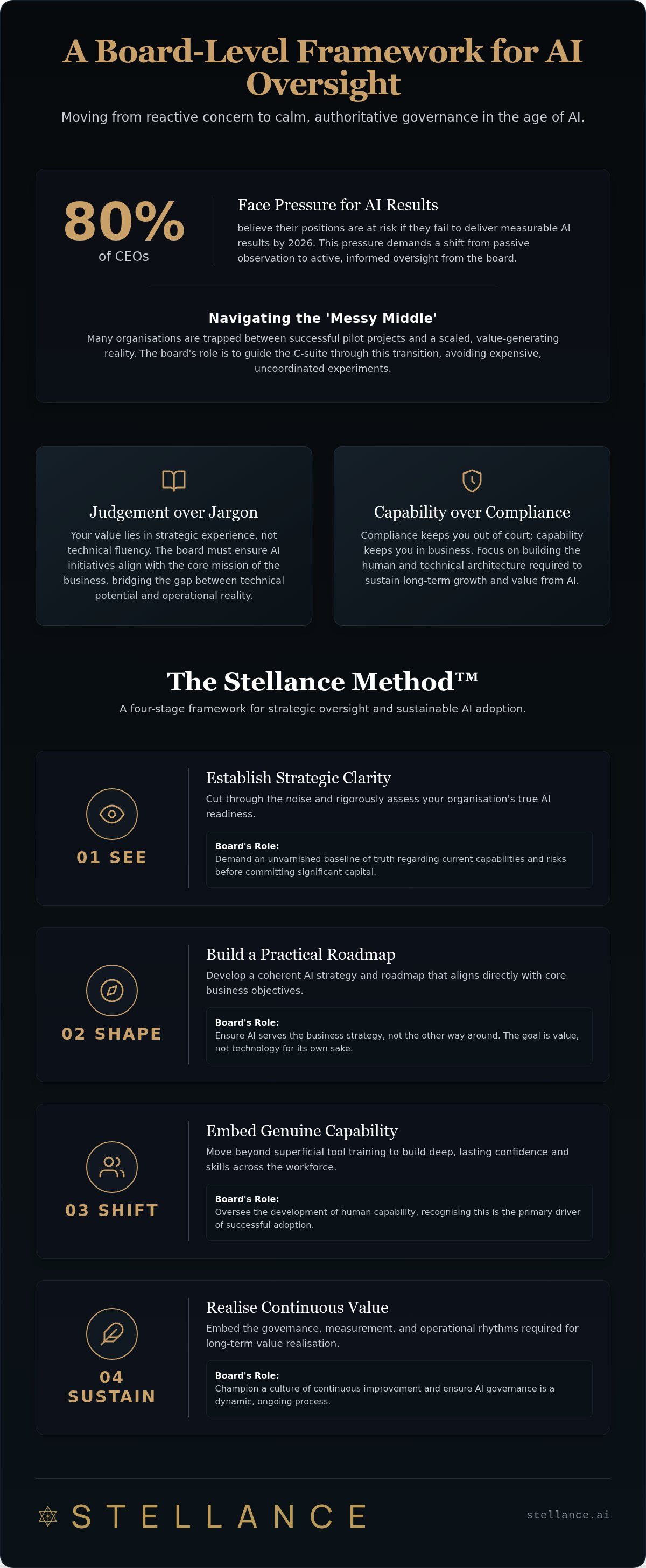
Eighty per cent of CEOs believe their positions are at risk if they fail to deliver measurable AI results by the end of 2026. This pressure flows directly into the boardroom. Non-executive directors are now expected to govern a technology they often feel ill-equipped to understand. Developing a robust AI strategy for board members isn't about mastering code. It's about exercising the same level of fiduciary duty and strategic rigour you apply to any other systemic risk.
You've likely felt the exhaustion of conflicting vendor claims and the anxiety of potential liability. It's a noisy environment. Genuine value is often obscured by expensive experiments. This guide provides the clarity you need to move from reactive concern to calm, authoritative oversight. We'll explore how to use The Stellance Method™ to see through the hype, shape a practical roadmap, and shift your organisation towards long-term capability. Judgement over jargon. You'll gain the confidence to ask the right questions and ensure AI becomes a driver of sustainable value rather than a source of unmanaged risk.
Key Takeaways
- Understand why a robust AI strategy for board members focuses on building long-term organisational capability rather than simply approving software expenditure.
- Learn to apply The Stellance Method™ to provide a structured, four-stage framework for monitoring progress from initial readiness through to continuous value realisation.
- Discover how to transition from fear-based risk management to a judgement-based approach that balances ethical governance with the need for strategic speed.
- Gain a toolkit of constructively challenging questions designed to reveal the reality of your organisation's AI maturity and cut through executive-level jargon.
- Explore the board’s vital role in guiding the C-suite through the complex transition from successful pilot projects to full-scale, value-driven adoption.
Defining AI Strategy for Board Members: Beyond the Hype
AI is often presented as a technical riddle for the IT department to solve. This is a mistake. For a non-executive director, an effective AI strategy for board members is the governance of organisational capability, not the procurement of software. It's the difference between buying a tool and building an architecture that can actually use it. Most organisations are currently trapped in the 'messy middle'. This is the difficult space between a successful pilot and a scaled, value-generating reality. In 2026, the era of passive observation has ended. Directors must move toward active, informed oversight to ensure AI initiatives don't become expensive, uncoordinated experiments.
The Board's Fiduciary Duty in AI Governance
Your primary responsibility remains the protection of long-term shareholder value whilst navigating disruptive technology. As the global AI regulation landscape becomes increasingly complex, with the EU AI Act reaching full application in August 2026, the temptation is to retreat into a tick-box compliance mindset. This is insufficient. A superior board-level mantra is 'capability over compliance'. Compliance keeps you out of court; capability keeps you in business. Without a coordinated strategy, organisations face 'strategic drift'. This happens when fragmented AI projects consume budget without ever shifting the bottom line. It's about ensuring the company has the human and technical architecture to sustain growth.
Judgement over Jargon: The Board's Primary Value
You don't need to understand neural networks to govern them. Your value lies in decades of lived experience, not technical fluency. The board's role is to act as the strategic anchor for AI, ensuring that every initiative aligns with the core mission of the business. We must prioritise value-driven strategic clarity over hype-driven decision-making. It's not about what the technology can do, but what the business needs it to achieve. By focusing on judgement over jargon, you can bridge the gap between technical potential and operational reality. This is where strategic advisory becomes essential. It helps you ask the questions that matter most to the long-term health of the organisation.
The Stellance Method™: A Framework for Strategic Oversight
Generic frameworks often fail because they lack the nuance of lived experience. The Stellance Method™ is different. It's a structured approach refined through 23 years of digital transformation, designed specifically to move organisations from confusion to measurable results. As an AI Adoption Strategist, Stellance provides the connective tissue between high-level ambition and operational reality. For an effective AI strategy for board members, this framework acts as a steady hand, ensuring no stage of the process is rushed or skipped. It's a battle-tested architecture. We've spent over two decades bridging the gap between complex systems and human output. This experience is vital when navigating the 'messy middle', where initial excitement often gives way to implementation fatigue.
SEE and SHAPE: Establishing Strategic Clarity
The journey begins with SEE. This isn't a passive audit. It's a rigorous assessment of real organisational readiness. Boards must cut through the noise of vendor promises to identify where the business actually stands. It's about establishing a baseline of truth before committing significant capital.
Once the terrain is clear, we move to SHAPE. This involves building a practical roadmap that aligns AI initiatives with existing business objectives. It's about ensuring AI serves the strategy, rather than the technology dictating the path. For those in the 'messy middle', our Professional AI Strategy Services provide the structure to build this leadership clarity.
SHIFT and SUSTAIN: Embedding Capability and Value
Execution usually falters during the SHIFT phase. Many organisations mistake tool training for genuine workforce enablement. A board's role is to oversee the development of deep organisational capability, moving beyond superficial platform adoption to ensure the workforce is actually ready to deliver.
This leads naturally to SUSTAIN, where we embed the governance and measurement required for long-term value realisation. This is where 'capability over compliance' manifests as a tangible reality. By focusing on the board's role in AI oversight, directors ensure that ethical safeguards are woven into the corporate fabric. This ensures an AI strategy for board members remains grounded in results rather than theoretical forecasts.
If you're ready to move beyond the hype and establish a defensible logic for your organisation's future, you can discuss your board's AI roadmap with us.
Risk Management vs. Strategic Opportunity: Navigating the Trade-offs
Risk isn't a binary state of safety or danger. It's a spectrum of trade-offs. For a robust AI strategy for board members, we must move away from a fear-based approach that prioritises total avoidance. Fear leads to paralysis. Instead, adopt a judgement-based approach that weighs the risk of a technical misstep against the far more certain risk of organisational stagnation. In 2026, the competitive landscape moves too quickly for a 'wait and see' policy. Stagnation is the silent killer of shareholder value. Boards must balance the implementation of ethical safeguards with the necessary speed of adoption. It's about being safe enough to move fast, not slow enough to be safe. For a practical starting point, refer to our AI Risk Management: A 2026 Checklist for Executives.
Algorithmic Bias and Ethical Governance
Transparency is not a technical feature; it's a governance requirement. Boards must demand to see the logic behind AI decision-making models to prevent algorithmic bias from eroding brand trust. It's not about the code, but the human element of ethics. We need people leading technology, not fear leading people. The board holds a fundamental duty to oversee the cultural shift that occurs when AI-driven insights begin to influence core business operations. This ensures that the 'messy middle' doesn't become a moral vacuum. Ethical governance is about establishing a defensible logic that protects both the customer and the company's long-term reputation.
Capability as a Risk Mitigation Strategy
The best defence against AI hallucinations and technical errors isn't better software. It's a more capable workforce. We often see boards becoming tool-obsessed in their risk management, looking for the perfect platform to solve their problems. This is a distraction. Real mitigation comes from human-centric capability building. When your people understand the limitations of the tools they use, they become the ultimate safeguard against systemic failure. This is why the SHIFT stage of The Stellance Method™ is so critical. It moves beyond training to genuine enablement. By focusing on AI for Strategic Decision Making, you empower your leadership team to use technology as a lever for growth rather than a source of anxiety. Building internal capability is the only way to move from reactive governance to proactive strategic advantage.
Key Questions Every Board Member Should Ask the C-Suite
Executive reports often focus on technical milestones and pilot successes. Whilst these are useful, they rarely reveal the true health of an organisation's transformation. Your role is to provide the constructive challenge that moves the conversation from technical potential to strategic reality. A successful AI strategy for board members relies on your ability to cut through the noise and demand evidence of long-term capability. You aren't there to approve the next shiny tool. You're there to ensure the company is building a defensible, value-driven future. Use these questions to navigate the 'messy middle' and ensure your leadership team is focused on practical results rather than futuristic promises.
Assessing Readiness and Strategy
The first step in any oversight journey is the SEE stage of The Stellance Method™. You must determine if the organisation is truly ready to scale or if it's merely performing 'innovation theatre'. Consider these questions:
- How does this AI initiative directly support our core business objectives? If the answer is vague or focuses solely on 'keeping up with competitors', the strategy lacks the necessary anchor.
- What evidence do we have of real organisational readiness beyond technical pilots? Success in a controlled environment doesn't guarantee success in the real world. Ask for data on data quality, infrastructure, and leadership alignment.
- Are we building capability or just buying licences? Buying software is a procurement exercise. Building capability is a strategic investment in the company's future architecture.
Evaluating Adoption and Long-term Value
Transformation fails when the workforce is left behind. During the SHIFT and SUSTAIN stages, your oversight must focus on how technology is being integrated into daily operations. This is about people, not just platforms.
- What is our plan for workforce enablement to ensure these tools are actually used? Tool training is a one-off event. Enablement is a continuous process of building confidence and capability.
- How are we measuring the 'Sustain-ability' of these AI-driven gains? Measurement must go beyond initial cost savings to include long-term value realisation and governance.
- What is the 'human-in-the-loop' strategy for our most critical AI processes? Autonomous systems require clear lines of human accountability to manage ethical and operational risks.
Operationalising AI: Moving from Boardroom Theory to SHIFT
Transformation often stalls in the gap between boardroom vision and operational execution. This is the 'messy middle'. It's the point where technical hurdles meet cultural resistance and where many initiatives lose their way. Your role as a board member isn't to manage the project, but to support the CEO through this complex transition into the SHIFT stage. It's a human-led journey that requires a calm, experienced hand on the shoulder of the leadership team. A successful AI strategy for board members ensures that adoption remains practical and value-driven. It's about providing the strategic patience and air cover required to move beyond pilots and into a scaled, resilient reality. We must treat this as an organisational challenge first and a technology challenge second.
The Role of Bespoke Executive Development
Generic corporate training often feels like a box-ticking exercise. It offers theory when leaders need application. It lacks the visceral, experience-based language that business leaders require to make defensible decisions. This is why bespoke 1-2-1 development is more effective than broad-brush programmes. Our AI Leadership Accelerator provides a tailored path that focuses on building the specific confidence and judgement required for oversight. It's not about learning to code. It's about learning to lead. Through individual engagements, senior leaders develop the ability to translate technical potential into a steady, logical roadmap. This coaching builds the 'connective tissue' between complex systems and human output.
Building a Culture of Continuous Capability
The board must champion a culture of progress over perfection. The goal isn't a flawless implementation on day one, but the establishment of a stable architecture for long-term growth. This is the SUSTAIN stage of The Stellance Method™. It involves embedding governance and measurement into the organisational fabric to ensure that value realisation is a continuous process. We don't want expensive, uncoordinated experiments. We want sustainable capability. When governance is treated as a strategic enabler rather than a barrier, the organisation can move with confidence. Our oversight ensures that AI adoption remains grounded in the real world of budgets and delivery. We're looking toward a future where technology is led by people, not fear. By focusing on human-centric enablement, you ensure the organisation is ready for whatever comes next.
Leading with Strategic Clarity and Calm
Establishing a robust AI strategy for board members is a journey toward defensible logic and long-term organisational health. It requires moving beyond the frantic pace of the market to embrace a posture of calm, informed oversight. By applying The Stellance Method™, you can navigate the transition from initial readiness to sustained value with confidence. True success isn't found in the tools you procure, but in the capability you build within your leadership and workforce.
Mike Borrelli and the Stellance team bring 23 years of digital transformation experience to this challenge. We act as a steady hand, helping you cut through the noise of the 'messy middle' to ensure technology serves your strategic objectives. This is a human-led evolution. It demands judgement over jargon and practical results over futuristic promises. The path from theory to operational reality is challenging, yet entirely navigable with the right framework and a focus on organisational readiness.
You have the opportunity to lead your organisation through this change with clarity and purpose. By prioritising human capability, you ensure a future where technology is a lever for growth rather than a source of anxiety. It's time to move beyond the hype and begin the real work of transformation.
Frequently Asked Questions
Is a technical background necessary for board members to oversee AI strategy?
No, a technical background isn't required to provide effective oversight. Your value lies in your strategic judgement and lived experience, not your ability to write code. An AI strategy for board members should focus on organisational capability and long-term value rather than technical implementation. You're there to ensure the technology serves the business mission. Focus on asking the right questions of the C-suite rather than mastering the underlying architecture.
Can the board delegate AI oversight entirely to the Risk or Audit committees?
You shouldn't delegate AI oversight entirely to a single committee. Whilst Risk and Audit have vital roles in managing specific threats, AI is a fundamental driver of business strategy and cultural change. It requires the attention of the full board to ensure alignment with core objectives. Treating AI purely as a risk management exercise misses the strategic growth opportunities and the human challenges of workforce enablement that only the whole board can address.
What happens if our organisation is stuck in the 'messy middle' of AI pilots?
Many organisations find themselves in the 'messy middle' between initial pilots and full-scale adoption. If you're stuck, use the SEE stage of The Stellance Method™ to cut through the noise and assess your real organisational readiness. This involves identifying the specific bottlenecks in your human and technical architecture. It's often a signal that your strategy needs a clearer SHAPE to align technical efforts with practical, value-driven business results.
How much time should the board dedicate to AI strategy in 2026?
In 2026, boards should expect to dedicate significant time to AI oversight, particularly as the EU AI Act reaches full application. It's no longer a peripheral IT concern but a core fiduciary duty. You'll need enough time to move beyond superficial briefings toward deep dives into capability building and governance. Regular, structured updates are essential to ensure the organisation remains safe enough to move fast in a competitive market.
Is AI governance primarily about compliance with new regulations?
AI governance isn't just about ticking boxes for new regulations. Whilst compliance is necessary to stay out of court, capability is what keeps you in business. A robust AI strategy for board members prioritises building the organisational architecture required to sustain growth. Focus on creating a culture where technology is led by people. Governance should act as a strategic anchor that enables innovation rather than a fear-based barrier that causes stagnation.
How can the board distinguish between AI hype and genuine strategic opportunity?
Distinguish genuine opportunity from hype by focusing on practical results rather than futuristic promises. Ask the C-suite how specific AI initiatives directly support your core business objectives. If the proposal relies on technical jargon without a clear link to measurable value, it's likely hype. Use your decades of experience to challenge assumptions and demand evidence of real organisational readiness before committing significant capital to new projects.
What are the first steps for a board to implement The Stellance Method™?
The first step is the SEE stage. This involves a rigorous assessment of your current organisational readiness and strategic clarity. You must identify where the business actually stands before building a roadmap. Mike Borrelli and the Stellance team use 23 years of digital transformation experience to help you cut through vendor noise. This initial assessment provides the baseline of truth needed to move into the SHAPE and SHIFT phases with confidence.
Can board members use AI tools themselves to improve their own decision-making?
Yes, board members can and should use AI tools to enhance their own oversight. AI can summarise dense board materials, benchmark performance against peers, and assist in complex scenario planning. However, this must be done with clear governance and an understanding of the tool's limitations. Using AI yourself builds the confidence and judgement required to oversee its adoption across the wider organisation, moving you from theory to practical experience.
Frequently Asked Questions
No, a technical background isn't required to provide effective oversight. Your value lies in your strategic judgement and lived experience, not your ability to write code. An AI strategy for board members should focus on organisational capability and long-term value rather than technical implementation. You're there to ensure the technology serves the business mission. Focus on asking the right questions of the C-suite rather than mastering the underlying architecture.
You shouldn't delegate AI oversight entirely to a single committee. Whilst Risk and Audit have vital roles in managing specific threats, AI is a fundamental driver of business strategy and cultural change. It requires the attention of the full board to ensure alignment with core objectives. Treating AI purely as a risk management exercise misses the strategic growth opportunities and the human challenges of workforce enablement that only the whole board can address.
Many organisations find themselves in the 'messy middle' between initial pilots and full-scale adoption. If you're stuck, use the SEE stage of The Stellance Method™ to cut through the noise and assess your real organisational readiness. This involves identifying the specific bottlenecks in your human and technical architecture. It's often a signal that your strategy needs a clearer SHAPE to align technical efforts with practical, value-driven business results.
In 2026, boards should expect to dedicate significant time to AI oversight, particularly as the EU AI Act reaches full application. It's no longer a peripheral IT concern but a core fiduciary duty. You'll need enough time to move beyond superficial briefings toward deep dives into capability building and governance. Regular, structured updates are essential to ensure the organisation remains safe enough to move fast in a competitive market.
AI governance isn't just about ticking boxes for new regulations. Whilst compliance is necessary to stay out of court, capability is what keeps you in business. A robust AI strategy for board members prioritises building the organisational architecture required to sustain growth. Focus on creating a culture where technology is led by people. Governance should act as a strategic anchor that enables innovation rather than a fear-based barrier that causes stagnation.
Distinguish genuine opportunity from hype by focusing on practical results rather than futuristic promises. Ask the C-suite how specific AI initiatives directly support your core business objectives. If the proposal relies on technical jargon without a clear link to measurable value, it's likely hype. Use your decades of experience to challenge assumptions and demand evidence of real organisational readiness before committing significant capital to new projects.
The first step is the SEE stage. This involves a rigorous assessment of your current organisational readiness and strategic clarity. You must identify where the business actually stands before building a roadmap. Mike Borrelli and the Stellance team use 23 years of digital transformation experience to help you cut through vendor noise. This initial assessment provides the baseline of truth needed to move into the SHAPE and SHIFT phases with confidence.
Yes, board members can and should use AI tools to enhance their own oversight. AI can summarise dense board materials, benchmark performance against peers, and assist in complex scenario planning. However, this must be done with clear governance and an understanding of the tool's limitations. Using AI yourself builds the confidence and judgement required to oversee its adoption across the wider organisation, moving you from theory to practical experience.
Next step
Let’s talk about where AI creates value in your organisation.
A short, practical conversation with no obligation.