Strategic AI Workforce Planning: A Leader’s Reference for Sustainable Adoption
13 September 2026 · 17 min read


Most AI strategies fail not because the technology is flawed, but because the human architecture beneath it was never designed to carry the weight. Leaders are currently caught in a messy middle where initial pilots have stalled and conflicting forecasts create more noise than clarity. You likely feel the pressure to move faster, yet the fear of skill obsolescence or workforce resistance acts as a silent handbrake on progress. True success requires a fundamental shift in perspective. It's not about the tools you buy. It's about the strategic AI workforce planning you embed within your organisational culture.
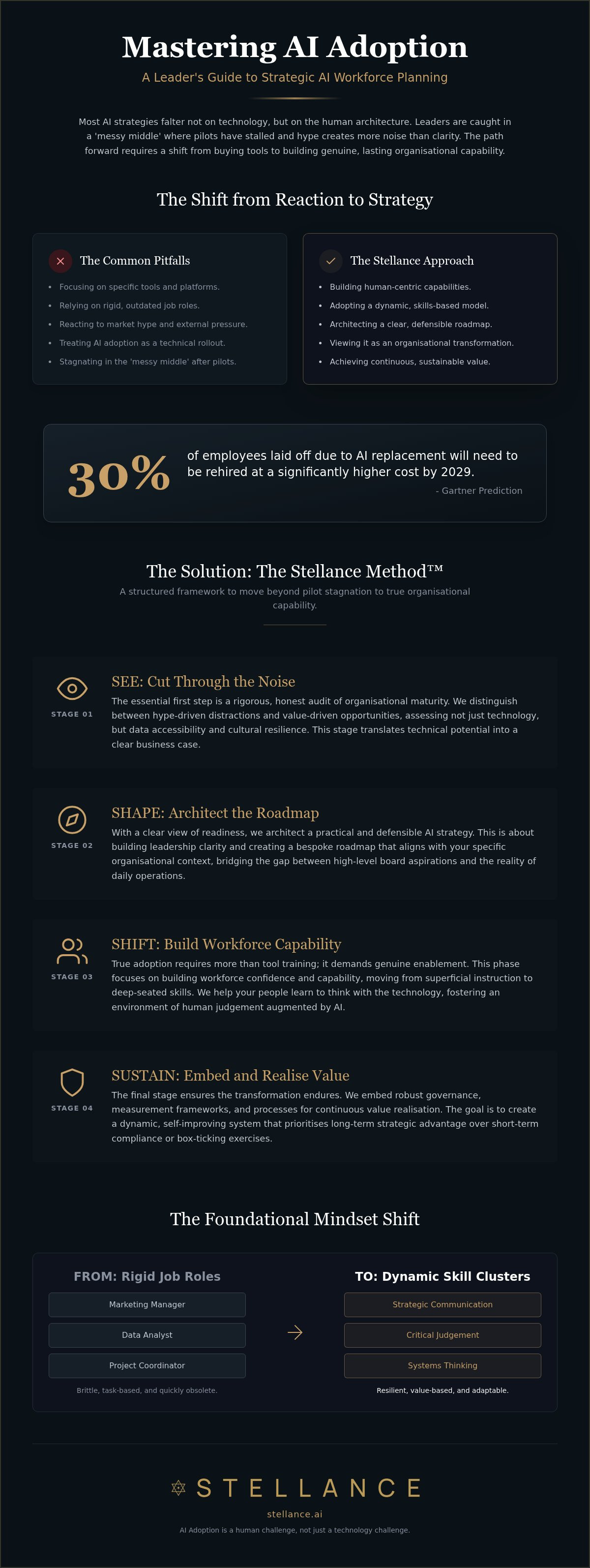
It's natural to feel overwhelmed by the frantic pace of emerging trends. Gartner predicts that by 2029, 30 per cent of employees laid off due to AI replacement will need to be rehired at a significantly higher cost. You need a clear, defensible roadmap that avoids these expensive reversals and builds measurable transformation. This reference provides that path. We'll explore how to master the transition from hype to genuine capability using a human-centric framework called The Stellance Method™, pioneered by Stellance AI - AI Strategy for Leaders. By following the sequenced stages of SEE, SHAPE, SHIFT, and SUSTAIN, you can stop reacting to the storm and start building a stable, value-driven future for your people.
Key Takeaways
- Learn to apply The Stellance Method™ to move beyond the messy middle of AI adoption. This structured framework ensures you transition from pilot stagnation to true organisational capability.
- Discover why strategic AI workforce planning must be treated as a human and organisational challenge rather than a mere technology rollout.
- Distinguish between superficial tool training and genuine capability building to ensure your workforce is enabled, not just instructed.
- Transition from rigid role-based structures to a dynamic skills-based approach. This allows your workforce to remain resilient whilst navigating the interplay between human judgement and automated agents.
- Establish sustainable governance that prioritises long-term value realisation over simple compliance or box-ticking exercises.
Beyond the Hype: Defining Strategic AI Workforce Planning in 2026
AI is not a plug and play upgrade for your existing headcount. In 2026, many organisations find themselves stuck in the "messy middle," where initial pilots have finished but the promised productivity gains remain elusive. This stagnation often occurs because leaders treat AI as a technical rollout rather than a fundamental shift in human architecture. True strategic AI workforce planning isn't about calculating the right number of seats to cut; it's about architecting an organisation where humans are enabled to do their best work alongside intelligent systems. It's a move from reacting to external pressure to making defensible, logic-driven decisions about your most valuable asset.
Whilst traditional strategic workforce planning often focuses on talent as financial capital, the approach advocated by Stellance AI - AI Strategy for Leaders prioritises capability over mere compliance. Checking a box for "AI training" doesn't create value. Building the internal muscle to adapt to constant technological shifts does. This is a journey from the noise of conflicting forecasts to the clarity of purposeful action, guided by the four stages of The Stellance Method™. It requires a steady hand and a commitment to honesty over easy promises.
The Shift from Roles to Capabilities
Job titles are becoming increasingly brittle. A "Marketing Manager" in 2024 does not perform the same tasks as one in 2026. We must move away from rigid titles and toward underlying skill clusters. By focusing on capability over jargon, leaders can identify high-value opportunities where AI actually moves the needle on delivery. Workforce capability is the intersection of human judgement and AI augmentation. This distinction is vital. It moves the conversation from what the tool does to what the human can now achieve. It's about enablement, not just instruction.
Why Traditional Planning Models Fail the AI Test
Standard corporate training programmes are often tool-obsessed. They teach people how to use a specific prompt or interface, but they fail to teach them how to think with the technology. This static approach cannot survive the current pace of evolution. AI doesn't wait for your annual planning cycle. It requires a dynamic architecture that prioritises clarity over noise in executive decision-making. If your roadmap is built on a specific software version rather than a long-term capability strategy, it's already obsolete. Stellance AI - AI Strategy for Leaders helps you bridge this gap through bespoke programmes, ensuring your strategy is built on 23 years of lived experience rather than recycled theory.
The SEE and SHAPE Phases: Assessing Readiness and Architecting the Roadmap
Scaling beyond the pilot phase is where most leaders lose their footing. It's the "messy middle" mentioned earlier, where initial enthusiasm meets the hard reality of legacy systems and human inertia. To navigate this transition safely, strategic AI workforce planning must begin with a cold, honest assessment of your current state. You can't build a resilient architecture on a foundation of unverified assumptions or recycled theory. It requires a steady hand to bridge the gap between high-level board aspirations and the granular reality of daily operations.
SEE: Cutting Through the Noise
The SEE phase is about distinguishing between hype-driven distractions and value-driven opportunities. It is an unglamorous but essential audit of organisational maturity. Stellance AI - AI Strategy for Leaders doesn't just ask if the technology works; we ask if your data is accessible and if your culture is resilient enough for wide-scale enablement. Using the rigorous assessment criteria within the Stellance Method™, we identify genuine workforce bottlenecks that software alone cannot fix. This stage is about translation. We turn technical potential into a business case that makes sense to a decision-maker who values stability over superficial experimentation.
SHAPE: Designing the AI Adoption Roadmap
Once readiness is established, you must SHAPE a practical, defensible strategy. This is not a static Gantt chart. It is a dynamic roadmap designed to balance immediate tactical wins with long-term structural resilience. A common failure point is treating AI as a siloed IT project. Instead, we use executive briefings to align senior leadership on a single, coherent vision that places human capability at the centre. As noted by NGA's AI and the Future of Work Initiative, the most effective workforce strategies are those that integrate public policy insights with private sector operational reality.
Stellance AI - AI Strategy for Leaders prioritises human-led change because 23 years of lived experience has taught us that software installations are easy, whilst organisational shifts are difficult. A roadmap that ignores the psychological impact of automation is a roadmap to workforce resistance. If your leadership team is struggling to find a unified path amongst the noise, a leadership advisory session can help anchor your strategy in logic rather than hype.
Analysing the Workforce: Humans, Agents, and the Skills-Based Future
Effective strategic AI workforce planning requires a fundamental shift in how we perceive the nature of work. Traditional planning is role-based; it treats job titles as fixed, indivisible units of labour. This model is far too rigid for an environment where technology evolves every few weeks. Instead, we must move toward task-based and skills-based planning. This isn't about being tool-obsessed. It's about understanding the granular components of every role to see where AI agents can assist and where human judgement must remain sovereign. Simply "botting" tasks without this clarity leads to a dangerous hollowing out of institutional knowledge. You lose the "why" behind the "how," leaving your organisation efficient but intellectually fragile.
The Role of Human Judgement in an AI-Enabled Workforce
AI cannot replace the Sage archetype. Leadership, complex decision-making, and ethical navigation require a level of nuance and lived experience that algorithms simply lack. In areas where empathy and ethics are non-negotiable, human presence is your primary value proposition. We must define these boundaries clearly to avoid operational drift. For a deeper look at building these internal muscles, see our AI Workforce Enablement: A Strategic Guide. True capability is found at the intersection of technological efficiency and human wisdom, not in the wholesale replacement of one by the other.
Mapping Tasks for AI Augmentation
We use a practical framework to categorise work into three distinct streams: Automate, Augment, or Abandon. Automate applies to repetitive, low-judgement tasks that drain human energy. Augment is where the most significant gains happen; it's where AI provides the data and humans provide the direction. Abandon refers to legacy processes that no longer serve the organisation in an AI-enabled world. This is a sober, unglamorous process. It avoids the trap of being motivational without substance. We must be candid about the difficulty of change whilst maintaining a steady hand on the shoulder of the workforce. Even the U.S. National AI Action Plan highlights the necessity of aligning innovation with workforce security and infrastructure. Strategic AI workforce planning isn't just about efficiency. It's about building a defensible future where your people feel enabled rather than replaced. It's about judgement over jargon. It's about results over theory.
The SHIFT Phase: Building Workforce Confidence and Capability
The SHIFT phase is where the architectural plans of the SHAPE stage meet the messy reality of human behaviour. It's the most delicate part of the journey. Many leaders mistake tool training for workforce enablement, assuming that a few workshops on prompt engineering will suffice. It won't. True capability building isn't about teaching someone to use a specific software; it's about helping them understand how to work alongside intelligent systems whilst retaining their unique human judgement. The human component of strategic AI workforce planning is often the most neglected, yet it's the only factor that determines whether a strategy lives or dies on the office floor.
Within the framework of strategic AI workforce planning, this phase is about replacing the quiet fear of obsolescence with a sense of practical optimism and purpose. We focus on building confidence and judgement amongst the entire workforce. It's a move away from the cold technical implementation of "digital workers" toward a supportive, people-centric advisory style. We don't want your people to feel replaced. We want them to feel enabled.
Enablement Over Training: A New Paradigm
One-day workshops are often where transformation goes to die. They offer a temporary spike in interest but fail to embed new habits into the daily rhythm of work. We advocate for a paradigm shift that prioritises long-term enablement over transactional training. This requires designing change programmes that recognise AI adoption as a psychological challenge first. It’s about building confidence through small, repeatable wins rather than overwhelming staff with complex technical jargon.
- Focus on "Progress over Perfection" to lower the barrier to entry for hesitant staff.
- Integrate AI use cases into existing workflows rather than creating entirely new, disconnected processes.
- Provide ongoing support that evolves as the technology matures and internal capability grows.
Building the AI-Ready Culture
Culture isn't changed by executive mandate; it’s shaped by the people your workforce trusts. Middle management must transition from being taskmasters to acting as "Guides" who support frontline adoption. This involves identifying and developing internal AI champions who lead by example rather than by mandate. These individuals act as the connective tissue between leadership strategy and operational execution. If you find your organisation stuck in the "messy middle," our Professional AI Strategy Services can help you architect a culture that values capability over mere compliance. Research from 2026 shows that 44 per cent of workers feel their employer lacks a clear policy on AI use. Closing this communication gap is the first step toward building a workforce that feels secure enough to innovate.
SUSTAIN: Embedding Governance and Continuous Value Realisation
The final stage of The Stellance Method™ is SUSTAIN. It is often the most difficult phase to execute correctly. Many organisations see an initial productivity spike from AI and assume the work is finished. It isn't. Without a structured approach to embedding governance and continuous value realisation, early gains often evaporate as legacy habits return. Strategic AI workforce planning must evolve from a project-based initiative into a permanent organisational capability. This is where we move beyond simple productivity metrics to focus on long-term, sustainable growth. It's about ensuring the transition from hype to capability is permanent.
Governance as an Enabler, Not a Barrier
Governance is frequently viewed as a series of restrictive red tapes. It shouldn't be. In a resilient workforce architecture, governance acts as a supportive framework that empowers employees to use AI with confidence. It is not about policing behaviour, but about providing the ethical boundaries and operational guardrails that allow innovation to flourish safely. The Sage perspective on risk is one of balance. We don't ignore the dangers of algorithmic bias or data privacy; we build the internal governance structures to mitigate them whilst keeping the organisation flexible. This ensures your workforce architecture remains ready for the next technological shift without requiring a total redesign. Governance, in this sense, is the bedrock of workforce stability.
Measuring What Matters in AI Transformation
Standard KPIs often fail to capture the true value of AI adoption. Measuring the number of prompts sent or hours saved is a shallow exercise that prioritises performance over organisational health. Instead, we focus on the "Return on Adoption." This involves developing metrics that reflect genuine human-AI synergy and workforce capability. You need to know how well your teams are integrating AI into complex decision-making, rather than just how fast they are producing drafts. Is institutional knowledge being preserved or hollowed out? Reporting on these results requires candour over comfort. It's better to face a difficult truth about a stalled initiative than to hide behind inflated productivity stats.
We position ourselves as a long-term partner for leaders navigating the messy middle of this transformation. We provide the steady hand and defensible logic needed to turn technical potential into measurable progress. If you're ready to move from confusion to a state of stable, value-driven adoption, we can help you architect the path forward. Our experience across 23 years of digital transformation has taught us that the finish line is just the beginning of value realisation.
Enquire about a bespoke AI Leadership Accelerator Programme
Architecting a Resilient Human-AI Future
The transition from AI experimentation to organisational capability is not a technical race. It's a human marathon. We've explored how cutting through the noise in the SEE phase and building leadership clarity in SHAPE provides a defensible foundation. True strategic AI workforce planning isn't about replacing roles; it's about enabling people through the SHIFT phase and embedding long-term governance in SUSTAIN. It's a move from reacting to external pressure to making logic-driven decisions that protect your institutional knowledge.
Our approach is built on 23 years of lived digital transformation experience. We don't rely on recycled theory or tool-specific hype. Instead, we use The Stellance Method™ to help you navigate the messy middle with a steady hand. It's about moving from confusion to a state of measurable, sustainable progress where human wisdom remains sovereign. You don't have to navigate this storm alone.
With the right architecture in place, your workforce can become more resilient, capable, and purposeful than ever before. The path from hype to value is clear. It's time to begin.
Frequently Asked Questions
What is the difference between workforce training and AI workforce enablement?
AI workforce enablement focuses on building the internal muscle to adapt to constant change, whereas training is often a transactional, one-day workshop about specific software. Enablement treats adoption as a human and organisational challenge first. It is about ensuring your staff have the confidence, judgement, and purpose to work alongside intelligent systems. We move away from tool-specific instructions toward developing long-term organisational capability, ensuring the workforce remains resilient even as specific tools evolve.
How does strategic AI workforce planning differ from traditional HR planning?
Traditional HR planning typically treats job titles as fixed, indivisible units of labour, but strategic AI workforce planning requires a more granular, task-based approach. We analyse the interplay between human judgement and AI agents at the skill level rather than the role level. This shift allows for a more dynamic architecture that can respond to technological shifts in real time. It prioritises capability over mere compliance, ensuring your workforce is designed for future growth.
What are the four stages of The Stellance Method™ for AI adoption?
The Stellance Method™ is a repeatable, four-stage framework designed to move organisations from noise to value realisation. It begins with SEE, where we assess real organisational readiness and cut through the hype. Next is SHAPE, which builds leadership clarity and a practical roadmap. The SHIFT phase focuses on building workforce confidence and capability through enablement. Finally, SUSTAIN embeds governance and measurement to ensure continuous value realisation and long-term sustainability for the entire organisation.
How do we identify which roles are most affected by AI without causing fear?
We identify affected roles by breaking them down into specific tasks using a framework of Automate, Augment, or Abandon. This objective analysis focuses on work clusters rather than personal job security, which helps reduce anxiety amongst the staff. By being candid about change and focusing on how AI augments human capability, you can replace fear with practical optimism. We prioritise human judgement in areas where empathy and ethics are non-negotiable.
Why is leadership clarity essential before starting an AI workforce SHIFT?
Leadership clarity acts as the anchor for any successful organisational transition. Without a unified vision at the top, the SHIFT phase often descends into confusion and workforce resistance. Leaders must first SHAPE a defensible strategy that balances short-term wins with long-term resilience. This clarity allows for the translation of high-level board aspirations into the granular reality of daily tasks. It ensures that every enablement initiative is driven by logic rather than external pressure.
Can strategic AI workforce planning help with the "messy middle" of scaling?
Yes, strategic AI workforce planning is specifically designed to navigate the "messy middle" where initial pilots have stalled. This stagnation usually occurs because the organisational architecture was not ready to carry the weight of wide-scale adoption. By applying a structured framework like The Stellance Method™, you can bridge the gap between experimentation and organisational capability. We help you move beyond the hype to build a clear, defensible roadmap that ensures transformation is measurable.
What metrics should we use to measure the success of an AI workforce strategy?
Success should be measured by the "Return on Adoption" rather than simple productivity metrics like hours saved. We look for indicators of human-AI synergy and the growth of internal organisational capability. Are your teams making better decisions? Is institutional knowledge being preserved whilst legacy processes are abandoned? These KPIs reflect the health of your human architecture and the effectiveness of your governance. It is about value realisation and long-term growth, not just checking boxes.
How do we balance human judgement with AI-driven automation in our workforce design?
We balance the two by architecting roles where human judgement remains sovereign in areas of ethics, empathy, and complex strategy. AI is used to automate repetitive, low-judgement tasks that drain human energy, whilst augmenting roles where data-driven insights can improve human delivery. This "Steady Hand" approach ensures that technology change is led by people. We treat AI as an enablement layer that supports, rather than replaces, the unique lived experience of your workforce.
Frequently Asked Questions
AI workforce enablement focuses on building the internal muscle to adapt to constant change, whereas training is often a transactional, one-day workshop about specific software. Enablement treats adoption as a human and organisational challenge first. It is about ensuring your staff have the confidence, judgement, and purpose to work alongside intelligent systems. We move away from tool-specific instructions toward developing long-term organisational capability, ensuring the workforce remains resilient even as specific tools evolve.
Traditional HR planning typically treats job titles as fixed, indivisible units of labour, but strategic AI workforce planning requires a more granular, task-based approach. We analyse the interplay between human judgement and AI agents at the skill level rather than the role level. This shift allows for a more dynamic architecture that can respond to technological shifts in real time. It prioritises capability over mere compliance, ensuring your workforce is designed for future growth.
The Stellance Method™ is a repeatable, four-stage framework designed to move organisations from noise to value realisation. It begins with SEE, where we assess real organisational readiness and cut through the hype. Next is SHAPE, which builds leadership clarity and a practical roadmap. The SHIFT phase focuses on building workforce confidence and capability through enablement. Finally, SUSTAIN embeds governance and measurement to ensure continuous value realisation and long-term sustainability for the entire organisation.
We identify affected roles by breaking them down into specific tasks using a framework of Automate, Augment, or Abandon. This objective analysis focuses on work clusters rather than personal job security, which helps reduce anxiety amongst the staff. By being candid about change and focusing on how AI augments human capability, you can replace fear with practical optimism. We prioritise human judgement in areas where empathy and ethics are non-negotiable.
Leadership clarity acts as the anchor for any successful organisational transition. Without a unified vision at the top, the SHIFT phase often descends into confusion and workforce resistance. Leaders must first SHAPE a defensible strategy that balances short-term wins with long-term resilience. This clarity allows for the translation of high-level board aspirations into the granular reality of daily tasks. It ensures that every enablement initiative is driven by logic rather than external pressure.
Yes, strategic AI workforce planning is specifically designed to navigate the "messy middle" where initial pilots have stalled. This stagnation usually occurs because the organisational architecture was not ready to carry the weight of wide-scale adoption. By applying a structured framework like The Stellance Method™, you can bridge the gap between experimentation and organisational capability. We help you move beyond the hype to build a clear, defensible roadmap that ensures transformation is measurable.
Success should be measured by the "Return on Adoption" rather than simple productivity metrics like hours saved. We look for indicators of human-AI synergy and the growth of internal organisational capability. Are your teams making better decisions? Is institutional knowledge being preserved whilst legacy processes are abandoned? These KPIs reflect the health of your human architecture and the effectiveness of your governance. It is about value realisation and long-term growth, not just checking boxes.
We balance the two by architecting roles where human judgement remains sovereign in areas of ethics, empathy, and complex strategy. AI is used to automate repetitive, low-judgement tasks that drain human energy, whilst augmenting roles where data-driven insights can improve human delivery. This "Steady Hand" approach ensures that technology change is led by people. We treat AI as an enablement layer that supports, rather than replaces, the unique lived experience of your workforce.
Next step
Let’s talk about where AI creates value in your organisation.
A short, practical conversation with no obligation.