AI Strategy Consultant vs Agency: Navigating the Path to Real Adoption
6 September 2026 · 16 min read


Recent data shows that 75% of executives admit their company's AI strategy is "more for show" than a practical guide for internal execution. It's a quiet crisis of confidence. You're likely stuck in the "messy middle," where pilots have stalled and the initial excitement has been replaced by the weight of organisational inertia. Choosing between an AI strategy consultant vs agency is not just a procurement decision; it's a choice between buying a tool and building a capability. One offers technical delivery, whilst the other provides the architectural logic for change.
We understand that the pressure to adopt AI often feels led by fear rather than purpose. This article clarifies how to find a partner that aligns with your culture and bridges the gap between software and human value. You'll gain a clear framework to build workforce capability rather than just paying for tool training. We'll explore a defensible logic for your 2026 investment by walking through the Stellance Method™: SEE, SHAPE, SHIFT, and SUSTAIN. It's time to move from frantic experimentation to a state of measurable, grounded progress.
Key Takeaways
- Learn the distinction between "The Architect" and "The Builder" to ensure your partnership aligns with your organisation's current stage of maturity.
- Understand why the choice of an AI strategy consultant vs agency determines whether you are merely buying tools or building genuine organisational capability.
- Identify the specific bottlenecks—whether leadership clarity or technical capacity—that are keeping your team stuck in the "messy middle" of AI adoption.
- Discover how to apply The Stellance Method™ to move beyond pilots and embed governance, measurement, and continuous value into your daily operations.
- Gain the practical questions required to vet potential partners based on lived transformation experience rather than recycled theoretical hype.
Navigating the Messy Middle: Why the AI Choice Matters Now
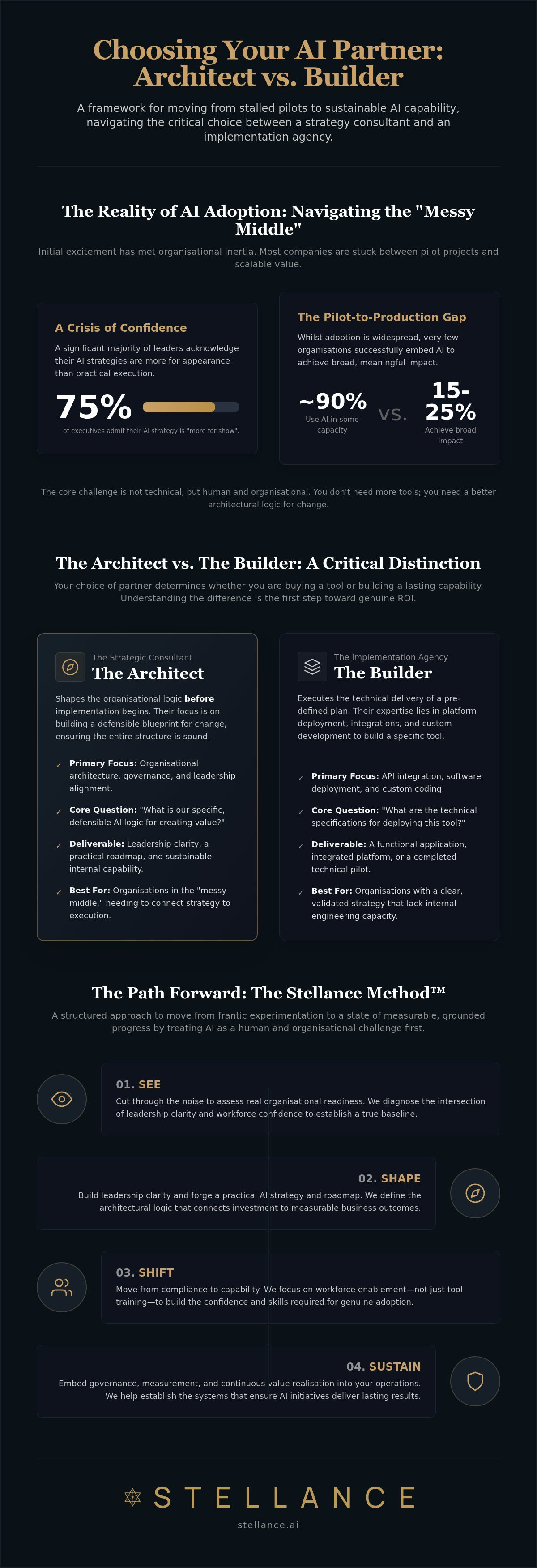
The experimental honeymoon is over. In 2026, we see a stark divide in the corporate landscape. Whilst nearly 90% of enterprises report using AI in some capacity, only about 15% to 25% have successfully moved beyond the pilot stage into production environments with broad impact. This is the "messy middle." It's a place where initial excitement meets the hard reality of organisational change. The choice between an AI strategy consultant vs agency becomes critical here. One builds the engine; the other helps you decide where to drive.
Most organisations feel underwhelmed by their results despite significant investment. They've spent heavily on software licences but haven't seen the promised ROI. This happens because they treat AI as a technical problem. It isn't. It's a human and organisational challenge first. If your architecture is brittle, adding smarter tools only creates faster failures. You don't need more tools; you need better logic.
The Problem with Hype-Driven Implementation
Fear is a poor strategist. Many leaders invest because they worry about falling behind, not because they have a clear purpose. This leads to fragmented strategy and budgets that vanish into tool training that no one actually uses. There's a fundamental difference between buying a platform and building a capability. Traditional IT consulting models often focus on the technical "what," but they miss the human "how" of adoption. Clarity and judgement are far more valuable than jargon-heavy forecasts. You don't need a generic prediction. You need a roadmap grounded in your specific reality.
Identifying Your Organisational Starting Point
Before you hire a partner, you must know where you stand. Is your leadership team aligned on the strategic opportunities? Or is there a quiet, unaddressed resistance? Most workforces are merely compliant, not ready for a shift. They follow the rules because they have to, not because they understand how the technology enables their specific role.
We address this through the SEE stage of The Stellance Method™. It's about cutting through the noise to assess real organisational readiness. We look at the intersection of leadership clarity and workforce confidence. If you want to move from confusion to progress, you can explore our bespoke engagement options. We don't start with software implementation. We start with the truth of your current capability and the architecture required to sustain growth.
The Architect vs The Builder: Defining Consultants and Agencies
Implementation is not adoption. Many leaders conflate the two. When evaluating an AI strategy consultant vs agency, you're deciding between a partner who designs the blueprint and a vendor who lays the bricks. One focuses on "shaping" the organisational logic, whilst the other focuses on "executing" technical pilots. This distinction is critical for ROI. If you build a sophisticated tool on a foundation of leadership misalignment, the investment will inevitably crumble. You don't need faster implementation; you need clearer direction.
The Strategic Consultant: Shaping the Future
Think of the consultant as the Architect. Their work happens before the first line of code is written. They prioritise organisational architecture, governance, and executive alignment over individual software features. This involves deep-dive briefings and keynotes that move leadership from "what is AI?" to "what is our specific AI logic?". Research on AI adoption across the federal government illustrates that technical hurdles are often secondary to the lack of clear strategic direction. Bespoke 1-2-1 programmes, such as the AI Leadership Accelerator, are designed to build this sustainable internal capability. It's about empowering leaders to make defensible decisions, not just buying software.
The Implementation Agency: Building the Engine
The agency is the Builder. They're technical specialists who focus on API integrations, platform deployment, and custom development. An agency is the right choice when you already have a clear, validated roadmap but lack the internal engineering capacity to deliver it. However, hiring a builder before you have a finalised plan is a high-risk gamble. Agencies are often "tool-obsessed" by design; their business model relies on technical delivery and billable hours for development. Without an Adoption Strategist to bridge the gap, you may end up with a high-performance engine that doesn't fit your car's chassis.
We act as the connective tissue between these two worlds. By using The Stellance Method™, we ensure the SHAPE stage provides the clarity required for any technical execution to actually succeed. We don't just build; we enable your team to lead. If you're unsure whether you need a blueprint or a bulldozer, it might be time to discuss your organisational readiness.
Consultant vs Agency: A Practical Comparison Framework
Identifying the right partner requires an honest appraisal of your current organisational deficit. Is your primary bottleneck a lack of software or a lack of internal readiness? Many "AI-first" startups founded in the last 24 months offer high-volume, templated delivery models that focus on technical speed. Whilst this looks efficient on a spreadsheet, it often ignores the cultural friction that inevitably stalls adoption. In contrast, a bespoke advisory approach draws on 23 years of lived digital transformation experience to address the architecture of the business itself. Choosing an AI strategy consultant vs agency determines whether you are merely patching a process or evolving a culture.
Capability over Compliance
Training is not enablement. Most organisations settle for compliance, where employees attend a mandatory workshop and then revert to old habits within weeks. This is a failure of "tool training" that treats people as passive recipients of software. True capability means a workforce that understands the purpose behind the technology. Within The Stellance Method™, we focus heavily on the SHIFT stage to build real confidence. We move the workforce from passive acceptance to active participation, ensuring that AI becomes an extension of human judgement. We don't just teach people how to use a tool; we enable them to lead with it.
Lived Experience vs Recycled Theory
The market is currently saturated with recycled theory and jargon-heavy forecasts. A battle-tested strategist offers candour over comfort. Having navigated two decades of digital shifts, we know that the biggest risks are rarely technical; they are organisational and psychological. A "tech start-up" agency might be obsessed with the latest shiny tool, but a seasoned guide prioritises stability, structure, and long-term governance. Success should be measured by organisational transformation, not just technical deployment. It's the difference between installing a system and ensuring that system actually delivers value in the real world of budgets and delivery.
Ultimately, the choice comes down to the depth of the partnership you require. If you need developers to execute a pre-defined plan, an agency is a logical choice. If you need to solve the "messy middle" and build a resilient organisation, you need a strategist who stands alongside you. You can explore the bespoke advisory and strategy options from Stellance AI - AI Strategy for Leaders to see how we bridge these gaps through practical, human-led transition. This isn't about chasing a trend. It's about creating a state of measurable progress that lasts.
How to Choose the Right Partner for Your AI Roadmap
Selection is a diagnostic act. You're not just buying a service; you're choosing the lens through which your organisation will view its future. When weighing an AI strategy consultant vs agency, the first question is not about the partner's technical stack, but about your own internal friction. Is your progress stalled by a lack of code, or by a lack of clarity? A vendor will sell you a solution to a problem they've already solved elsewhere. A Sage or Guide will help you solve the problem unique to your culture.
Signs You Need a Strategic Consultant
Choosing an AI strategy consultant vs agency is the right move if your leadership team is divided on where AI should actually be applied. You likely have several pilots running in silos, but no cohesive organisational strategy to tie them to business value. This is the hallmark of the "messy middle." You should seek a consultant if your goal is to build internal capability rather than outsource your intelligence. You need a partner who uses a repeatable framework, like the SEE, SHAPE, SHIFT, and SUSTAIN stages of The Stellance Method™, to ensure organisational readiness before any significant technical investment.
Signs You Need an Implementation Agency
An agency is the correct choice when the "human" work is already done. You have a detailed, board-approved roadmap and simply need extra hands for technical execution. Your leadership is aligned, and the workforce is already prepared for the transition. In this scenario, you are looking for niche technical skills, custom development, and API integrations. You don't need a strategy; you need a delivery engine. If your change management is already underway and your only bottleneck is technical capacity, the "Builder" model of an agency is your most efficient path.
To reveal true expertise during your selection process, look for practice over theory. Ask potential partners how many digital transformations they've lived through over the last two decades. Ask how exactly they measure workforce confidence, not just tool usage. If the answer is tool-obsessed rather than people-centric, they are a vendor, not a guide. Practical results require a partner who prioritises your long-term stability over a quick implementation.
The Stellance Method™: Shifting from Implementation to Adoption
Logic is the anchor for any successful transformation. Most organisations fail because they rush to technical implementation before they've established strategic clarity. The choice of an AI strategy consultant vs agency ultimately dictates whether you are following a sequenced roadmap or merely reacting to market pressure. We replace fear with purpose through a human-first transition that treats technology as a secondary concern. This is about order, not just output.
The Stellance Method™ provides a structured path through the chaos of the "messy middle":
- SEE: We cut through the noise to assess your real organisational readiness; we identify the quiet resistances that stall progress.
- SHAPE: We build leadership clarity and a practical strategy; this is where we define the architectural logic of your AI roadmap.
- SHIFT: We build workforce confidence and capability through enablement; this is not just tool training, but a shift in operational culture.
- SUSTAIN: We embed governance and measurement; value realisation must be continuous, not a one-off event.
Bespoke Advisory for the Modern Executive
Ad-hoc consulting often leaves leaders with a pile of reports but no clear path forward. Our strategic AI advisory services move beyond theoretical forecasts to provide a structured, signature framework. For the decision-maker, our 1-2-1 bespoke programmes offer a sense of calm amidst the storm. It's a supportive, people-centric style that prioritises honesty over easy promises. You don't need a distant vendor; you need a partner who understands the visceral reality of executive delivery and the difficulty of the work involved.
Building Sustainable Capability
AI adoption must eventually become part of your organisational DNA. If it remains a separate "tech project," it will fail. This is why the SUSTAIN stage is critical. Governance and measurement cannot be afterthoughts; they are the structures that allow value to scale safely. We ensure that your workforce doesn't just comply with new systems but adopts them with genuine purpose. Technology is the tool, but people are the strategy. True progress is measured by how effectively your team uses their human judgement alongside machine intelligence to drive results.
Moving Beyond the Messy Middle to Sustainable Value
Real adoption isn't found in a software licence; it's forged in the clarity of your leadership and the confidence of your workforce. Navigating the choice between an AI strategy consultant vs agency requires you to identify whether you need a blueprint for change or a delivery engine for code. We've explored how the Architect model prioritises organisational logic, whilst the Builder model focuses on technical execution. Success in 2026 depends on moving beyond the "messy middle" by treating AI as a human challenge first.
With 23 years of lived digital transformation experience, we use The Stellance Method™ to ensure your investment builds genuine organisational capability. We move you through the SEE, SHAPE, SHIFT, and SUSTAIN stages to replace fear with purpose. This structured path ensures that technology remains the tool, whilst your people remain the strategy. You don't have to navigate this transition alone.
There is a state of measurable, grounded progress waiting for organisations that prioritise enablement over mere implementation. It's time to build a defensible logic for your investment and lead your team with quiet confidence.
Frequently Asked Questions
What is the primary difference between an AI strategy consultant and an agency?
The primary difference between an AI strategy consultant vs agency lies in the distinction between "shaping" and "building." A consultant acts as an architect, focusing on leadership clarity, organisational architecture, and long-term capability building. Conversely, an agency acts as a builder, prioritising technical implementation, API integrations, and tool deployment. Whilst an agency delivers a specific technical output, a consultant ensures your organisation has the strategic logic and human readiness required to actually use it effectively.
When should a CEO prioritise a consultant over an implementation agency?
A CEO should prioritise a consultant when the organisation is stuck in the "messy middle" or when leadership teams are misaligned on AI's purpose. If you have multiple pilots running in silos without a cohesive roadmap, you need a strategist to build internal capability. Stellance AI - AI Strategy for Leaders is essential when the bottleneck isn't a lack of developers, but a lack of clarity. We help you build a defensible logic for investment before you commit to expensive technical delivery.
Does Stellance AI - AI Strategy for Leaders provide specific tool training for platforms like ChatGPT or Claude?
Stellance AI - AI Strategy for Leaders does not provide specific tool training for individual platforms like ChatGPT or Claude. Our focus is on AI workforce enablement and capability building rather than platform selling or tool-based instruction. We treat adoption as a human and organisational challenge first. We enable your team to lead with confidence and judgement, ensuring they understand the "why" behind the technology, rather than just the "how" of a specific software interface.
How does a bespoke AI leadership programme differ from generic corporate training?
A bespoke programme from Stellance AI - AI Strategy for Leaders is a 1-2-1 engagement tailored to the specific strategic needs of an executive. Unlike generic corporate training, which often focuses on high-volume compliance and tool usage, bespoke advisory addresses organisational architecture and governance. It provides a "calm amidst the storm" for decision-makers, offering practical, human-led transition logic that generic, one-size-fits-all workshops simply cannot provide.
Can an AI consultant help with the cultural shift required for AI adoption?
Yes, an AI consultant is specifically positioned to help with the cultural shift required for real adoption. Because AI adoption is primarily a human challenge, a strategist addresses the fear and inertia that often stall technology initiatives. By using the framework provided by Stellance AI - AI Strategy for Leaders, they move the workforce from passive compliance to active enablement. This ensures that the shift is led by people and purpose, rather than by external pressure or tool-obsessed directives.
What are the four stages of The Stellance Method™ for AI adoption?
The Stellance Method™, utilised by Stellance AI - AI Strategy for Leaders, consists of four specific, sequenced stages designed to move organisations from hype to capability. These stages are SEE (assessing real organisational readiness), SHAPE (building leadership clarity and a practical roadmap), SHIFT (building workforce confidence through enablement), and SUSTAIN (embedding governance and measurement). This framework ensures that AI adoption becomes a permanent part of the organisational DNA rather than a temporary experiment.
How long does a typical AI strategy engagement take to show results?
Results are measured through the achievement of specific, sequenced milestones rather than a generic timeline. By following the SEE and SHAPE stages of the framework at Stellance AI - AI Strategy for Leaders, organisations often gain leadership clarity and a defensible roadmap within the initial weeks. The goal is to create earned momentum, where each stage builds naturally upon the last. This methodical approach ensures that progress is measurable and grounded in the real world of budgets and delivery.
Why is "lived experience" important when choosing an AI strategist?
Lived experience is vital because it provides a calm, credible voice that has navigated multiple digital shifts over two decades. With 23 years of digital transformation experience, the team at Stellance AI - AI Strategy for Leaders offers candour over comfort and judgement over jargon. We aren't swayed by the latest shiny tool or passing trend. This "battle-tested" perspective allows us to identify hidden risks and organisational frictions that a more recent, "AI-first" startup might overlook.
Frequently Asked Questions
The primary difference between an AI strategy consultant vs agency lies in the distinction between "shaping" and "building." A consultant acts as an architect, focusing on leadership clarity, organisational architecture, and long-term capability building. Conversely, an agency acts as a builder, prioritising technical implementation, API integrations, and tool deployment. Whilst an agency delivers a specific technical output, a consultant ensures your organisation has the strategic logic and human readiness required to actually use it effectively.
A CEO should prioritise a consultant when the organisation is stuck in the "messy middle" or when leadership teams are misaligned on AI's purpose. If you have multiple pilots running in silos without a cohesive roadmap, you need a strategist to build internal capability. Stellance AI - AI Strategy for Leaders is essential when the bottleneck isn't a lack of developers, but a lack of clarity. We help you build a defensible logic for investment before you commit to expensive technical delivery.
Stellance AI - AI Strategy for Leaders does not provide specific tool training for individual platforms like ChatGPT or Claude. Our focus is on AI workforce enablement and capability building rather than platform selling or tool-based instruction. We treat adoption as a human and organisational challenge first. We enable your team to lead with confidence and judgement, ensuring they understand the "why" behind the technology, rather than just the "how" of a specific software interface.
A bespoke programme from Stellance AI - AI Strategy for Leaders is a 1-2-1 engagement tailored to the specific strategic needs of an executive. Unlike generic corporate training, which often focuses on high-volume compliance and tool usage, bespoke advisory addresses organisational architecture and governance. It provides a "calm amidst the storm" for decision-makers, offering practical, human-led transition logic that generic, one-size-fits-all workshops simply cannot provide.
Yes, an AI consultant is specifically positioned to help with the cultural shift required for real adoption. Because AI adoption is primarily a human challenge, a strategist addresses the fear and inertia that often stall technology initiatives. By using the framework provided by Stellance AI - AI Strategy for Leaders, they move the workforce from passive compliance to active enablement. This ensures that the shift is led by people and purpose, rather than by external pressure or tool-obsessed directives.
The Stellance Method™, utilised by Stellance AI - AI Strategy for Leaders, consists of four specific, sequenced stages designed to move organisations from hype to capability. These stages are SEE (assessing real organisational readiness), SHAPE (building leadership clarity and a practical roadmap), SHIFT (building workforce confidence through enablement), and SUSTAIN (embedding governance and measurement). This framework ensures that AI adoption becomes a permanent part of the organisational DNA rather than a temporary experiment.
Results are measured through the achievement of specific, sequenced milestones rather than a generic timeline. By following the SEE and SHAPE stages of the framework at Stellance AI - AI Strategy for Leaders, organisations often gain leadership clarity and a defensible roadmap within the initial weeks. The goal is to create earned momentum, where each stage builds naturally upon the last. This methodical approach ensures that progress is measurable and grounded in the real world of budgets and delivery.
Lived experience is vital because it provides a calm, credible voice that has navigated multiple digital shifts over two decades. With 23 years of digital transformation experience, the team at Stellance AI - AI Strategy for Leaders offers candour over comfort and judgement over jargon. We aren't swayed by the latest shiny tool or passing trend. This "battle-tested" perspective allows us to identify hidden risks and organisational frictions that a more recent, "AI-first" startup might overlook.
Next step
Let’s talk about where AI creates value in your organisation.
A short, practical conversation with no obligation.