AI Risk Management: A 2026 Checklist for Executives
7 September 2026 · 17 min read


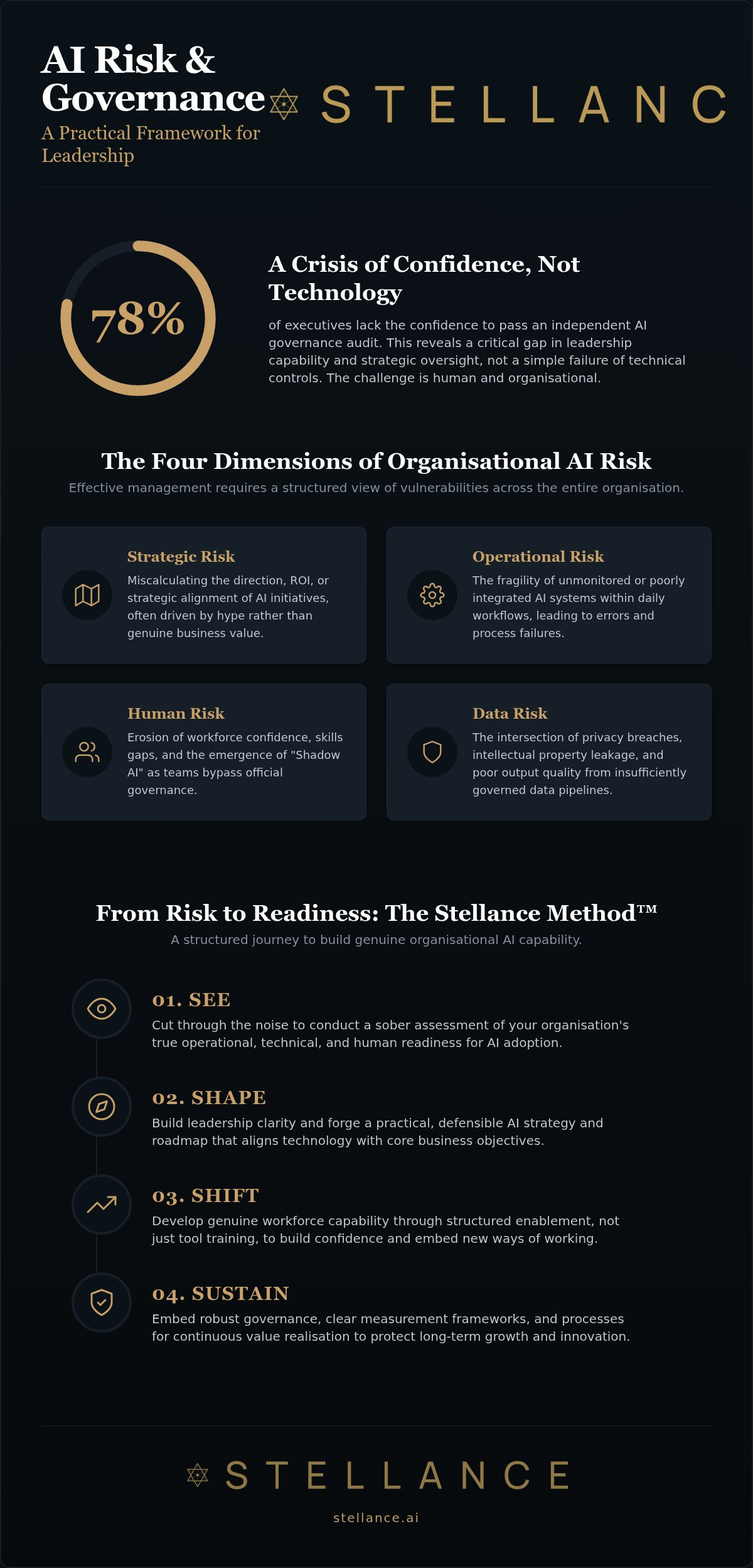
Seventy-eight per cent of executives lack the confidence to pass an independent AI governance audit within ninety days. This isn't a failure of technology, but a gap in AI risk management for executives who find themselves caught between the pressure to innovate and the need to protect the organisation. It’s a sobering reality in a year where the EU AI Act has moved from theory to enforceable practice.
You're likely navigating the "messy middle" of adoption. It's a place where pilots are abundant, yet a clear, defensible framework for oversight remains elusive. The noise of technical hype is deafening, whilst the reality of "Shadow AI" creates quiet, systemic vulnerabilities. We understand the fear of making irreversible strategic errors when leadership and technical teams feel disconnected.
This article moves beyond the technical noise to provide a pragmatic 2026 checklist for building a human-centric strategy. We'll show you how to move from pilot to scale with clarity and confidence. By applying the signature framework of Stellance AI - AI Strategy for Leaders, The Stellance Method™, you can replace reactive firefighting with a structured roadmap. This is not about tool training, but about building genuine organisational capability.
Key Takeaways
- Reframe AI risk as a leadership capability rather than a technical bug. Learn why strategic alignment must take precedence over simple coding errors.
- Establish a clear, defensible framework for AI risk management for executives to bridge the gap between isolated pilots and enterprise-wide scaling.
- Discover why assessing real organisational readiness through the SEE stage is more vital for safety than simply purchasing the latest tools.
- Build workforce confidence through the SHIFT stage of The Stellance Method™ so teams can manage risks in daily workflows. Capability beats tool training.
- Transition from static compliance to continuous value realisation. Embed governance and measurement into the SUSTAIN stage to protect long-term growth.
Beyond the Noise: Why AI Risk is a Leadership Challenge, Not a Technical One
AI risk is not a technical failure. It is a strategic misalignment. Many leaders treat AI as a simple software update, something to be "handled" by the IT department or a compliance officer. This is a mistake. True AI risk management for executives requires a fundamental shift in posture. It demands a "Sage" approach: a posture of quiet confidence that prioritises long-term architecture over short-term experimentation. It requires a steady hand on the shoulder of the organisation, ensuring that technology serves the strategy rather than dictating it.
When you outsource risk to technical teams alone, you lose the bridge between complex systems and human output. Engineers can secure a database or patch a vulnerability. They cannot, however, ensure that an autonomous AI agent aligns with your brand’s ethical standards or operational readiness. The "messy middle" of 2026 adoption is defined by this gap. It is the space where pilots have finished, but scaling is stalled because leadership hasn't yet defined a defensible logic for oversight. The vulnerability isn't in the code; it’s in the lack of strategic clarity.
The High Cost of Hype-Driven Decision Making
Fear of missing out (FOMO) is a primary risk factor for modern boards. It drives reactive spending and "tool-obsessed" pilots that lack a clear return on investment. Whilst some industry discussions focus on the theoretical existential risk from artificial general intelligence, the immediate danger for most organisations is more visceral. It is the erosion of organisational trust and the waste of capital on misaligned initiatives. Leadership clarity is the only antidote. It requires moving away from the noise of "what is possible" to focus on the sober reality of what is actually valuable for the business.
Capability vs Compliance: A New Framework for 2026
Static compliance lists are insufficient for the non-deterministic nature of generative AI. You cannot "set and forget" governance when a system’s behaviour can shift with a new prompt or a model update. Instead, you must build organisational "muscle memory." This is the core of The Stellance Method™ at Stellance AI - AI Strategy for Leaders. By using the SEE stage to assess real readiness and the SHAPE stage to build a practical strategy, you move beyond ticking boxes. It is about workforce enablement, not just tool training. It is about building the confidence within your teams to recognise risks before they become operational failures. For those navigating this transition, our Leadership Advisory & AI Strategy services help bridge the gap between technical potential and strategic delivery.
The Four Dimensions of AI Risk in the Modern Organisation
AI risk is not a monolith. It is a multi-dimensional challenge that requires a structured, sober response. Effective AI risk management for executives involves identifying vulnerabilities across four critical areas: strategy, operations, humans, and data. Each dimension requires a different level of oversight, yet they are all interconnected by the same need for leadership clarity and a defensible logic for progress.
Strategic risk involves miscalculating the direction or ROI of AI initiatives. Operational risk focuses on the fragility of unmonitored systems in daily workflows. Data risk covers the intersection of privacy, intellectual property, and output quality. Finally, human risk addresses the potential erosion of workforce confidence. Managing these factors is not about achieving perfect safety. It is about building the capability to navigate uncertainty with a steady hand.
Strategic Risk and the "SEE" Stage of Adoption
Many organisations suffer from a significant gap between executive vision and operational reality. Leaders often find themselves seduced by futurism for its own sake, ignoring whether an initiative solves a genuine organisational problem. At Stellance AI - AI Strategy for Leaders, we use the SEE stage of The Stellance Method™ to dismantle these illusions. It is a methodical process of assessing real organisational readiness. It ensures that strategy is grounded in current capability rather than speculative potential. If you don't SEE the landscape clearly, your roadmap is built on sand.
Operational risk manifests as the fragility of non-deterministic systems. Unlike traditional software, AI can drift or fail in ways that are not immediately obvious. Whilst technical frameworks like the NIST AI Risk Management Framework provide a foundational structure for security, they must be translated into executive-level oversight to be effective. This translation is where many leadership teams struggle, often leaving a gap between technical security and strategic governance.
The Human Element: Enabling the Workforce to Manage Risk
The most significant risk is often the erosion of workforce confidence. When employees feel overwhelmed by AI hype, they don't innovate; they retreat. True risk mitigation is found in workforce enablement, not just tool training. It is about building the capability to use AI safely and effectively. This human-centric approach transforms employees from passive users into active guardians of organisational standards. It addresses the psychological impact of disruption by providing a clear path forward.
Building this level of resilience requires more than a software licence. It demands a partner with lived experience. Our Leadership Advisory & AI Strategy services provide the steady hand needed to navigate these complexities. If you are ready to move from pilot to scale safely, get in touch with our team to discuss your specific roadmap and how we can support your journey.
Navigating the "Messy Middle": Why Traditional Risk Frameworks Fall Short
Traditional Enterprise Risk Management (ERM) is built for a deterministic world. In standard software, if you provide input X, you receive output Y. AI does not operate on these rules. It is non-deterministic, meaning its behaviours can shift even when the inputs remain the same. This inherent unpredictability is why "set and forget" governance is not just insufficient; it is dangerous. For effective AI risk management for executives, the focus must shift from static checklists to dynamic, lived oversight.
Most organisations currently reside in the "messy middle" of adoption. You have moved past the initial excitement of isolated pilots, yet enterprise-wide scaling feels fraught with invisible hazards. In this phase, rigid compliance often acts as a handbrake rather than a safety feature. We encourage a posture of progress over perfection. This doesn't mean lowering standards. It means building a framework that expects uncertainty and manages it through radical transparency. Executive briefings must prioritise candour over comfort. If a system is only eighty per cent reliable in certain contexts, leadership needs to know that reality before the system hits the front line.
The Trap of the "Technology Vendor" Perspective
Technology vendors are incentivised to accelerate sales, which often leads them to downplay the "black box" risks of their proprietary platforms. They sell the promise of efficiency whilst obscuring the complexity of implementation. A pragmatic mentor approach, however, maintains independence. You must be able to identify where a vendor’s architecture might clash with your internal governance or data privacy standards. Whilst the NIST AI Risk Management Framework provides a rigorous technical baseline, it cannot replace the strategic judgement required to manage proprietary tool sprawl within your specific culture.
Building Leadership Clarity Through the "SHAPE" Stage
Leadership alignment is the only way to bridge the gap between technical potential and operational stability. This is the core of the SHAPE stage within The Stellance Method™. During this phase, we work with boards to define a practical strategy that accounts for uncertainty. It involves setting a clear risk appetite and identifying exactly which organisational problems AI is intended to solve. By building a roadmap that balances ambition with reality, you ensure that AI risk management for executives becomes a tool for enablement rather than a barrier to growth. This structured approach provides the defensible logic needed to move from pilot to scale with genuine confidence.
The Executive AI Risk Checklist: A Practical Framework for Decision-Makers
Effective AI risk management for executives isn't found in a software dashboard. It lives in the quality of the questions asked at the board level. Many organisations are tool-rich but strategy-poor. They have implemented platforms without defining the accountability structures required when those platforms produce unexpected results. This checklist provides a steady hand, moving you from reactive firefighting to a posture of defensible logic.
- Strategy Alignment: Does this initiative solve a specific organisational problem or is it a response to external pressure?
- Capability Assessment: Do we have the internal skills to manage the output, or just the budget to buy the licence?
- Governance Structure: Is there a clear line of accountability for non-deterministic outcomes?
- Human Impact: Have we addressed the psychological shift required for teams to work alongside autonomous agents?
- Measurement: Are we tracking risk mitigation with the same rigour as value realisation?
Strategic Readiness Checklist
Success begins by verifying the "why" before the "how". Strategy is not about the technology; it's about the business outcome. You must ensure the board is briefed on realistic AI behaviours, not just the marketing promises of vendors. This requires using the SEE stage of The Stellance Method™ to cut through the noise and assess real readiness. If the leadership team isn't aligned on the risk appetite, the project is vulnerable before the first line of code is even considered.
Operational and Capability Checklist
There is a fundamental difference between being trained on a tool and being enabled to use it. Training is a one-time event; enablement is a continuous build of organisational muscle memory. As you move through the SHIFT stage, you must assess if your workforce has the confidence to spot model drift or ethical lapses. Sustainability also depends on your architecture. A fragile, ad-hoc integration will eventually break under the weight of scaling. You can Explore our AI Adoption Roadmap services to see how we bridge these gaps between technical implementation and human capability.
Governance must be embedded, not bolted on. This is the focus of the SUSTAIN stage. It ensures that measurement isn't a post-mortem exercise but a real-time safeguard for value. When you treat AI adoption as a human challenge first, risk management becomes a natural byproduct of your culture rather than a burden on your speed.
From Compliance to Capability: Embedding The Stellance Method™
Compliance is a floor, not a ceiling. Whilst regulatory adherence is necessary, it is insufficient for the dynamic nature of 2026 AI systems. True AI risk management for executives requires a shift from a "compliance-first" to a "judgement-first" culture. In this environment, your workforce acts as the primary safeguard. They are the ones who detect subtle model drift or data quality issues before they escalate into operational failures.
Building this capability is the focus of the SHIFT stage. It moves beyond tool training to foster genuine confidence. When employees are merely trained, they follow instructions. When they are enabled, they exercise judgement. This distinction is critical for safety. It ensures that your teams feel supported enough to flag anomalies rather than hiding them out of fear or confusion. Enablement transforms risk management from a centralised bottleneck into a distributed organisational strength.
Governance must also evolve from a periodic audit to a continuous cycle. This is the role of the SUSTAIN stage. It embeds measurement and value realisation into the daily rhythm of the business. By treating governance as a living architecture, you protect the organisation’s long-term growth whilst maintaining the flexibility to adapt as technology shifts. It is the steady hand that ensures your AI initiatives remain aligned with your strategic intent over time.
The Stellance Method™: A Repeatable Path to Safety
Navigating the "messy middle" requires more than academic theory. It demands a partner with lived experience. The Stellance Method™ is built on 23 years of digital transformation expertise, providing a structured progression through SEE, SHAPE, SHIFT, and SUSTAIN. We help you cut through the noise to assess real readiness, build leadership clarity, enable your workforce, and embed lasting value. This isn't about chasing the next trend. It is about creating a defensible logic for every decision you make in a chaotic market.
Next Steps for the Perceptive Leader
The path forward begins with identifying your first "messy middle" challenge. Is it a lack of board-level clarity? Is it unmonitored "Shadow AI" amongst your teams? A perceptive leader knows that progress requires a constructively challenging partner. You need someone who stands alongside you, offering a steady hand whilst pushing for practical, measurable results. This is not a journey to be taken in isolation or outsourced to a technical vendor with a narrow perspective.
If you are ready to move from isolated pilots to a scaled, secure architecture, consider a bespoke path. You can Learn more about the AI Leadership Accelerator to see how we help executives build the strategic capability needed for long-term success. Bespoke mentorship ensures that your framework is tailored to your specific organisational psychology and business goals, providing the confidence to lead through the next decade of change.
From Uncertainty to Defensible Logic
AI risk isn't a technical bug to be fixed. It's a leadership capability to be built. Moving beyond the noise of tool-obsessed pilots requires a shift toward sober, human-centric oversight. By prioritising organisational readiness and workforce enablement, you transform systemic vulnerabilities into a source of strategic strength. This is the essence of effective AI risk management for executives in 2026.
Success in the "messy middle" depends on a pragmatic framework that values lived experience over academic theory. The Stellance Method™ provides this structure, drawing on 23 years of digital transformation expertise to bridge the gap between technical potential and operational stability. It's about moving from a posture of reaction to one of quiet, defensible confidence. You don't need to chase every trend to stay ahead; you simply need a steady hand on the architecture of your organisation.
The transition from pilot to scale is difficult, but with the right strategy, it's entirely manageable. Focus on your people, refine your governance, and lead with clarity.
Frequently Asked Questions
What is the biggest AI risk for executives in 2026?
The primary risk is strategic misalignment, specifically the gap between executive vision and unmonitored employee use of unsanctioned tools. Whilst many focus on technical failures, the real danger is "Shadow AI" creating systemic vulnerabilities without leadership oversight. Effective AI risk management for executives involves moving beyond tool-obsession to address the human and organisational challenges that arise when technology outpaces governance. It requires a sober assessment of real readiness.
How does The Stellance Method™ differ from standard AI consulting?
Standard consulting often focuses on technical implementation or platform-specific training. The Stellance Method™ is different because it treats adoption as a human challenge first. It utilises a four-stage framework: SEE, SHAPE, SHIFT, and SUSTAIN. This approach draws on 23 years of lived digital transformation experience to build long-term organisational capability rather than providing a one-off technical fix or a generic compliance checklist. It prioritises clarity over noise and judgement over jargon.
Can traditional risk management frameworks work for generative AI?
Traditional frameworks usually assume deterministic outcomes where inputs lead to predictable results. Generative AI is non-deterministic, meaning its behaviours can shift unexpectedly. "Set and forget" governance fails in this environment. You need a dynamic approach that emphasises continuous oversight and workforce judgement. It’s about building a judgement-first culture where teams are enabled to spot drift and anomalies in real-time rather than relying on static audits. Capability always beats simple compliance.
Why is workforce enablement considered a risk management strategy?
Workforce enablement is the ultimate risk mitigation tool because people are the primary guardians of your organisational standards. When teams are merely trained on a tool, they follow instructions. When they are enabled through the SHIFT stage of The Stellance Method™, they develop the confidence to exercise judgement. This capability allows them to identify ethical lapses or data quality issues before they become operational failures. It addresses the human side of the technology challenge.
What should be included in an AI executive briefing regarding risk?
An effective briefing must prioritise candour over comfort. It should include a clear assessment of strategic alignment, operational fragility, and the psychological impact on the workforce. Rather than focusing on technical specs, the briefing should address whether the AI initiative solves a genuine organisational problem and if the business has the capability to manage the output safely. It must provide a defensible logic for the roadmap ahead, ensuring the board understands realistic outcomes.
How do we move from AI pilots to scalable, safe adoption?
Moving from pilot to scale requires transitioning from ad-hoc experimentation to a structured architecture. This involves the SHAPE stage to build a practical roadmap and the SUSTAIN stage to embed continuous governance. Scalable adoption isn't about buying more licences; it's about building the organisational muscle memory to manage AI risk management for executives. You must ensure that your governance and measurement systems grow alongside your technical implementation to realise continuous value.
What is the "messy middle" of AI adoption?
The "messy middle" describes the phase where an organisation has moved past initial pilots but hasn't yet achieved enterprise-wide scaling. Leaders in this stage often feel overwhelmed by technical hype whilst remaining under-whelmed by actual business results. It’s a period of high vulnerability where "Shadow AI" often flourishes because the organisation lacks the leadership clarity and workforce capability needed to move forward. It represents the gap between technical potential and operational reality.
How can leaders balance AI innovation with operational stability?
Balancing innovation with stability requires a posture of progress over perfection rather than rigid, prohibitive compliance. Leaders should use the SEE stage to assess real organisational readiness and the SHAPE stage to align technology with business goals. This ensures that innovation is value-driven rather than hype-driven. By building capability incrementally, you maintain a steady hand on the shoulder of the organisation. This allows for safe experimentation within a secure, defensible framework.
Frequently Asked Questions
The primary risk is strategic misalignment, specifically the gap between executive vision and unmonitored employee use of unsanctioned tools. Whilst many focus on technical failures, the real danger is "Shadow AI" creating systemic vulnerabilities without leadership oversight. Effective AI risk management for executives involves moving beyond tool-obsession to address the human and organisational challenges that arise when technology outpaces governance. It requires a sober assessment of real readiness.
Standard consulting often focuses on technical implementation or platform-specific training. The Stellance Method™ is different because it treats adoption as a human challenge first. It utilises a four-stage framework: SEE, SHAPE, SHIFT, and SUSTAIN. This approach draws on 23 years of lived digital transformation experience to build long-term organisational capability rather than providing a one-off technical fix or a generic compliance checklist. It prioritises clarity over noise and judgement over jargon.
Traditional frameworks usually assume deterministic outcomes where inputs lead to predictable results. Generative AI is non-deterministic, meaning its behaviours can shift unexpectedly. "Set and forget" governance fails in this environment. You need a dynamic approach that emphasises continuous oversight and workforce judgement. It’s about building a judgement-first culture where teams are enabled to spot drift and anomalies in real-time rather than relying on static audits. Capability always beats simple compliance.
Workforce enablement is the ultimate risk mitigation tool because people are the primary guardians of your organisational standards. When teams are merely trained on a tool, they follow instructions. When they are enabled through the SHIFT stage of The Stellance Method™, they develop the confidence to exercise judgement. This capability allows them to identify ethical lapses or data quality issues before they become operational failures. It addresses the human side of the technology challenge.
An effective briefing must prioritise candour over comfort. It should include a clear assessment of strategic alignment, operational fragility, and the psychological impact on the workforce. Rather than focusing on technical specs, the briefing should address whether the AI initiative solves a genuine organisational problem and if the business has the capability to manage the output safely. It must provide a defensible logic for the roadmap ahead, ensuring the board understands realistic outcomes.
Moving from pilot to scale requires transitioning from ad-hoc experimentation to a structured architecture. This involves the SHAPE stage to build a practical roadmap and the SUSTAIN stage to embed continuous governance. Scalable adoption isn't about buying more licences; it's about building the organisational muscle memory to manage AI risk management for executives. You must ensure that your governance and measurement systems grow alongside your technical implementation to realise continuous value.
The "messy middle" describes the phase where an organisation has moved past initial pilots but hasn't yet achieved enterprise-wide scaling. Leaders in this stage often feel overwhelmed by technical hype whilst remaining under-whelmed by actual business results. It’s a period of high vulnerability where "Shadow AI" often flourishes because the organisation lacks the leadership clarity and workforce capability needed to move forward. It represents the gap between technical potential and operational reality.
Balancing innovation with stability requires a posture of progress over perfection rather than rigid, prohibitive compliance. Leaders should use the SEE stage to assess real organisational readiness and the SHAPE stage to align technology with business goals. This ensures that innovation is value-driven rather than hype-driven. By building capability incrementally, you maintain a steady hand on the shoulder of the organisation. This allows for safe experimentation within a secure, defensible framework.
Next step
Let’s talk about where AI creates value in your organisation.
A short, practical conversation with no obligation.